

En route to Islamabad court, Khan voices fears of arrest amid high security 

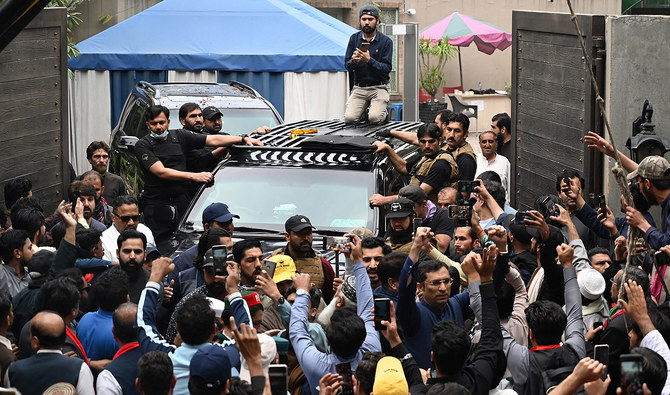
Supporters of former Pakistan's Prime Minister Imran Khan gather around his car as he leaves his residence in Lahore on March 18, 2023, on his way to appear in a court in Islamabad. (Photo courtesy: AFP)
Short Url
Updated 18 March 2023
Follow

En route to Islamabad court, Khan voices fears of arrest amid high security 

  • The former premier says authorities have made a ‘complete plan’ to arrest him that shows their malafide intentions 
  • Information minister laments Khan supporters attacked police, threw petrol bombs, yet he continues to get relief 

ISLAMABAD: Former prime minister Imran Khan on Saturday voiced fears of his arrest as he left his Lahore home for an Islamabad district court for appearance in a case involving the sale of state gifts, amid stringent security and deployment of thousands of law enforcers around the Islamabad judicial complex. 

The development comes after days of attempts by Khan and his Pakistan Tehreek-e-Insaf (PTI) party to prevent the law enforcers from arresting the ex-premier after an Islamabad district court issued his non-bailable arrest warrants in the case. 

On Friday, the Islamabad High Court (IHC) had suspended the non-bailable arrest warrants against Khan until March 18 and gave him another opportunity to appear before the Islamabad district and sessions court to face charges in the case. 

Khan, whose caravan was still on its way to the capital, recorded a video message for his supporters and apprised them of his fears about a possible arrest by the law enforcement. 

“I want to tell you all that they have made a complete plan to arrest me and this proves their malafide intent,” he said. 

The former premier said he intended to appear before the court a few days ago as well, but the police “attacked” his Lahore home with the sole purpose of putting him behind bars. 

“Why put me in jail, because it is part of the London plan,” he said. “This is Nawaz Sharif’s demand to put Imran Khan in jail and he may not take part in election.” 

Information Minister Marriyum Aurangzeb criticized the former prime minister for falsely claiming before the international media that he had protective bail in the case. 

“If you have the bail, then why you portray yourself as disabled, elderly,” she questioned Khan at a press conference. 

The minister noted that Khan supporters attacked police with batons and threw petrol bombs on their vehicles, but still the former premier got relief from a Lahore court that barred the law enforcers from arresting him in nine different cases. 

“These petrol bombs were not thrown on police, Rangers vans, they were thrown on court orders that police went there to implement,” she said. 

“Sixty-five policeman were injured, court gave him relief. No one is there to question.” 

The Islamabad administration imposed Section 144 (ban on public gatherings and display of weapons) in the federal capital, while around 4,000 police and paramilitary personnel have been deployed on security duty during proceedings of the case, which has come to be known as the Toshakhana reference, at the judicial complex, according to the Islamabad police. 

“Section 144 is in force in Islamabad. Private companies, security guards or individuals are prohibited from carrying weapons,” the Islamabad police wrote on Twitter. “Carry proof of vehicle integrity while driving.” 

Authorities have also imposed Section 144 in the twin city of Rawalpindi and directed citizens to avoid unnecessary movement. 

Khan, who until now attempted to evade arrest in the case, left his Lahore residence for Islamabad Saturday morning, his party wrote on Twitter. 

Meanwhile, police raided Khan’s Lahore residence when the ex-premier was traveling to Islamabad. 

The law enforcers removed camps and other obstacles outside Khan’s home as well as baton-charged and arrested Khan supporters who opposed the “anti-encroachment operation.” 

The vicinity was a site of clashes between PTI supporters and police this week after a team of Islamabad police, backed by their Lahore counterparts and paramilitary personnel, attempted to arrest Khan on Tuesday on the orders of the Islamabad district court. 

While Khan alleged the undue use of force by the police, the Punjab government said his supporters pelted stones and threw petrol bombs at law enforcers. 


Pakistan remembers Benazir Bhutto, first woman PM in Muslim world, on death anniversary

Updated 27 December 2025
Follow

Pakistan remembers Benazir Bhutto, first woman PM in Muslim world, on death anniversary

  • Bhutto was daughter of ex-PM Zulfikar Ali Bhutto who was hanged during reign of former military ruler Gen. Zia-ul-Haq
  • Year before assassination in 2007, Bhutto signed landmark deal with rival Nawaz Sharif to prevent army interventions

ISLAMABAD: Prime Minister Shehbaz Sharif and other Pakistani leaders on Saturday paid tribute to Benazir Bhutto, the first woman prime minister in the Muslim world who was assassinated 18 years ago in a gun and bomb attack after a rally in the city of Rawalpindi.

Born on Jun. 21, 1953, Bhutto was elected premier for the first time in 1988 at the age of 35. She was deposed in 1990, re-elected in 1993, and ousted again in 1996, amid allegations of corruption and mismanagement which she denied as being politically motivated.

Bhutto only entered politics after her father was hanged in 1979 during military ruler Gen. Zia-ul-Haq’s reign. Throughout her political career, she had a complex and often adversarial relationship with the now ruling Sharif family, but despite the differences signed a ‘Charter of Democracy’ in 2006 with three-time former PM Nawaz Sharif, pledging to strengthen democratic institutions and prevent military interventions in Pakistan in the future.

She was assassinated a year and a half later.

“Mohtarma Benazir Bhutto took exemplary steps to strengthen the role of women, protect the rights of minorities, and make Pakistan a peaceful, progressive, and democratic state,” PM Shehbaz Sharif, younger brother of ex-PM Nawaz Sharif, said in a statement on Saturday.

“Her sacrifices and services are a beacon of light for the nation.”

President Asif Ali Zardari, Bhutto’s widower, said Bhutto believed in an inclusive Pakistan, rejected sectarianism, bigotry and intolerance, and consistently spoke for the protection of minorities.

“Her vision was of a federation where citizens of all faiths could live with dignity and equal rights,” he said. “For the youth of Pakistan, her life offers a clear lesson: speak up for justice, organize peacefully and do not surrender hope in the face of adversity.”

Powerful families like the Bhuttos and the Sharifs of Pakistan to the Gandhis of India and the Bandaranaike family of Sri Lanka have long dominated politics in this diverse region since independence from British colonial rule. But none have escaped tragedy at the hands of rebels, militants or ambitious military leaders.

It was Zulfikar Ali Bhutto, Bhutto’s father, who founded the troubled Bhutto dynasty, becoming the country’s first popularly elected prime minister before being toppled by the army in 1977 and later hanged. Both his sons died in mysterious circumstances.

Before her assassination on Dec. 27, 2007, Bhutto survived another suicide attack on her motorcade that killed nearly 150 people as she returned to Pakistan after eight years in exile in October 2007.

Bhutto’s Oxford-educated son, Bilawal Bhutto-Zardari, now leads her Pakistan Peoples Party, founded by her father, and was foreign minister in the last administration of PM Shehbaz Sharif.

Aseefa Bhutto Zardari, Bhutto’s daughter who is currently the first lady of Pakistan, said her mother lived with courage and led with compassion in life.

“Her strength lives on in every voice that refuses injustice,” she said on X.

Pakistan has been ruled by military regimes for almost half its history since independence from Britain in 1947. Both former premiers Imran Khan and the elder Sharif, Nawaz, have alleged that they were ousted by the military after they fell out with the generals. The army says it does not interfere in politics.