

After $25 million pledge, Qatar team tours Pakistan’s flood areas to devise aid ‘strategy’ 

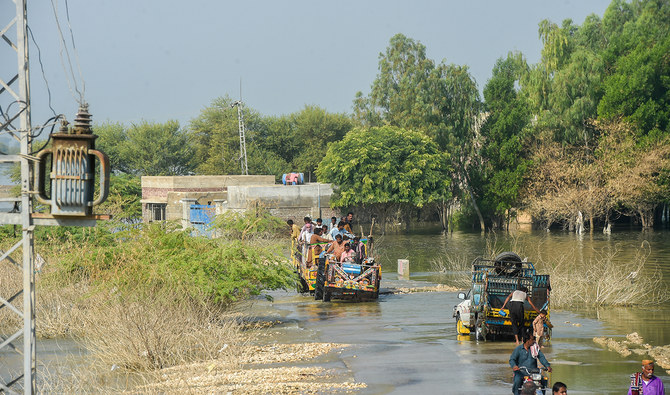
In this picture taken on October 28, 2022, internally displaced people use tractor trolley to wade across a flooded street in Dadu district of Sindh province. (AFP/FILE)
Short Url
Updated 17 March 2023
Follow

After $25 million pledge, Qatar team tours Pakistan’s flood areas to devise aid ‘strategy’ 

  • Last summer, at least 1,700 people died in flash floods that effected over 33 million and caused losses worth $30 billion
  • Large swatches of Pakistan’s crops were also washed away in the deluges and agricultural lands inundated

KARACHI: Qatar Fund For Development (QFFD) will deliberate on the “best strategy” to assist Pakistan in building more resilience following last year’s devastating floods, a top expert at the Doha-based government fund who is touring deluge-hit areas of the South Asian nation said on Thursday. 

Last summer, at least 1,700 people died in flash floods that effected over 33 million across the nation and caused losses worth $30 billion, adding to the woes of an economy that is in the middle of a full-blown meltdown. Large swatches of Pakistan’s crops were also washed away in the deluges and agricultural lands inundated. 

In January, Qatar pledged over $25 million during an international conference in Geneva to raise money for Pakistan’s post-floods reconstruction.



Aisha Al-Kuwari, Humanitarian and International Cooperation Expert at Qatar Fund For Development (QFFD) participating in a panel discussion at ‘Agri Connections 2023’ which was organized by Pakistan Agricultural Coalition on March 16, 2023 in Karachi. (AN photo)

Speaking at Pakistan’s first agricultural conference titled, ‘Agri Connection 2023,’ held in Karachi on Thursday, QFFD’s Aisha Al-Kuwari, who had toured flood-affected areas of Pakistan and held meetings with farmers this week, said the Fund would “deliberate on the strategy to assist Pakistan” upon the team’s return to Qatar.

“We are here to investigate in what way, shape, and form we can assist, particularly, because Qatar is really interested in helping,” Al-Kuwari said.

“Hopefully, upon return, we will be deliberating on the best strategy for us to really intervene and assist in the response and build more resilience in the country.” 

Al-Kuwari said the Fund was committed to working with its Pakistani partners “to address challenges that they face and help them achieve their goals for sustainable development.” 

The Fund was committed to supporting the United Nations Sustainable Development Goals (SDGs), particularly SDG-II, Al-Kuwari said, which aims at ending hunger, achieving food security, improving nutrition worldwide, and promoting sustainable agriculture practices. 

The Fund is also supporting SDG-8, which seeks to promote sustained, inclusive, and sustainable economic growth, full and productive employment, as well as decent work for all.

“Access to food and nutrition is critical in achieving economic growth and developing decent work is essential for ensuring that people have the right resources and opportunities to access nutritious food,” she said. “By 2030, all of us would need to report to the SDGs and as a donor entity.”

Al Kuwari acknowledged that access to capital was critical for farmers because they needed to invest in their farms and required equipment and resources to grow post-floods. 

“Without adequate access to capital, farmers cannot produce enough crops to meet their needs, and the growing population and in coming years would increase,” she said.


Pakistan urges equal application of international law, flags Indus treaty at UN debate

Updated 4 sec ago
Follow

Pakistan urges equal application of international law, flags Indus treaty at UN debate

  • Pakistani envoy says silence over violations of international law are fueling conflicts from South Asia to Gaza
  • He urges the UN secretary-general to use the Charter’s preventive tools more proactively to help avert conflicts

ISLAMABAD: Pakistan’s UN ambassador on Monday called for equal application of international law in resolving global conflicts, warning that India’s decision to hold the 1960 Indus Waters Treaty in abeyance and the unresolved dispute over Kashmir continued to threaten stability in South Asia.

Speaking at an open debate of the UN Security Council on “Leadership for Peace,” Ambassador Asim Iftikhar Ahmad said selective enforcement of international law and silence in the face of violations were fueling conflicts worldwide, undermining confidence in multilateral institutions.

His remarks come months after a brief but intense military escalation between India and Pakistan in May, following a gun attack on tourists in Indian-administered Kashmir. India blamed the attack on Pakistan, a charge Islamabad denied while calling for a transparent international probe.

The attack triggered a military standoff between the two South Asian nuclear neighbors and prompted New Delhi to suspend the World Bank-brokered Indus Waters Treaty, a move Pakistan says has no basis in international law and has described as “an act of war.”

“India’s unilateral suspension of the Indus Waters Treaty — a rare and enduring example of successful diplomacy — is yet another blatant breach of international obligations that undermines regional stability and endangers the lives and livelihoods of millions,” Ahmad told the council.

He said Jammu and Kashmir remained one of the oldest unresolved disputes on the Security Council’s agenda and required a just settlement in line with UN resolutions and the wishes of the Kashmiri people, a position India has long rejected.

Ahmad broadened his remarks to global conflicts, citing Gaza, Ukraine, Sudan and other crises, and said peace could not be sustained through “selective application of international law” or by sidelining the United Nations when violations occur.

The Pakistani envoy also referred to the Pact for the Future, a political declaration adopted by UN member states this year aimed at strengthening multilateral cooperation, accelerating progress toward the 2030 development goals and reforming global governance institutions.

While welcoming the pact, Ahmad warned that words alone would not deliver peace, pointing to widening development financing gaps, rising debt distress and climate shocks that he said were reversing development gains across much of the Global South.

He called for a stronger and more proactive role for the UN Secretary-General, including earlier use of preventive tools under the UN Charter, and urged the Security Council to demonstrate credibility through consistency, conflict prevention and greater respect for international court rulings.

“No nation can secure peace alone,” Ahmad said. “It is a collective endeavor, requiring leadership, cooperation and genuine multilateralism.”