

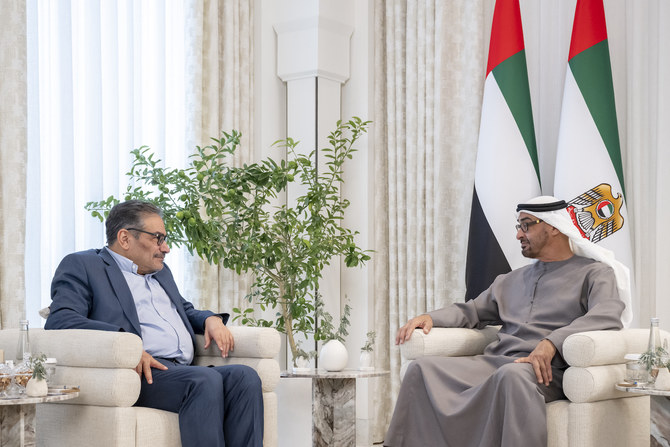
UAE president meets with top Iranian security official

The UAE’s President Sheikh Mohamed bin Zayed Al-Nahyan receives Iran’s Supreme National Security Council secretary Ali Shamkhani in Abu Dhabi. (WAM)
Short Url
Updated 17 March 2023
Follow

UAE president meets with top Iranian security official

  • They discussed regional and international issues of concern, and the importance of working to support peace and cooperation in the region

DUBAI: The UAE’s President Sheikh Mohamed bin Zayed Al-Nahyan received Iran’s Supreme National Security Council secretary Ali Shamkhani in Abu Dhabi on Thursday.

During the meeting, Sheikh Mohamed and Shamkhani discussed bilateral relations between the UAE and Iran, and opportunities for enhancing cooperation between the two countries.

They also discussed regional and international issues of concern, and the importance of working to support peace and cooperation in the region to enable progress and prosperity for its people.

The meeting comes nearly a week after Saudi Arabia and Iran agreed to reestablish diplomatic relations and reopen their embassies within two months.


MSF calls Israeli ban a ‘grave blow’ to Gaza aid

Updated 52 min 59 sec ago
Follow

MSF calls Israeli ban a ‘grave blow’ to Gaza aid

  • Doctors Without Borders is among 37 foreign humanitarian organizations banned from the territory
  • The group, which has hundreds of staff in Gaza, says: 'Denying medical assistance to civilians is unacceptable'

JERUSALEM: International charity Doctors Without Borders Friday condemned a “grave blow to humanitarian aid” after Israel revoked the status it needs to operate in Gaza for refusing to share Palestinian staff lists.
Israel on Thursday confirmed it had banned access to the Gaza Strip to 37 foreign humanitarian organizations for refusing to share lists of their Palestinian employees.
Doctors Without Borders (MSF), which has 1,200 staff members in the Palestinian territories, the majority of them in Gaza, said in a statement that “denying medical assistance to civilians is unacceptable under any circumstances.”
The medical organization argued that it had “legitimate concerns” over new Israeli requirements for foreign NGO registration, specifically the disclosing of personal information about Palestinian staff.


It pointed to the fact that 15 MSF staff had been “killed by Israeli forces,” and that access to any given territory should not be conditional on staff list disclosure.
“Demanding staff lists as a condition for access to territory is an outrageous overreach,” the charity said.
MSF also denounced “the absence of any clarity about how such sensitive data will be used, stored, or shared,” charging that Israeli forces “have killed and wounded hundreds of thousands of civilians” in Gaza during the course of the war.
It also charged that Israel had “manufactured shortages of basic necessities by blocking and delaying the entry of essential goods, including medical supplies.”
Israel controls and regulates all entry points into Gaza, which is surrounded by a wall that began to be built in 2005.
Felipe Ribero, MSF head of mission in the Palestinian territories, told AFP that all of its operations were still ongoing in Gaza.
“We are supposed to leave under 60 days, but we don’t know whether it will be three or 60 days” before Israeli authorities force MSF to leave, he said.
Prominent humanitarian organizations hit by the Israeli ban include the Norwegian Refugee Council (NRC), World Vision International and Oxfam, according to an Israeli ministry list.
The ban, which came into effect on December 31, 2025 at midnight, has triggered widespread international condemnation.
Israel says the new regulation aims to prevent bodies it accuses of supporting terrorism from operating in the Palestinian territories.
MSF says it currently supports one in five hospital beds in Gaza and assists one in three mothers in the territory, and urged the Israeli authorities to meet to discuss the ban.