

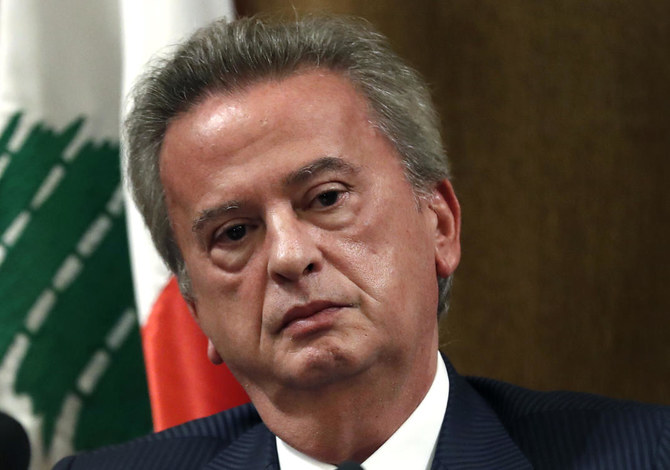
Salameh testifies before European judicial delegation in Lebanon

Riad Salameh has been Lebanon’s central bank governor since 1993. (File/AP)
Short Url
Updated 16 March 2023
Follow

Salameh testifies before European judicial delegation in Lebanon

  • Bank du Liban governor attends meeting in Beirut at the Palace of Justice
  • Pope Francis meets caretaker PM Mikati as tensions rise amid currency crisis, political deadlock

BEIRUT: The governor of the banque du Liban, Riad Salameh, testified on Thursday before a European judicial delegation at the Palace of Justice in Beirut, as part of investigations into Salameh’s involvement in financial irregularities.

Strict security measures were taken in and around the palace. The army was deployed in the vicinity of the headquarters of the Military Court and the headquarters of the army intelligence near the National Museum, all the way to the Adliya Bridge.

Salameh entered and exited through a gate far from the press, via an elevator that leads directly to the floor where the session took place.

The European delegation, led by French judge Aude Buresi, who represented France and Luxembourg, did not question Salameh directly, with local judge Charbel Bou Samra questioning the governor as interpreters translated the answers.

No Lebanese or foreign lawyer accompanied Salameh to the hearing.

According to leaked information, Salameh answered all the questions and appeared comfortable while providing the delegation with explanations.

The European delegation is investigating the laundering of some $330 million.

The session was attended by the head of the Cases Authority at the Ministry of Justice, Helena Iskandar, after obtaining approval from the European judicial delegation, provided that she would not interfere in the course of the session.

Salameh reportedly told the delegation that he needed to chair a meeting of the Banque du Liban, scheduled for Thursday at 5 p.m., in the hope of the delegation ending the hearing early.

The delegation is not entitled to take any action against Salameh on Lebanese soil, and if it decides to charge him, can do so only in the countries where the investigation was initially opened.

Unconfirmed reports said Salameh submitted his resignation to Lebanon’s caretaker prime minister, Najib Mikati, before the hearing, with Mikati asking him to wait until his governorship ends in July. However, central bank sources denied such claims, stressing that Salameh never offered to quit.

Should Salameh’s mandate end before a new Lebanese president is elected and government formed to appoint a new governor, Salameh’s deputy, Wassim Mansouri, takes over the task by proxy.

Mansouri, however, is Shiite, with the central bank governor position reserved for the Maronite community.

Meanwhile, there was turmoil in the financial market as banks continued their strike for a third day, and the Lebanese pound dropped to 102,200 pounds to the dollar, while food and fuel prices rose.

George Brax, a member of the syndicate of gas station owners, said he expected gas stations to face a technical problem in the next few days, as screens on fuel pumps will run out of space to display prices.

There has been no positive development so far in the process of electing a new president, despite continuous calls by Arab, foreign, and international officials to elect a new head of state without further delay.

After meeting with Mikati at the Vatican on Thursday, Pope Francis reiterated his firm belief in the message that Lebanon performs through cultural and religious pluralism that distinguishes it and makes it unique in the region.

He stressed the necessity of solidarity among Lebanese officials to get out of their various crises and elect a new president.

“I gave the pope a letter explaining the situation in Lebanon and the potential avenues of solution in which the Vatican could contribute to ensure their success, through its contacts with the international community, notably regarding the presidential election,” the statement from Mikati’s press office said.

In Beirut, the head of the Lebanese pharmacists syndicate Joe Salloum urged all trade unions and popular forces to declare “an open and comprehensive strike until a president is elected, and the rescue operation begins.”


US military launches strikes in Syria against Daesh fighters after American deaths

Updated 20 December 2025
Follow

US military launches strikes in Syria against Daesh fighters after American deaths

  • “This is not the beginning of a war — it is a declaration of vengeance,” Defense Secretary Pete Hegseth says
  • President Trump earlier pledged “very serious retaliation” but stressed that Syria was fighting alongside US troops

WASHINGTON: The Trump administration launched military strikes Friday in Syria to “eliminate” Daesh group fighters and weapons sites in retaliation for an ambush attack that killed two US troops and an American interpreter almost a week ago.
A US official described it as “a large-scale” strike that hit 70 targets in areas across central Syria that had Daesh (also known as Islamic State or IS) infrastructure and weapons. Another US official, who also spoke on condition of anonymity to discuss sensitive operations, said more strikes should be expected.
The attack was conducted using F-15 Eagle jets, A-10 Thunderbolt ground attack aircraft and AH-64 Apache helicopters, the officials said. F-16 fighter jets from Jordan and HIMARS rocket artillery also were used, one official said.
“This is not the beginning of a war — it is a declaration of vengeance. The United States of America, under President Trump’s leadership, will never hesitate and never relent to defend our people,” Defense Secretary Pete Hegseth said on social media.


President Donald Trump had pledged “very serious retaliation” after the shooting in the Syrian desert, for which he blamed Daesh. The troops were among hundreds of US troops deployed in eastern Syria as part of a coalition fighting the terrorist group.
Trump in a social media post said the strikes were targeting Daesh “strongholds.” He reiterated his support for Syrian President Ahmad Al-Sharaa, who he said was “fully in support” of the US effort to target the militant group.
Trump also offered an all-caps threat, warning the group against attacking US personnel again.
“All terrorists who are evil enough to attack Americans are hereby warned — YOU WILL BE HIT HARDER THAN YOU HAVE EVER BEEN HIT BEFORE IF YOU, IN ANY WAY, ATTACK OR THREATEN THE USA.,” the president added.
The attack was a major test for the warming ties between the United States and Syria since the ouster of autocratic leader Bashar Assad a year ago. Trump has stressed that Syria was fighting alongside US troops and said Al-Sharaa was “extremely angry and disturbed by this attack,” which came as the US military is expanding its cooperation with Syrian security forces.
Syria’s foreign ministry in a statement on X following the launch of US strikes said that last week’s attack “underscores the urgent necessity of strengthening international cooperation to combat terrorism in all its forms” and that Syria is committed “to fighting Daesh and ensuring that it has no safe havens on Syrian territory and will continue to intensify military operations against it wherever it poses a threat.”


Daesh has not claimed responsibility for the attack on the US service members, but the group has claimed responsibility for two attacks on Syrian security forces since, one of which killed four Syrian soldiers in Idlib province. The group in its statements described Al-Sharaa’s government and army as “apostates.” While Al-Sharaa once led a group affiliated with Al-Qaeda, he has had a long-running enmity with Daesh.
Syrian state television reported that the US strikes hit targets in rural areas of Deir ez-Zor and Raqqa provinces and in the Jabal Al-Amour area near Palmyra. It said they targeted “weapons storage sites and headquarters used by Daesh as launching points for its operations in the region.”

Trump this week met privately with the families of the slain Americans at Dover Air Force Base in Delaware before he joined top military officials and other dignitaries on the tarmac for the dignified transfer, a solemn and largely silent ritual honoring US service members killed in action.

President Donald Trump, from left, Defense Secretary Pete Hegseth and Chairman of the Joint Chiefs Air Force Gen. Dan Caine attend a casualty return ceremony at Dover Air Force Base, Delaware, on Dec. 17, 2025,of soldiers who were killed in an attack in Syria last week. (AP)

The guardsmen killed in Syria last Saturday were Sgt. Edgar Brian Torres-Tovar, 25, of Des Moines, and Sgt. William Nathaniel Howard, 29, of Marshalltown, according to the US Army. Ayad Mansoor Sakat, of Macomb, Michigan, a US civilian working as an interpreter, was also killed.
The shooting nearly a week ago near the historic city of Palmyra also wounded three other US troops as well as members of Syria’s security forces, and the gunman was killed. The assailant had joined Syria’s internal security forces as a base security guard two months ago and recently was reassigned because of suspicions that he might be affiliated with Daesh, Interior Ministry spokesperson Nour Al-Din Al-Baba has said.
The man stormed a meeting between US and Syrian security officials who were having lunch together and opened fire after clashing with Syrian guards.
When asked for further information, the Pentagon referred AP to Hegseth’s social media post.