



Kuwait envoy praises Japanese students for humanitarian choices

1 / 3
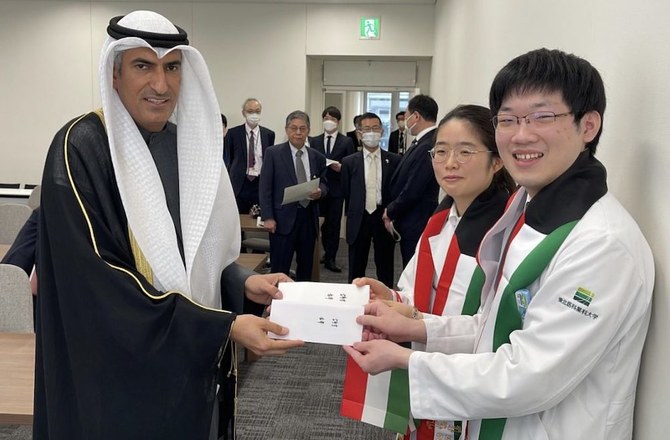
Above, Kuwait’s Ambassador to Japan, Sami Ghassab Alzamanan, at the Tokyo University of Medicine and Pharmacy last week. (ANJ photo)
2 / 3
Above, Kuwait’s Ambassador to Japan, Sami Ghassab Alzamanan, at the Tokyo University of Medicine and Pharmacy last week. (ANJ photo)
3 / 3
Above, Kuwait’s Ambassador to Japan, Sami Ghassab Alzamanan, at the Tokyo University of Medicine and Pharmacy last week. (ANJ photo)
Short Url
Updated 15 March 2023
Follow

Kuwait envoy praises Japanese students for humanitarian choices

TOKYO: Kuwait’s ambassador to Japan, Sami Ghassab Alzamanan, addressed graduates of Tokyo University of Medicine and Pharmacy last week and praised the graduates for choosing careers that required compassion, empathy and commitment to helping others.

In his speech at the ceremony, which was attended by the governor of Miyagi Prefecture, the president of Tohoku University of Medical and Pharmaceutical Sciences, university professors and the graduates’ families, Alzamanan also praised the students for their continuous dedication in overcoming the challenges of their studies.

The ambassador said: “The medical and health field is not only based on science, but also on humanity.”

“Humanitarian principles and adherence to human rights formed the basis of the Kuwait-Japan partnership that began before the independence of the State of Kuwait in 1961,” the ambassador said. He encouraged the graduates to continue the message of humanity without distinction of race, religion or color.

Alzamanan also added that he was honored that his country’s contribution during the Great East Japan Earthquake in 2011 resulted in the establishment of the “Partnership Fund with Kuwait for Medical Studies” and said that universities provide an environment of intellectual freedom and human dignity, as well as fostering creation and creativity.

Ambassador Alzamanan concluded by wishing the students continued success and reaffirmed that the State of Kuwait was always ready to support bilateral work of interest to both countries.

This article originally appeared on Arab News Japan


India and Israel: trade, defense and diplomacy

Updated 2 sec ago
Follow

India and Israel: trade, defense and diplomacy

NEW DELHI: Indian Prime Minister Narendra Modi will visit Israel on Wednesday aiming to deepen ties with a key trade and defense partner, while balancing his government’s broader diplomatic interests in the Middle East.
New Delhi has steadily expanded cooperation with Israel across the defense, agriculture, technology and cybersecurity sectors.
One of India’s largest conglomerates, Adani Group, operates the Mediterranean port of Haifa, while Israeli military drone technology played a pivotal role during India’s May 2025 clash with Pakistan.
At the same time, India maintains strong relations with Gulf nations and Tehran, including developing Iran’s Chabahar port — a trade gateway to Afghanistan, where New Delhi has built a relationship with Taliban authorities.
Here’s a closer look at India-Israel ties.

- Trade -

In September 2023, grand plans were unveiled in New Delhi for an India-Middle East-Europe Economic Corridor — to link railways, ports, electricity, data networks and pipelines, including through Saudi Arabia and Israel.
Those plans were stalled by Hamas’s October 7 deadly attack on Israel, which responded with a devastating war in the Gaza Strip.
Trade remains central to the diplomatic relationship with Israel, providing access to products from its advanced tech sector, while India offers a vast consumer market.
Key sectors include agriculture technology, food security, water management, diamonds, dairy, fisheries, and manufacturing.
Bilateral trade reached $3.75 billion in 2024-25, according to Indian figures, though this is understood to exclude arms sales.
Thousands of Indians work in Israel, including those who came to replace the jobs of Palestinian construction workers barred from entering since the October 7 attack and outbreak of war in 2023.

- Defense -

Israel is one of India’s top arms suppliers, dating back to its military support during the 1962 war with China and subsequent conflicts with Pakistan in 1971 and 1999.
Between 2020-24, Israel provided 13 percent of India’s military hardware, making it New Delhi’s third-largest supplier after Russia and France, according to the Stockholm International Peace Research Institute (SIPRI).
India and Israel have launched multi-billion-dollar joint ventures to produce drones, missile systems, radar, cybersecurity technology, naval vessels and firearms.

- Diplomacy -

Full diplomatic relations between the two countries were established in 1992. Ties deepened after Hindu-nationalist leader Modi took office in 2014.
Modi visited Israel in 2017, and Prime Minister Benjamin Netanyahu traveled to India the following year.
Both right-wing leaders have called each other a “friend.”
US President Donald Trump invited India to become a member of the “Board of Peace” that he established after helping negotiate a ceasefire to halt two years of war between Israel and Hamas in Gaza.
New Delhi sent a representative to the board’s inauguration this month, but said its attendance was only in an “observer” capacity.
India in January hosted foreign ministers from Arab League nations, which have heavily criticized the war in Gaza. Modi told them he offered “continued support for the people of Palestine” and “welcomed ongoing peace efforts.”
A free trade agreement with Oman last year reflects India’s push for broader Middle East market access.

- Ancient roots -

Jewish links to India span millennia with India’s Arabian Sea port of Kochi — a key post in the ancient Greco-Roman trade network — home to a Jewish community for centuries.
“Civilizational relations between the countries date back more than two millennia,” India’s foreign ministry says.
The Paradesi Synagogue in Kochi, India’s oldest, was built in 1568 — though barely any Jews remain in the city today.
Many emigrated to Israel after 1948, and more than 100,000 Jews of Indian origin live in Israel today, according to New Delhi.
In India’s northeast Manipur state, thousands from the Bnei Menashe community claim descent from one of the “lost tribes” of Israel.
Some members of the community have moved to Israel and the Israeli government has said it is preparing to resettle thousands more in the next few years.