

In AlUla, a place of extraordinary human and natural heritage, taking the venerated traditions of a deep-rooted past with you on the journey ahead is imperative.
As AlUla, like Saudi Arabia, modernizes, an example that aptly illustrates this is the revered pastime of camel racing, a staple of life throughout the Kingdom and one of the main elements of its heritage and culture.
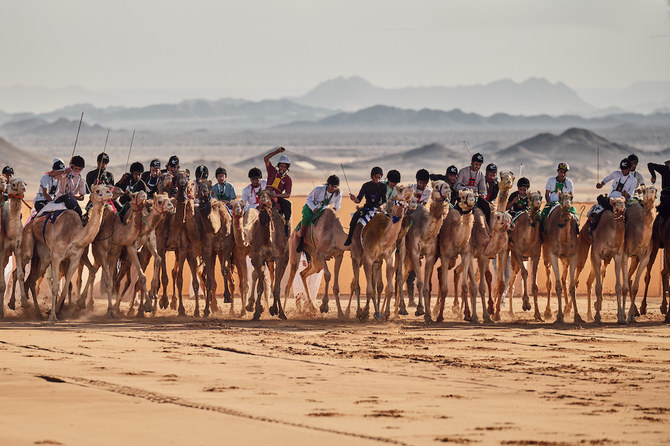
Held under the patronage of Crown Prince Mohammed bin Salman, chairman of the Royal Commission for AlUla, the inaugural AlUla Camel Cup is the pinnacle of camel racing.
It is an event – organised by the RCU as part of the AlUla Moments calendar, in collaboration with the Saudi Camel Racing Federation – fusing modern and ancient, sport and culture, elemental and opulent.
From March 14 to 17, more than 40 of the region’s finest racing camels will compete at the revamped, state-of-the-art AlUla Camel Racing Field in this beautiful part of the Kingdom.
Camel racing has been bolstered through continuous investment and development in Saudi Arabia, with those at the highest levels of decision making recognising the importance of every element in contributing to comprehensive national progression.
The use of advanced technology and training techniques has enhanced the safety and efficiency of races – as well as broadening camel racing’s appeal – while still preserving the sport’s cultural and traditional values.
GPS monitors, for example, track the speed and performance of the camels, which are given healthy diets and regular training sessions to improve their performance.
In terms of rules, there have been several changes aimed at improving safety and fairness in the sport. For example, there are now strict regulations on the weight of jockeys (which are commonly robots in modern races). There are also measures to prevent cheating such as anti-doping and the use of microchips to verify the identity of camels.
If you thought football managers were passionate, then watch camel owners and trainers during race competitions to see how exuberant and caught up in the moment they can get.
They scrutinize every detail of a race closely while driving their cars along the entire field or track, adding a unique thrill to the races.
Top camel owners take the sport very seriously and invest lots of time and resources to develop their animals, whether through breeding or purchasing elite camels.
While specific growth percentages year on year cannot be accurately measured, camel racing has exceeded expectations and has seen significant growth in terms of the number of camels, new owners, and returning owners.
In recent years, however, the growth rate has exceeded 100 percent – a testament to the sport’s popularity and cultural significance in the Kingdom and, indeed, that of the wider region.
Camel racing’s journey now moves forward at the AlUla Camel Cup, an exceptional and momentous event that propels into motion an exhilarating display through the ages to the modern day.


