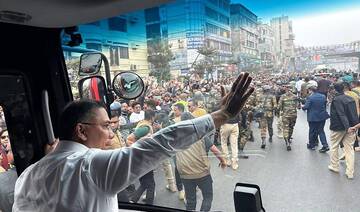
LAHORE, Pakistan: Pakistan’s Imran Khan said on Wednesday he would heed a court summons, as his supporters continued to clash with security forces that had come to arrest the former prime minister for not showing up in a case against him related to selling state gifts.
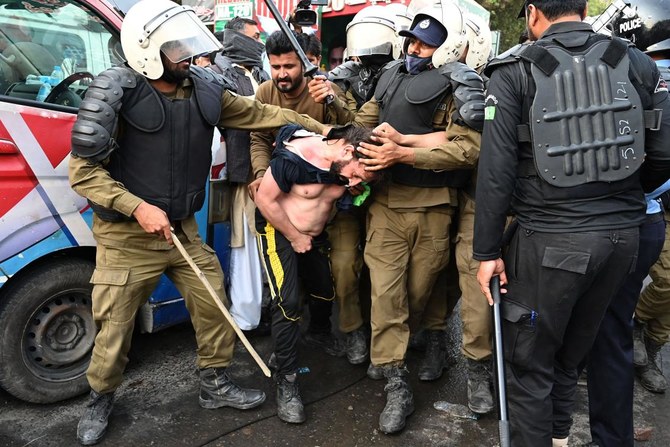
The violence, which erupted on Tuesday and involved security forces firing tear gas and water cannons at stone-pelting crowds that had cordoned off Khan’s home in Lahore, adds to the instability in nuclear-armed Pakistan, which is struggling with an economic crisis and awaiting an International Monetary Fund bailout.
A lower court in the capital Islamabad had last week issued an arrest warrant against Khan for defying orders to present himself in court to defend charges that he unlawfully sold state gifts given to him by foreign dignitaries while he was prime minister from 2018 to 2022.
In a tweet, Khan said he had signed a “surety bond” that would guarantee his appearance in the court by a March 18 deadline, and senior aide Fawad Chaudhry said Khan’s party, the Pakistan Tehreek-e-Insaf, had asked the court to stop the police from arresting him.
“We have asked the police to wait until the court decision on the matter,” added Chaudhry, a former information minister.
It was not immediately clear when the court would decide.
The legal proceedings against Khan began after he was ousted from office in a parliamentary vote early last year. Since then, he has been demanding a snap election and holding nationwide protest rallies, and was shot and wounded in one of these rallies. Current Prime Minister Shehbaz Sharif has rejected Khan’s demands, saying the election would be held as scheduled later this year.
Khan, 70, a former international cricketer turned politician, still enjoys a large support base in Pakistan. In a video message broadcast by his party, he blamed the government for trying to arrest him, and called on his supporters to continue to fight.
“If anything happens to me, or I go to prison, or they kill me, you have to prove that this nation will continue to struggle even without Imran Khan,” he said.
In a statement late on Tuesday, Information Minister Marriyum Aurangzeb said the government had nothing to do with the arrest warrant against Khan, and that the matter was up to the courts.
“Instead of cooperating with law enforcement officials, Imran Khan is breaking the law, defying court orders and using his party workers... as human shields to evade arrest and stoke unrest,” she added.


Pakistan: Former leader Imran Khan to appear in court in bid to end clashes
https://arab.news/zq8xf
Pakistan: Former leader Imran Khan to appear in court in bid to end clashes

- Violence adds to the instability in Pakistan, which is struggling with an economic crisis and awaiting an IMF bailout
- A lower court last week issued an arrest warrant against Khan for defying orders to present himself in court


Bangladesh’s religio-political party open to unity govt
- Opinion polls suggest that Jamaat-e-Islami will finish a close second to the Bangladesh Nationalist Party in the first election it has contested in nearly 17 years
DHAKA: A once-banned Bangladeshi religio-political party, poised for its strongest electoral showing in February’s parliamentary vote, is open to joining a unity government and has held talks with several parties, its chief said.
Opinion polls suggest that Jamaat-e-Islami will finish a close second to the Bangladesh Nationalist Party in the first election it has contested in nearly 17 years as it marks a return to mainstream politics in the predominantly Muslim nation of 175 million.
Jamaat last held power between 2001 and 2006 as a junior coalition partner with the BNP and is open to working with it again.
“We want to see a stable nation for at least five years. If the parties come together, we’ll run the government together,” Jamaat chief Shafiqur Rahman said in an interview at his office in a residential area in Dhaka, days after the party created a buzz by securing a tie-up with a Gen-Z party.
Rahman said anti-corruption must be a shared agenda for any unity government.
The prime minister will come from the party winning the most seats in the Feb. 12 election, he added. If Jamaat wins the most seats, the party will decide whether he himself would be a candidate, Rahman said.
The party’s resurgence follows the ousting of long-time Prime Minister Sheikh Hasina in a youth-led uprising in August 2024.
Rahman said Hasina’s continued stay in India after fleeing Dhaka was a concern, as ties between the two countries have hit their lowest point in decades since her downfall.
Asked about Jamaat’s historical closeness to Pakistan, Rahman said: “We maintain relations in a balanced way with all.”
He said any government that includes Jamaat would “not feel comfortable” with President Mohammed Shahabuddin, who was elected unopposed with the Awami League’s backing in 2023.