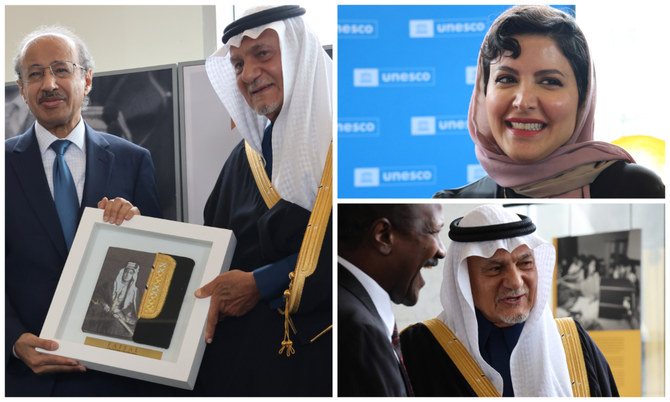

PARIS: Visitors flocked to the Segur Hall at UNESCO headquarters in Paris to attend the opening of an exhibition on Monday dedicated to King Faisal, organized by the King Faisal Center for Research and Islamic Studies.
Following its stop in London in 2019, the exhibition “Faisal: Life in the Heart of the 20th Century” has now come to Paris, tracing the footsteps of King Faisal, who traveled to Great Britain, Ireland and France in 1919, when he was barely 13 years old.
“One hundred years ago, King Faisal was here in Paris,” said Prince Turki Al-Faisal, his son, in a speech that “came from his heart” delivered in the language of Molière. “He laid the foundation stone for building Saudi-French relations and emphasized that relations between nations must be based on mutual respect, concern for common interests, and building bridges of cooperation between the countries’ leaders so that security and safety are achieved, and the people of the world enjoy prosperity and peace,” he continued.

The exhibition invites viewers to step into the shoes of the 13-year-old prince, from his departure from Riyadh in August 1919 to represent his father — then wali of Najd and future founder of the present Kingdom of Saudi Arabia — to the negotiations that led to the Treaty of Versailles.
“Imagine yourself accompanied by a delegation of historians and advisors to Europe, only one year after the end of the First World War,” Princess Haifa Al-Mogrin, Saudi Arabia’s ambassador to UNESCO, told the audience in her opening speech.
The young prince visited Cambridge University, the South Wales coalfield and the factories of Birmingham. The scale of British industrial activity had a lasting impact on him, as did the horrors of war, which he discovered while visiting the battlefields of the Western Front in France and Belgium.
“This exhibition traces a journey that changed the life of Faisal, who became king of Saudi Arabia for more than a decade, beginning in 1964,” the ambassador said in her speech. Naturally, the historic trip allowed the young prince to witness the consequences of the conflict but also to discover the beautiful aspects of Europe’s history, values and culture. King Faisal’s encounters with the places he traveled through also shaped his understanding of the importance of education and industry.
Manuscripts, telegrams, letters, paintings, maps, photographs and press articles allow visitors to understand this “historic visit, which is part of the history of the Kingdom, but also of the French Republic,” said Prince Turki, now president of the King Faisal Center for Research and Islamic Studies, after having been head of Saudi intelligence from 1977 to 2001.

“Relations between France and Saudi Arabia are very strong thanks to the contacts that King Faisal initiated since 1919,” Prince Turki explained to Arab News in French, “a relationship that has been strengthened by frequent visits to France and the reception of French heads of state in Saudi Arabia.”
For her part, Princess Haifa told Arab News in French that she is “very happy to host the exhibition at UNESCO, the house of education, science and culture, where we have the chance to tell the story of King Faisal to 193 countries of the world who were present today and were very curious to know more about the life of the young prince, who…interacted with the world…and finally returned to Saudi Arabia to become king."
The exhibition “Faisal: Life in the Heart of the 20th Century” will run until March 24 at the Segur Hall of UNESCO, Paris.