

Pakistan, Iran finalize agreement to supply 100MW power to Gwadar port city

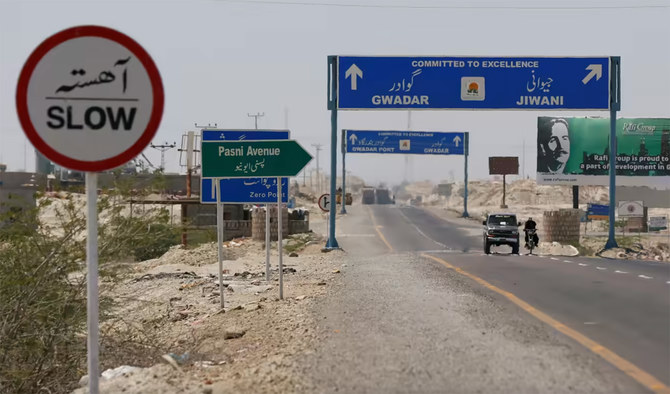
A general view of signs along a highway leading to Gwadar, Pakistan on April 12, 2017. (REUTERS/File)
Short Url
Updated 13 March 2023
Follow

Pakistan, Iran finalize agreement to supply 100MW power to Gwadar port city

  • Project to ensure uninterrupted power supply to Gwadar city, says Pakistan's energy ministry
  • Pakistan's energy minister congratulates Iranian, Saudi leadership on renewing diplomatic ties

ISLAMABAD: Pakistan and Iran finalized an agreement on Monday according to which Tehran would supply 100 megawatts (MW) of power to the Gwadar port city, Pakistan's energy ministry said in a statement. 

Gwadar is located in Pakistan's southwestern Balochistan province, which is the country's most underdeveloped and neglected region. The port city of Gwadar is not connected to the national grid and has instead relied on power from neighboring Iran. 

The strategically located fishing city has often seen weeks-long protests over the shortage of water and electricity, among other reasons. 

Pakistan’s Energy Minister Khurram Dastgir reached Iran on March 10 last week to review progress on the project to supply power to Gwadar. During his visit, Dastagir held meetings with his counterpart, Iranian Energy Minister Ali Akber Mehrabian, and other Iranian officials, the ministry said. 

To finalize the power supply agreement, three sessions were held between technical teams on both sides. "As a result of these meetings an agreement was signed on 13.03.2023 between Pakistan & Iran to provide 100 megawatts of electricity," Pakistan's Ministry of Energy said. 

Both ministers laid emphasis on developing bilateral relations between Pakistan and Iran and spoke of additional cooperation in the field of energy, the ministry added.

"The project will be inaugurated at the earliest. This project will ensure uninterrupted supply to Gwadar and lay the foundations of a prosperous Gwadar," it said. 

During his visit, Dastagir congratulated the leadership of Iran and Saudi Arabia for renewing their diplomatic relations.


PM Sharif calls on Pakistan, UAE to enhance cooperation in trade and investment

Updated 23 December 2025
Follow

PM Sharif calls on Pakistan, UAE to enhance cooperation in trade and investment

  • Prime Minister Shehbaz Sharif meets UAE Ambassador Salem Mohammed Salem Al Bawab Al Zaabi
  • Sharif invites collaboration with UAE in energy, minerals, IT, railways and aviation sectors, says PMO

ISLAMABAD: Prime Minister Shehbaz Sharif on Tuesday called on Pakistan and the UAE to enhance their trade, economic and investment relations, inviting investment from the Gulf country in Pakistan’s priority sectors. 

The UAE is Pakistan’s third-largest trading partner and a major source of foreign investment for the South Asian country. In May 2024, the UAE committed to investing $10 billion in Pakistan’s economic sectors in the coming years.

Sharif met UAE Ambassador Salem Mohammed Salem Al Bawab Al Zaabi at the Prime Minister House on Tuesday where the two sides discussed bilateral relations and economic ties, the Prime Minister’s Office (PMO) said. 

“Expressing his satisfaction at the volume of bilateral trade between the two sides, the Prime Minister further highlighted the need for both sides to focus on enhancing economic ties, trade, investment opportunities, and collaboration in areas such as energy, minerals, IT, railways and aviation,” the statement said. 

Sharif also invited increased UAE investments in key sectors to support Pakistan’s economic growth and stability, the PMO said.

The Pakistani prime minister acknowledged the UAE’s consistent support for Pakistan “in times of need,” acknowledging the country’s humanitarian assistance and developmental projects.

Al Zaabi thanked the Pakistani premier for extending him a warm welcome, the PMO said. 

“He reaffirmed the UAE’s firm resolve and keen interest to deepen its partnership with Pakistan across all spheres and assured the Prime Minister that he would work hard to explore new avenues for cooperation that would benefit both nations,” the statement concluded.