

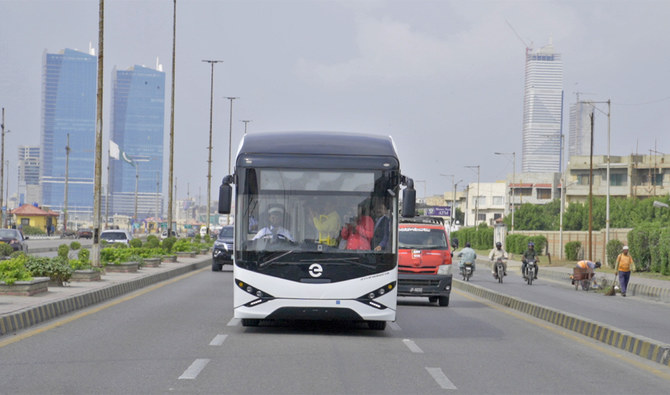

ISLAMABAD: For Karachi-based Raja Kamran, swapping his motorcycle commute for Pakistan’s first-ever electric bus service has saved cash — and helped him avoid some of the city’s pollution.
A small fleet of fully electric buses started operating in the country’s financial capital in January as part of a government drive to cut worsening air pollution produced by vehicles and industry, power plants and brick kilns, as well as the burning of solid waste.
“The electric bus service has not only decreased my weekly traveling costs but also helped (with) my ... health problems,” the 50-year-old journalist said by phone, noting that he had suffered back pain while riding his motorcycle to work.
However, Kamran said there were not enough e-buses — only 10 of the initial fleet of 50 are currently running — and that he sometimes had to wait 45 minutes to catch one of them.
Urban air pollution is a major and longstanding problem across Pakistan, with the country ranking third worldwide out of 118 nations for worst air quality in 2021, according to IQAir, a Swiss pollution technology company.
Bad-quality air is a leading cause of death in the South Asian nation of about 224 million people, resulting in an estimated 236,000 premature deaths in 2019, the latest Global Burden of Disease (GBD) study says.
With concerns growing over the number of vehicles on the roads — there were 30.7 million in Pakistan in 2020, up from 9.6 million in 2011 — cities such as Peshawar and Karachi have announced plans to promote greener transport.
Karachi’s 50 e-buses can each carry at least 70 passengers and travel 240 km (149 miles) on a single charge.
The fleet, which cost $15 million, was funded through a public-private partnership, with a transport company purchasing the buses and operating them for eight years before the Sindh provincial government takes over as owner.
The government is now in talks with the Asian Development Bank (ADB), seeking a loan of about $30 million to purchase an additional 100 buses, according to Abdul Haleem Shaikh, secretary of Sindh’s transport and mass transit department.
“We want to provide people with emission-free, comfortable and luxury buses along with trained staff to discourage them from using their smoke-emitting cars and motorbikes,” he said.
Yet environmental and urban experts have questioned whether the small number of electric buses will have a significant impact, and called for a much wider and more meaningful transport overhaul.
System change needed?
Consecutive climate disasters — from heatwaves to forest fires — have struck Pakistan in the last few years, and the country is still recovering from unprecedented floods in 2022.
But air pollution remains one of the country’s main environmental concerns, with at least 40 percent of dirty air in Pakistan produced by vehicles, the country’s climate change ministry has said.
In November 2019, Pakistan’s government set a target to bring a half million electric motorcycles and rickshaws, along with more than 100,000 electric cars, buses and trucks, into the transportation system within five years. The current overall number on the roads is unknown.
Pakistan has a longer-term goal of ensuring that a third of all cars and trucks and half of motorcycles and buses sold by 2030 are electric, and has generally vowed to ramp up its efforts to cut greenhouse gas emissions in the years leading up to that date.
In the northwestern city of Peshawar, the provincial government is taking old buses off the road and replacing them with diesel-electric hybrid models as part of a new public transport system.
And in Karachi, in a push separate from the 50 new e-buses, the government has been rolling out a network of 250 vehicles fueled by bio-methane produced from water buffalo manure.
Yet the bus initiatives in Karachi — both newer and older — have been criticized by some analysts, who say they do not do enough to lower pollution.
A better focus would have been reducing the total number of cars and motorcycles on the roads, and creating more public awareness about the impact of air pollution, said Muhammad Toheed, associate director at the Karachi Urban Lab of the Institute of Business Administration.
“A commuter that uses his own smoke-emitting vehicle or bike to get to his workplace does not understand what cruelty he is committing with the environment,” he said.
Yasir Husain of the Darya Lab, a consultancy firm dealing with environmental issues, said at least 1,500 rather than 150 e-buses would be needed to have any impact in reducing emissions in Karachi.
“The government also should provide soft loans through easy financing to promote the use of e-bikes, and e-rickshaws,” said Husain, who is also the founder of Green Pakistan Coalition, an advocacy group.
Shaikh, the transport secretary, acknowledged that the 150 new electric buses would not do much to reduce air pollution in isolation, but pointed to the bio-methane vehicles and also highlighted the 29 traditional bus routes covering the city.
He said Pakistan’s current economic crisis and the financial toll of the 2022 flooding would not hinder the rollout of more e-buses, as such funding would come from international lenders.
Bhevish Kumar, a 24-year-old entrepreneur, said he had been taking the new e-buses to attend business meetings but was skeptical that the limited fleet would really do much to clean Karachi’s choking air.
“There is need for its expansion and more penetration of e-bus services into the city’s transport system to ensure that people do not burn ... fuel in their vehicles,” he said.


