


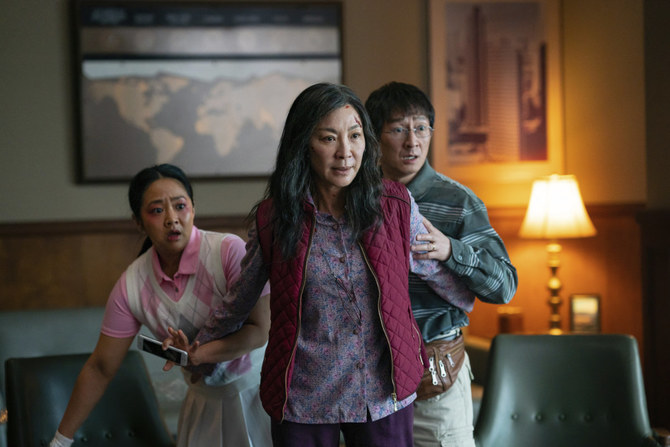

HOLLYWOOD, US: From Oscars favorites “Everything Everywhere All at Once” and “RRR” to an unprecedented four acting nominations, Asian representation in Hollywood has finally achieved a remarkable and overdue breakthrough this year, industry insiders say.
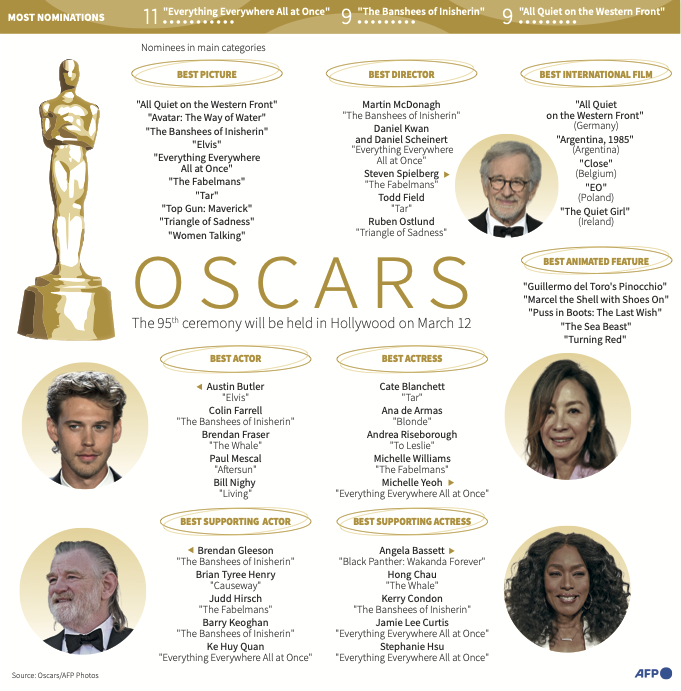
Among many records tumbling this awards season, Malaysian “Everything Everywhere” star Michelle Yeoh is only the second Asian best actress nominee in 95 years of Oscars history, with a strong chance of becoming the first winner Sunday.
Only four Asian actors have ever won Oscars. That is the same number nominated this year alone, including Yeoh’s co-stars Ke Huy Quan and Stephanie Hsu, and Hong Chau of “The Whale.”
Then there is India’s all-singing, all-dancing “RRR,” heavily tipped to win best original song, and Nobel literature laureate Kazuo Ishiguro’s nominated screenplay for “Living.”
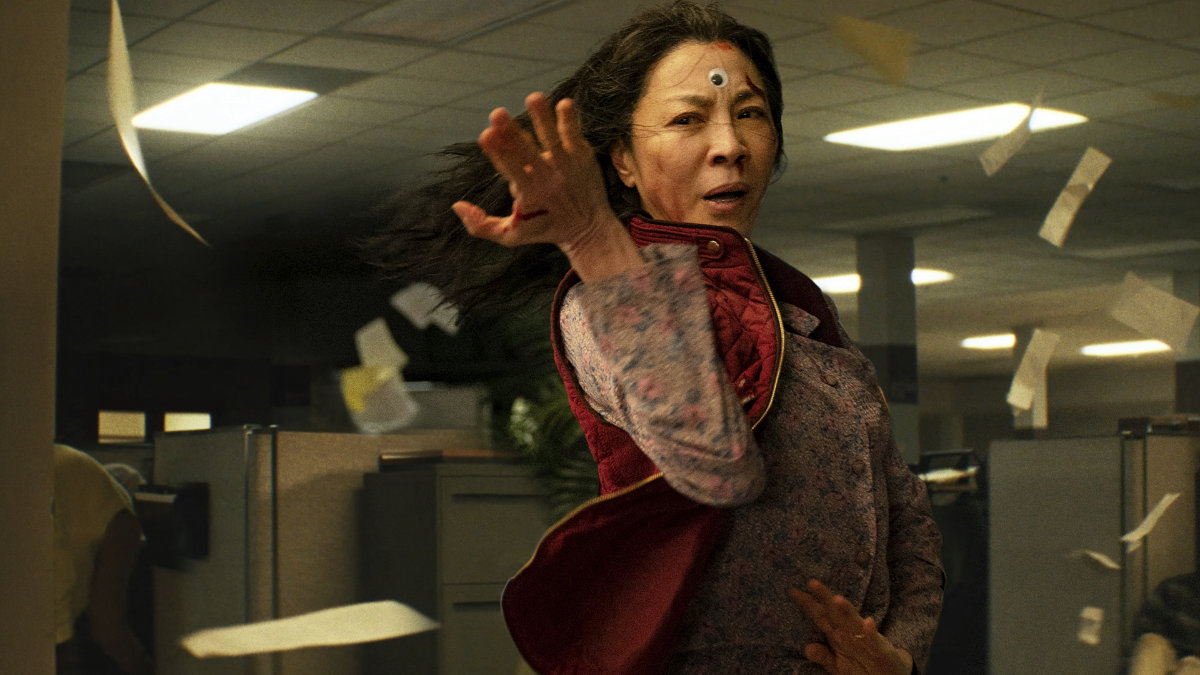
This image released by A24 shows Michelle Yeoh in a scene from "Everything Everywhere All at Once." (Allyson Riggs/A24 via AP)
Behind the camera, best picture frontrunner “Everything Everywhere” — a $100 million box office hit with 11 Oscar nominations — has an Asian co-director, Daniel Kwan, and an Asian producer, Jonathan Wang.
“There’s something really beautiful about being able to show that if you put people in these roles, people will go see it,” Wang told AFP.
“Why is it only white characters who go on the fun adventures, but Asian and Black characters and Latino characters have to experience the suffering?
“It’s time to flip that on its head. And people are going to run to the box office.”
It is all a far cry from Hollywood’s past.
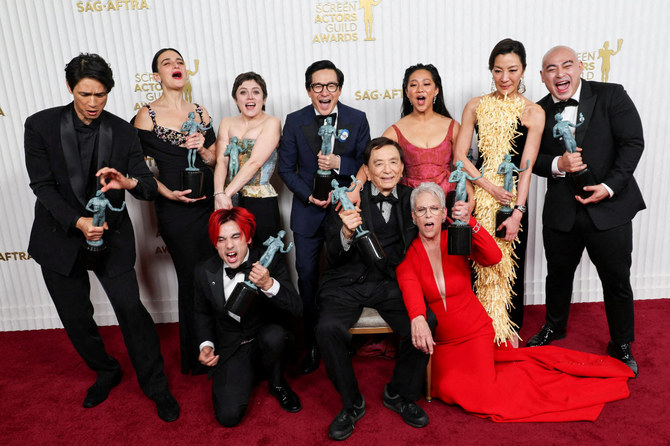
At the recent Screen Actors Guild awards, James Hong, the 94-year-old veteran who appears in “Everything Everywhere,” reflected on how white actors with “their eyes taped up” once played leading Asian roles because producers thought “the Asians are not good enough and they are not box office.”
“But look at us now,” he said, to a huge ovation.
Back in 1965, Hong co-founded the East West Players, a Los Angeles theater group created to boost the visibility of Asian American actors and issues.
The company has welcomed this year’s diverse Oscar nominations, which artistic director Snehal Desai says are “much appreciated and long overdue.”
“These are artists who have been doing this work for decades. We are glad for the visibility and recognition, but it really should not have taken this long,” he said.
Vietnam-born Quan, a major child star in the 1980s with “Indiana Jones and the Temple of Doom” and “The Goonies,” all but abandoned acting for decades due to a lack of roles.
“Quan’s story of his prolonged absence from the industry in particular strikes a resonant chord for our community, as we continue to fight for more opportunities and quality representation,” the group said in a statement.
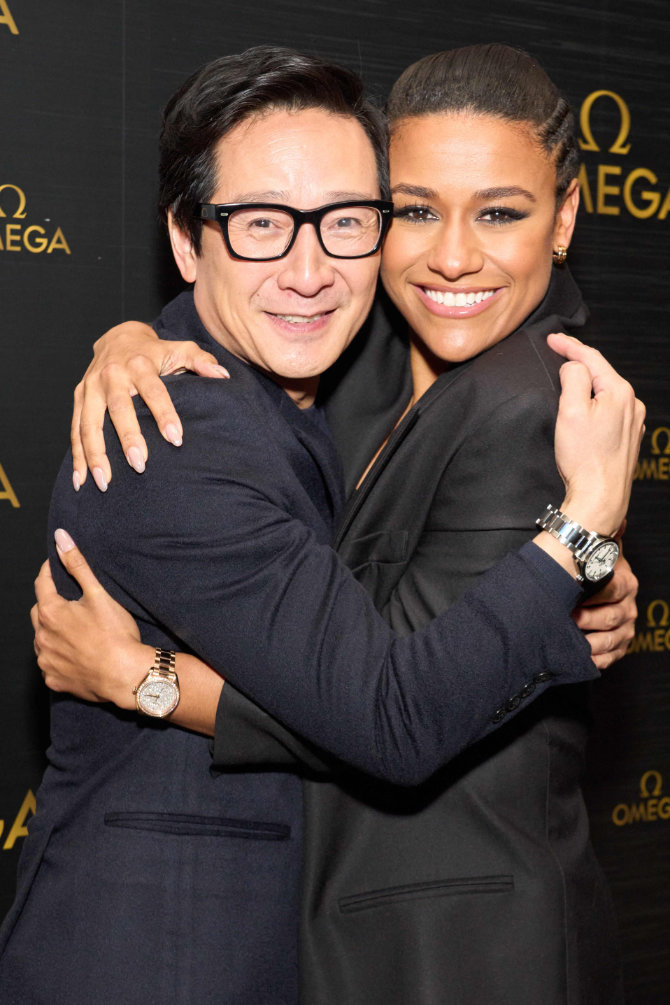
Ke Huy Quan and Ariana Debose arrive to the OMEGA Cocktail Reception and Dinner Celebrating The Academy Awards on March 9, 2023 in Los Angeles. (Getty Images/AFP)
Kristina Wong, an actor and comedian currently appearing in a one-woman show co-produced by East West Players, said she had been driven to write her own productions because it was the only way to see “weird” immigrant stories told.
“It is either this, or sit around and audition for bubble gum commercials,” she told AFP.
“I’ve done that life. And it sucks. It’s not fulfilling creatively.”
There is still “a lack of opportunities in general,” said Wong.
But with her “Kristina Wong, Sweatshop Overlord” a Pulitzer drama finalist, and “Everything Everywhere” racking up awards and box office receipts, “I think we’re ready” for new stories, she said.
“We’ve been seeing the same tired old stories about... this white guy action hero, going ‘I’m going to fix this with a gun.’“
“It’s made me excited, thinking maybe there’s an audience ready to be challenged.”

Costume designer Shirley Kurata, nominated for an Oscar for the movie "Everything Everywhere All at Once," poses for AFP in her store on March 2, 2023 in Los Angeles. (AFP)
Still, Asian success at the Oscars has remained limited to a tiny group.
Just 23 Asian actors’ performances have ever been nominated, representing a mere 1.2 percent of all nominations, according to a New York Times study.
Only Ben Kingsley, whose father was Indian, has been nominated more than once. And there has never been a year in which more than one Asian actor won.
Could this be the year representation goes beyond a few, specific individuals?
South Korea-born Joel Kim Booster, who wrote and starred in gay rom com “Fire Island,” said having his work championed by two Asian executives at Disney-owned Searchlight had “really pushed this project through and made sure that it was going to get made.”
“For a long time, there was this pull-the-ladder-up-behind-me mentality” among many minorities who found success in Hollywood, he told AFP.
“There was a scarcity... a mentality of ‘there’s only room for one of us at the table and that’s going to be me.’
“I think that has dissipated in a big way.”


