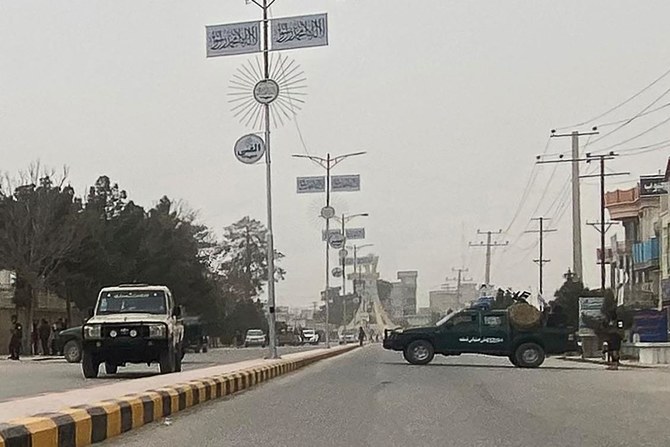
MAZAR-I-SHARIF, Afghanistan: The Taliban governor of Afghanistan’s Balkh province, known for fighting against Daesh terrorists, was killed in a suicide attack at his office on Thursday, officials said.
The killing, a day after he met top government officials visiting from Kabul, makes Mohammad Dawood Muzammil one of the highest-ranking figures slain since the Taliban stormed back to power in 2021.
Violence across Afghanistan has dramatically dropped since the Taliban seized control, but the security situation has again deteriorated with Daesh claiming several deadly attacks.
“Two people, including Mohammad Dawood Muzammil, the governor of Balkh, have been killed in an explosion this morning,” local police spokesman Asif Waziri said, adding that the blast happened on the second floor of his office, in the provincial capital Mazar-i-Sharif.
“It was a suicide attack. We don’t have information as to how the suicide bomber reached the office of the governor,” he said, adding that two people were also wounded.
The explosion happened moments after the governor arrived in his office, said Khairuddin, who was wounded in the incident and in a hospital in Mazar-i-Sharif.
“There was a bang. I fell on the ground,” he said, adding that he witnessed a friend lose a hand in the blast.
Authorities deployed extra security at the governorate, who forbade journalists from taking photos, an AFP correspondent reported from near the site of the blast.
Muzammil was “martyred in an explosion by the enemies of Islam,” tweeted government spokesman Zabihullah Mujahid.
Muzammil was initially appointed governor of the eastern province of Nangarhar, where he led the fight against Daesh militants, before being moved to Balkh last year.
On Wednesday, he met two deputy prime ministers and other senior officials visiting Balkh to review a major irrigation project in northern Afghanistan, according to a government statement.
Daesh has emerged as the biggest security challenge to the Taliban government since last year, carrying out attacks against Afghan civilians as well as foreigners and foreign interests.
Several attacks have rocked Balkh, including in Mazar-i-Sharif last year, some claimed by Daesh.
In January, a suicide bomber killed at least 10 people when he blew himself up near the foreign ministry in Kabul, in an attack claimed by Daesh.
The Taliban and Daesh share an austere Sunni Islamist ideology, but the latter are fighting to establish a global “caliphate” instead of the Taliban’s more inward-looking goal of ruling an independent Afghanistan.
At least five Chinese nationals were wounded in December when gunmen stormed a hotel popular with businesspeople in Kabul.
That raid was claimed by Daesh, as was an attack on Pakistan’s embassy in Kabul in December that Islamabad denounced as an “assassination attempt” against its ambassador.
Two Russian embassy staff members were killed in a suicide bombing outside their mission in September in another attack claimed by Daesh.


Taliban governor of Afghan province killed in suicide attack
https://arab.news/cet3a
Taliban governor of Afghan province killed in suicide attack

- The killing makes Mohammad Dawood Muzammil one of the highest-ranking figures slain since the Taliban stormed back to power in 2021


Mali, Burkina say restricting entry for US nationals in reciprocal move
- Both countries said they are applying the same measures on American nationals as imposed on them
ABIDJAN: Mali and Burkina Faso have announced travel restrictions on American nationals in a tit-for-tat move after the US included both African countries on a no-entry list.
In statements issued separately by both countries’ foreign ministries and seen Wednesday by AFP, they said they were imposing “equivalent measures” on US citizens, after President Donald Trump expanded a travel ban to nearly 40 countries this month, based solely on nationality.
That list included Syrian citizens, as well as Palestinian Authority passport holders, and nationals of some of Africa’s poorest countries including also Niger, Sierra Leone and South Sudan.
The White House said it was banning foreigners who “intend to threaten” Americans.
Burkina Faso’s foreign ministry said in the statement that it was applying “equivalent visa measures” on Americans, while Mali said it was, “with immediate effect,” applying “the same conditions and requirements on American nationals that the American authorities have imposed on Malian citizens entering the United States.”
It voiced its “regret” that the United States had made “such an important decision without the slightest prior consultation.”
The two sub-Saharan countries, both run by military juntas, are members of a confederation that also includes Niger.
Niger has not officially announced any counter-measures to the US travel ban, but the country’s news agency, citing a diplomatic source, said last week that such measures had been decided.
In his December 17 announcement, Trump also imposed partial travel restrictions on citizens of other African countries including the most populous, Nigeria, as well as Ivory Coast and Senegal, which qualified for the football World Cup to be played next year in the United States as well as Canada and Mexico.


