

Pakistani rupee depreciates further on continued uncertainty over IMF bailout

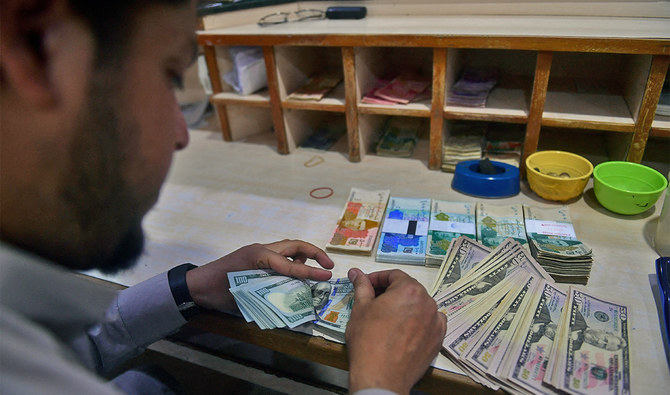
A dealer counts US dollars at a money exchange market in Karachi on January 26, 2023. (AFP/File)
Short Url
Updated 09 March 2023
Follow

Pakistani rupee depreciates further on continued uncertainty over IMF bailout

  • The rupee has been falling since January after foreign exchange companies removed a cap on the exchange rate
  • Market-based rate is key demand of IMF as part of programme of economic reforms it has agreed on with Pakistan

KARACHI: Pakistani currency dealers said on Thursday uncertainty continued to prevail in the market despite assurances from the government that it was close to finalizing a bailout deal with the International Monetary Fund, leading to the rupee depreciating further and trading at Rs282.30 against the United States dollar in the interbank market.

The rupee has been falling since January after foreign exchange companies removed a cap on the exchange rate, a key demand of the IMF as part of a program of economic reforms it has agreed on with the cash-strapped South Asian nation.

On Wednesday, the currency had closed at Rs279.12 against the USD in the interbank.

“Procrastination at IMF front is creating uncertainty in the market despite the assurance about signing a staff-level agreement with the IMF,” Zafar Sultan Paracha, general secretary of the Exchange Companies Association of Pakistan (ECAP), told Arab News. “The market wants to see some tangible actions at the IMF front.”

“The financial institutions are also involved in currency manipulation, while slow encashment by exporters and high demand from importers is also weakening the Pak rupee,” Paracha added.

Facing an acute balance of payments crisis, Pakistan is desperate to secure external financing, with less than three weeks’ worth of import cover in its foreign exchange reserves.

Pakistan secured a $6 billion IMF bailout in 2019. It was topped up with another $1 billion last year to help the country following devastating floods, but the IMF then suspended disbursements in November due to Pakistan’s failure to make more progress on fiscal consolidation.

While the move to remove the foreign exchange rate cap has increased the chances of a restart in IMF funding, Pakistan is also reeling from multi-decade high inflation, which economists fear will now get worse.

Most of Pakistan’s critical imports, including fuel, are paid for in dollars.


Curfew extended in Gilgit-Baltistan, probe ordered after deadly Khamenei protests

Updated 03 March 2026
Follow

Curfew extended in Gilgit-Baltistan, probe ordered after deadly Khamenei protests

  • At least 15 people were killed in clashes with law enforcement agencies over the weekend in Gilgit-Baltistan
  • Government also announces a de-weaponization campaign, crackdown on hate speech and cybercrime in region

ISLAMABAD: The government in Pakistan’s Gilgit-Baltistan (GB) region on Tuesday extended a curfew in Gilgit district and ordered a judicial probe into violent protests over the killing of Iranian Supreme Leader Ali Khamenei in US-Israeli strikes last week, an official said.

At least 15 people were killed in clashes with law enforcement agencies over the weekend in GB, where protesters torched and vandalized several buildings, including United Nations regional offices, an army-run school, software technology park and a local charity building.

The violence prompted regional authorities to impose curfew in Gilgit and Skardu districts on March 2-4 as officials urged people to stay indoors and cooperate with law enforcers, amid widespread anger in Pakistan, particularly among members of the Shiite minority, over Khamenei’s killing.

On Tuesday, the GB government convened to review the situation and announced the extension of curfew in Gilgit among a number of security measures as well as ordered the establishment of a judicial commission to investigate the weekend violence in the region.

“The government has made it clear that the law will strictly take its course against elements involved in vandalism at government institutions, private properties and incidents of vandalism in Gilgit and Skardu and no kind of mischief will be tolerated,” Shabbir Mir, a GB government spokesperson, said in a statement.

“In view of the security situation, curfew will remain in force in Gilgit, while the decision to extend the curfew in Skardu will be taken keeping the ground realities and the changing situation in view.”

The statement did not specify how long the curfew will remain in place in Gilgit.

Besides the formation of the judicial commission to investigate the violent clashes, the government also decided to launch a large-scale de-weaponization campaign in the entire Gilgit district, for which relevant institutions have been directed to immediately complete all necessary arrangements, according to Mir.

In addition, a crackdown has been ordered on hate speech, spread of fake news and cybercrime.

“The aim of these decisions is to ensure the rule of law, protect the lives and property of citizens and crack down on miscreants,” he said. “Approval has also been given to immediately survey the affected infrastructure and start their restoration work on priority basis.”

Demonstrators in Pakistan’s southern port city of Karachi also stormed the US Consulate on Sunday, smashing windows and attempting to burn the building. Police responded with batons, tear gas, and gunfire, leaving 10 people dead and more than 50 injured.

Pakistani authorities have since beefed up security at US diplomatic missions across the country, including around the US consulate building in Peshawar, to avoid any further violence.