

With viral video, school-going street vendor turns Peshawar Zalmi brand ambassador

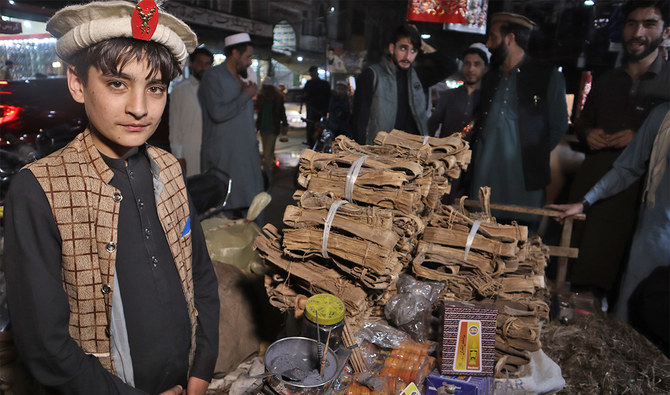
Ahmad Shehzad poses for a picture in Peshawar's Qissa Khwani Bazar, Pakistan, on 7 March 2023. (AN Photo)
Short Url
Updated 09 March 2023
Follow

With viral video, school-going street vendor turns Peshawar Zalmi brand ambassador

  • Ahmad Shehzad, a seventh-grade student, helps his father sell merchandize after finishing the school day
  • Zalmi called him its ‘real ambassador’ after a TikTok video went viral in which Shehzad is waiting for customers

PESHAWAR: Ahmad Shehzad, a seventh-grade student who manages his father’s street business after finishing the school day, was handpicked by Peshawar Zalmi as brand ambassador following his viral TikTok clip last month in which he can be seen offering potato chips to an unknown man carrying the camera.

Shehzad has eight siblings and works as a street vendor in the city’s historic Qissa Khwani Bazaar, or Storytellers’ Market, where he mostly sells traditionally used oral hygiene products, kohl and other merchandize to people.

The video that made him popular on social media was recorded about three weeks ago while he was waiting for customers.

“I was setting here when a person named Mehmood came over and captured the video,” he told Arab News while pointing toward a place near his cart. “I offered him my chips and he shared the video on social media which got a lot of attention.”

As the video went viral, Javed Afridi, who owns the Pakistan Super League (PSL) franchise representing Peshawar, shared Shehzad’s picture on Twitter and described him as the “real ambassador” of Zalmi.

“People from Peshawar Zalmi came over, took me to the stadium, gave me [their team’s cricket] kit, and handed me over Rs10,000,” said the young boy.


Ahmad Shehzad poses for a picture with his cart in Peshawar's Qissa Khwani Bazar, Pakistan, on 7 March 2023. (AN Photo)

He informed he only went to watch one match of the eighth PSL edition in the ground, adding his ticket and transport were arranged by Zalmi.

“I went to the Rawalpindi Cricket Stadium where Peshawar Zalmi won the match,” he added. “I felt very happy.”

However, he said he was not taken to more PSL matches by the franchise despite being declared its brand ambassador.

“People surround me all the time now and don’t let me do my work easily,” he continued. “When someone shoots a video with me, it makes me happy.”
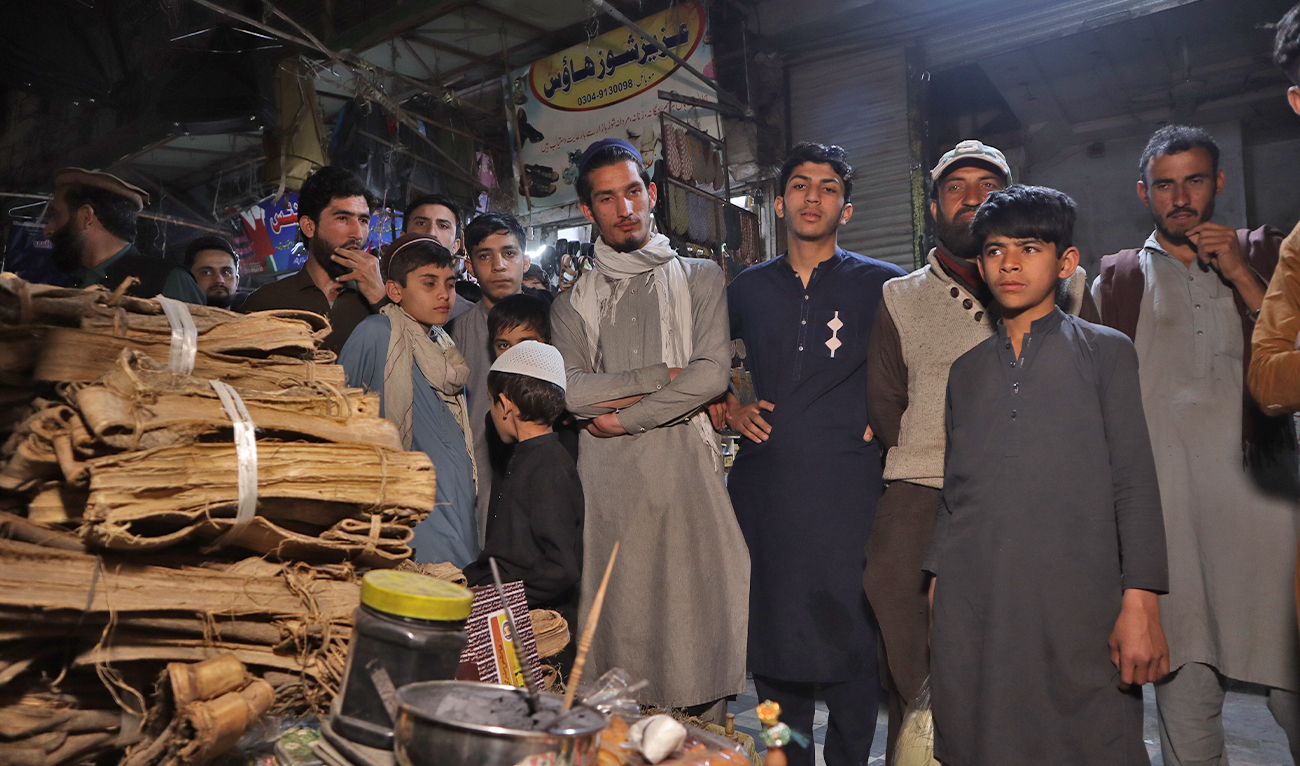


Onlookers gather around Ahmad Shehzad's cart in Peshawar, Pakistan, on March 9, 2023. (AN Photo)

Shehzad’s father, Khan Bahadur, told Arab News he came to Peshawar to earn a decent income for his family.

“If someone supports me, I will try to provide better education to Shehzad which is a big dream,” he said.

“The news [about Shehzad becoming Zalmi’s brand ambassador] has spread so much that people don’t let us do our business here,” he added. “Some people come and request to make a video with him, others say they want to take photographs.”

Bahadur thanked Afridi for choosing his son as Zalmi’s brand ambassador.

“So much respect has come into our lives [since then],” he said. “Shehzad has been respected and in return people also respect me.”


Nearly 25% of Pakistan’s primary schools enrolling girls operate as single-teacher ones— report

Updated 13 sec ago
Follow

Nearly 25% of Pakistan’s primary schools enrolling girls operate as single-teacher ones— report

  • Pakistan needs over 115,000 more teachers in primary schools enrolling girls to meet global benchmark of one teacher per 30 students, says report
  • Sixty percent of Pakistani primary schools enrolling girls are overcrowded, while 32% lack clean drinking water or toilets, says Tabadlab report

ISLAMABAD: Nearly 25% of Pakistan’s primary schools that enrolls girls operate as single-teacher ones, a report by a leading think tank said this week, calling on the government to devolve teacher recruitment powers, upskill underutilized teachers and introduce reforms to hire and promote faculty members. 

Pakistan faces an acute education crisis which is reflected in the fact that it has the world’s second-highest number of out-of-school children, an estimated 22.8 million aged 5-16 who are not in educational institutions, according to UNICEF. 

While poverty remains the biggest factor keeping children out of classrooms, Pakistan’s education crisis is exacerbated by inadequate infrastructure and underqualified teachers, cultural barriers and the impacts of frequently occurring natural disasters. 

According to “The Missing Ustaani,” a report published by Islamabad-based think tank Tabadlab and supported by Malala Fund and the Pakistan Institute of Education (PIE), Pakistan needs over 115,000 more teachers in primary schools with girls’ enrolment to meet the basic international benchmark of ensuring one teacher per 30 children. Currently, the average Student-to-Teacher Ratio (STR) across Pakistan’s primary schools with girls’ enrolment is 39:1, it said. 

“Approximately 60% of these schools are overcrowded, necessitating the recruitment of over 115,000 additional teachers nationwide,” the report said on Monday. “Compounding this, nearly 25% of primary schools with girls’ enrolment operate as single-teacher schools, placing immense pressure on the quality of education.”

It said the situation is more dire in Pakistan’s poverty-stricken southwestern Balochistan province, where nearly 52% of the schools are single-teacher only ones while the percentage decreases slightly in the southern Sindh province to 51 percent. 

The report said while the STR improves to 25:1 at the middle school level, acute shortages of subject specialists emerge as the top-priority concern for quality education in these schools.

“Furthermore, around 32% of primary schools with girls’ enrolment and 18% of middle schools face ‘critical infrastructural shortages’— lacking clean drinking water or toilets in addition to high STRs— which significantly affects girls’ attendance and learning, particularly during adolescence,” the report said. 

The report cited a set of priority recommendations to address Pakistan’s systemic teacher deployment challenges and improve educational equity for girls. 

It urged the government to devolve recruitment authority to school or cluster levels to enable timely, context-specific hiring. It also called upon authorities to reform teacher transfer and promotion policies to introduce school-specific postings with minimum service terms. 

This, it said, would reduce arbitrary transfers and improving continuity in classrooms. The report advised authorities to upskill surplus or underutilized primary teachers to support instruction at the middle school level, helping address subject-specialist shortages.

“Together, these reforms offer a pathway toward a more equitable, efficient, and responsive teaching workforce— one capable of improving learning outcomes and ensuring that every girl in Pakistan has access to a qualified teacher,” the report said. 

To tackle Pakistan’s education crisis, Prime Minister Shehbaz Sharif declared an ‘education emeregency’ in September 2024, stressing the importance of education for all.