Russia unleashes missile barrage on Ukraine as ground battle rages in the east

1 / 3
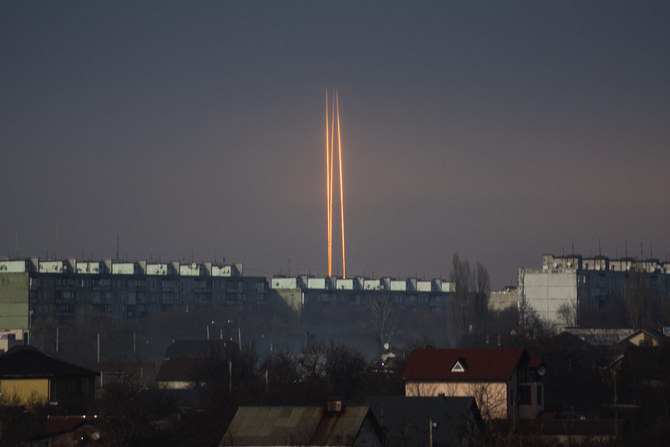
Three Russian rockets launched against Ukraine from Russia's Belgorod region are seen at dawn in Kharkiv, Ukraine, early on March 9, 2023. (AP Photo/Vadim Belikov)
2 / 3
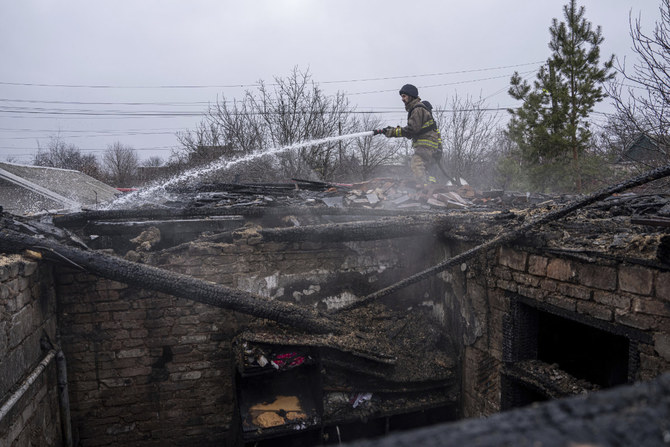
A rescue worker puts out the fire of a house which was destroyed by Russian shelling in Kostiantynivka, Ukraine, on March 8, 2023. (AP)
3 / 3
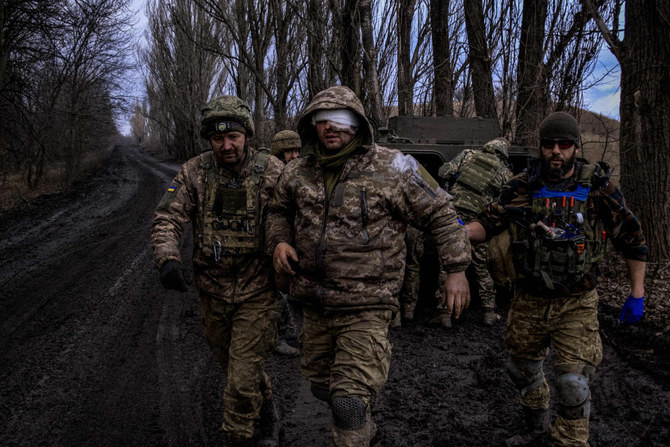
Ukrainian combat medics evacuate a wounded Ukrainian serviceman from the front line near Bakhmut on March 8, 2023, amid the Russian invasion of Ukraine. (Photo by Sergey Shestak/AFP)
Short Url
Updated 09 March 2023
Follow

Russia unleashes missile barrage on Ukraine as ground battle rages in the east

  • Smoke billows over Bakhmut, buildings burn
  • EU agrees to push ahead on joint arms buying to help Kyiv

KYIV, Ukraine: Volleys of Russian missiles struck a series of Ukrainian regions early on Thursday, including the Black Sea port of Odesa and the second city of Kharkiv, knocking out power to several areas, regional officials said.
The governor of Odesa region, Maksym Marchenko, said on Telegram that a mass missile attack had hit an energy facility in the port city, cutting power. Residential areas had also been hit, but no casualties were reported.
Kharkiv region Governor Oleh Synehubov said the city and region had been hit by 15 strikes, with targets including infrastructure. Other strikes were reported in the central city of Dnipro and regions throughout the country.
Late on Wednesday, Ukraine’s military said it had managed to push back intense Russian attacks on the city of Bakhmut despite a Russian claim of control over its eastern half.
As one of the bloodiest battles of the year-long war ground on in the small city’s ruins, Ukrainian defenders — who last week appeared to be preparing for a tactical retreat — remained defiant.
“The enemy continued its attacks and has shown no sign of a letup in storming the city of Bakhmut,” the General Staff of the Ukrainian armed forces said on Facebook. “Our defenders repelled attacks on Bakhmut and on surrounding communities.”
Ukrainian military and political leaders now speak of hanging on to positions and inflicting as many casualties as possible on the Russians to grind down their fighting capability.
President Volodymyr Zelensky said in late Wednesday video address that the battle for Bakhmut and the surrounding Donbas region was “our first priority.”
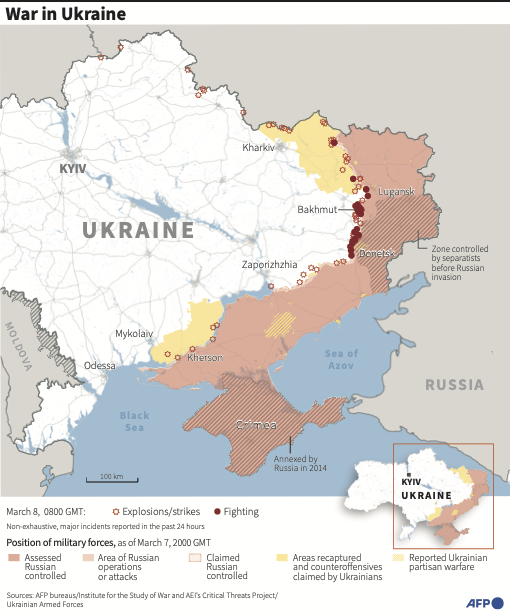
In a separate interview with CNN, he said: “We think that in the Donbas direction Russia has started its offensive. This is the offensive. This is what it looks like: a slow aggression, because they don’t have enough strength and forces.”
Yevgeny Prigozhin, head of the Russian mercenary group Wagner, said his fighters had captured the eastern part of Bakhmut. If true, Russian forces would control nearly half the city in a costly pursuit of their first big victory in several months.
“Everything east of the Bakhmutka River is completely under the control of Wagner,” Prigozhin said on the Telegram messaging app.
The river bisects Bakhmut, on the edge of Ukraine’s Donetsk province that is already largely under Russian occupation. The city center is on the west side of the river.
Prigozhin has issued premature success claims before. Reuters was not able to verify the situation on the ground.
Ukrainian military analyst Oleh Zhdanov said that in addition to the Zabakhmutka district on the eastern outskirts of Bakhmut, the Russians had captured Ilyinivka district on the north side.
“The situation is critical,” he said in a video commentary, adding that Russian forces had also made gains near Avdiivka to the south of Bakhmut as well as to the north around Svatovo.

Arms buying push
Russia was throwing more troops into the battle, NATO Secretary-General Jens Stoltenberg said before a meeting of European Union defense ministers in Stockholm.
“They have suffered big losses, but at the same time we cannot rule out that Bakhmut may eventually fall in the coming days,” Stoltenberg said.
This would not necessarily be a turning point in the war but showed “we should not underestimate Russia,” he said.
EU defense ministers agreed to speed up the supply of artillery rounds and buy more shells to help Ukraine’s military, which is burning through shells faster than its allies can manufacture them.
Under the plan, EU states would get financial incentives worth 1 billion euros to send more of their artillery rounds to Kyiv, while another 1 billion euros would fund joint procurement of new shells.

Devastated cities
Russia has said it has annexed nearly 20 percent of Ukraine’s territory and says taking Bakhmut would be a step toward seizing the whole of the industrial Donbas region on its border.
Western analysts say Bakhmut has little strategic value, although its capture would be a boost to Russian President Vladimir Putin and his military after a series of setbacks in what they call their “special military operation.”
Kyiv says the losses suffered by Russia there could determine the course of the war, with Ukraine expected to launch a counteroffensive when the weather improves and it receives more Western military aid, including tanks.
The months of warfare in the east have been among the deadliest and most destructive since Russia invaded in February last year, adding Bakhmut’s name to a list of devastated cities that includes Mariupol, Sievierodonetsk and Lysychansk.
A Ukrainian military drone showed the scale of destruction in Bakhmut, filming apartment blocks on fire and smoke billowing from residential areas.
Iryna Vereshchuk, a deputy Ukrainian premier, said fewer than 4,000 civilians — including 38 children — out of a pre-war population of some 70,000 remain in Bakhmut.
US Director of National Intelligence Avril Haines told a Senate committee that Washington did not foresee the Russian military recovering enough this year to make major gains.
Russia casts its invasion of Ukraine as a response to threats to its security from its neighbor’s ties to the West. 


Proposals on immigration enforcement flood into state legislatures, heightened by Minnesota action

Updated 16 January 2026
Follow

Proposals on immigration enforcement flood into state legislatures, heightened by Minnesota action

  • Oregon Democrats plan to introduce a bill to allow residents to sue federal officers for violating their Fourth Amendment rights against unlawful search and seizure

NASHVILLE, Tennessee: As Democrats across the country propose state law changes to restrict federal immigration officers after the shooting death of a protester in Minneapolis, Tennessee Republicans introduced a package of bills Thursday backed by the White House that would enlist the full force of the state to support President Donald Trump’s immigration crackdown.
Momentum in Democratic-led states for the measures, some of them proposed for years, is growing as legislatures return to work following the killing of Renee Good by an Immigration and Customs Enforcement officer. But Republicans are pushing back, blaming protesters for impeding the enforcement of immigration laws.

Democratic bills seek to limit ICE

Democratic Gov. Kathy Hochul wants New York to allow people to sue federal officers alleging violations of their constitutional rights. Another measure aims to keep immigration officers lacking judicial warrants out of schools, hospitals and houses of worship.
Oregon Democrats plan to introduce a bill to allow residents to sue federal officers for violating their Fourth Amendment rights against unlawful search and seizure.
New Jersey’s Democrat-led Legislature passed three bills Monday that immigrant rights groups have long pushed for, including a measure prohibiting state law enforcement officers from cooperating with federal immigration enforcement. Democratic Gov. Phil Murphy has until his last day in office Tuesday to sign or veto them.
California lawmakers are proposing to ban local and state law enforcement from taking second jobs with the Department of Homeland Security and make it a violation of state law when ICE officers make “indiscriminate” arrests around court appearances. Other measures are pending.
“Where you have government actions with no accountability, that is not true democracy,” Democratic state Sen. Scott Wiener of San Francisco said at a news conference.
Democrats also push bills in red states
Democrats in Georgia introduced four Senate bills designed to limit immigration enforcement — a package unlikely to become law because Georgia’s conservative upper chamber is led by Lt. Gov. Burt Jones, a close Trump ally. Democrats said it is still important to take a stand.
“Donald Trump has unleashed brutal aggression on our families and our communities across our country,” said state Sen. Sheikh Rahman, an immigrant from Bangladesh whose district in suburban Atlanta’s Gwinnett County is home to many immigrants.
Democrats in New Hampshire have proposed numerous measures seeking to limit federal immigration enforcement, but the state’s Republican majorities passed a new law taking effect this month that bans “sanctuary cities.”
Tennessee GOP works with White House on a response
The bills Tennessee Republicans are introducing appear to require government agencies to check the legal status of all residents before they can obtain public benefits; secure licenses for teaching, nursing and other professions; and get driver’s licenses or register their cars.
They also would include verifying K-12 students’ legal status, which appears to conflict with a US Supreme Court precedent. And they propose criminalizing illegal entry as a misdemeanor, a measure similar to several other states’ requirements, some of which are blocked in court.
“We’re going to do what we can to make sure that if you’re here illegally, we will have the data, we’ll have the transparency, and we’re not spending taxpayer dollars on you unless you’re in jail,” House Speaker Cameron Sexton said at a news conference Thursday.
Trump administration sues to stop laws
The Trump administration has opposed any effort to blunt ICE, including suing local governments whose “sanctuary” policies limit police interactions with federal officers.
States have broad power to regulate within their borders unless the US Constitution bars it, but many of these laws raise novel issues that courts will have to sort out, said Harrison Stark, senior counsel with the State Democracy Research Initiative at the University of Wisconsin Law School.
“There’s not a super clear, concrete legal answer to a lot of these questions,” he said. “It’s almost guaranteed there will be federal litigation over a lot of these policies.”
That is already happening.
California in September was the first to ban most law enforcement officers, including federal immigration officers, from covering their faces on duty. The Justice Department said its officers won’t comply and sued California, arguing that the laws threaten the safety of officers who are facing “unprecedented” harassment, doxing and violence.
The Justice Department also sued Illinois last month, challenging a law that bars federal civil arrests near courthouses, protects medical records and regulates how universities and day care centers manage information about immigration status. The Justice Department claims the law is unconstitutional and threatens federal officers’ safety.
Targeted states push back
Minnesota and Illinois, joined by their largest cities, sued the Trump administration this week. Minneapolis and Minnesota accuse the Republican administration of violating free speech rights by punishing a progressive state that favors Democrats and welcomes immigrants. Illinois and Chicago claim “Operation Midway Blitz” made residents afraid to leave their homes.
Homeland Security spokesperson Tricia McLaughlin accused Minnesota officials of ignoring public safety and called the Illinois lawsuit “baseless.”