

At UN conference, Pakistan demands rights for Muslim women in non-Muslim societies

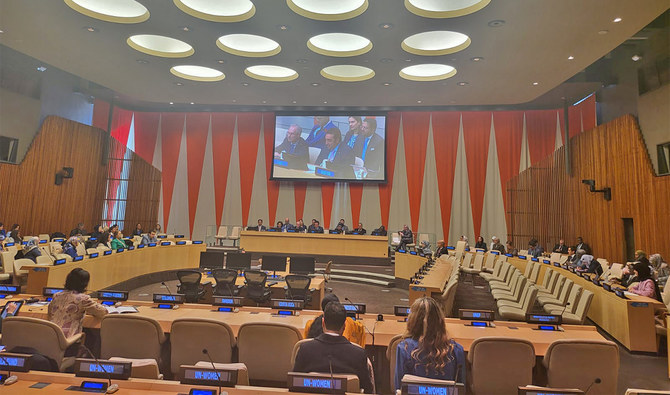
Pakistan's foreign minister Bilawal Bhutto-Zardari chairs a conference on “Women in Islam: Understanding the rights and Identity of Women in the Islamic World” in New York, US, on March 8, 2023. (@MediaCellPPP/Twitter)
Short Url
Updated 09 March 2023
Follow

At UN conference, Pakistan demands rights for Muslim women in non-Muslim societies

  • Foreign Minister Bilawal Bhutto-Zardari opens "Women in Islam" UN conference in New York
  • Bhutto-Zardari expresses "deep disappointment" over Afghanistan's restrictions on women, girls 

ISLAMABAD: Pakistan's Foreign Minister Bilawal Bhutto-Zardari urged the international community to ensure Muslim women were not denied their religious and cultural rights in non-Muslim societies, during his address at a U.N. conference on Wednesday. 

The Pakistani foreign minister was speaking at the "Women in Islam" conference held at the U.N. headquarters in New York. Held on the sidelines of the Commission on Status of Women (CSW), the conference featured senior ministers from countries around the world. 

Pakistan, as the chair of the Organization of Islamic Countries (OIC) Council of Mini­sters, hosted the March 8 conference with Bhutto-Zardari delivering the opening statement. 

“We must counter the denial of religious and cultural rights to Muslim women in non-Muslim societies and negative stereotyping and discrimination against Muslim women,” Bhutto-Zardari said during his speech. 

The minister said that the world should also not "forget the suffering" of Muslim women in occupied territories such as Palestine and the Indian-administered Jammu and Kashmir.

Bhutto-Zardari said it is natural for Pakistan and other OIC member states to feel "deeply disappointed" at women in Afghanistan being denied their basic right to work and education. 

“I sincerely urge the Afghan Interim Government to reverse these restrictions and enable the women of Afghanistan to make their full and invaluable contribution to the development and progress of their nation," he added.

The minister said Islam does not tolerate discrimination on gender, race, and color, adding that the religion also forbids injustice against people and nations. 

“Islam treats women as human beings in their own right, not as chattel,” he added.


Bangladesh leader pushes for SAARC revival after meeting Indian, Pakistani dignitaries

Updated 5 sec ago
Follow

Bangladesh leader pushes for SAARC revival after meeting Indian, Pakistani dignitaries

  • Muhammad Yunus met Pakistan’s parliamentary speaker, Indian FM at Khaleda Zia’s funeral on Wednesday
  • SAARC has been dysfunctional since 2016, after India withdrew following a militant attack it blamed on Islamabad

ISLAMABAD: Bangladesh Chief Adviser Muhammad Younus this week pushed for reviving the South Asian Association for Regional Cooperation (SAARC) platform after meeting dignitaries from India, Pakistan and other parts of the region. 

SAARC has been effectively dysfunctional since 2016, when its planned Islamabad summit collapsed after India withdrew following a militant attack it blamed on Pakistan. Islamabad denied involvement, but New Delhi’s decision prompted Afghanistan, Bangladesh and Bhutan to pull out, leading to the indefinite postponement of the summit.

Younus met Pakistan’s National Assembly Speaker Ayaz Sadiq and Indian External Affairs Minister Subrahmanyam Jaishankar at former Bangladesh premier Khaleda Zia’s state funeral in Dhaka on Wednesday. The funeral also saw a handshake between the Indian and Pakistani representatives, the first high-level contact between officials of the two countries since their conflict in May. 

“During the meetings, Professor Yunus repeatedly emphasized the need to revive the South Asian Association for Regional Cooperation (SAARC),” Yunus’ account on social media platform X said.

“We witnessed a true SAARC spirit at the funeral yesterday,” the account quoted Yunus as saying. “SAARC is still alive. The SAARC spirit is still alive.”

The Bangladesh leader said apart from Jaishankar and Sadiq, representatives from South Asia who attended the funeral included Nepal’s Foreign Minister Bala Nanda Sharma, Sri Lanka’s Minister of Foreign Affairs, Employment and Tourism Vijitha Herath, and Maldives Minister of Higher Education and Labor Ali Haider Ahmed. 

Yunus said he tried to convene an informal gathering of SAARC leaders on the sidelines of the UN General Assembly in New York last year.

His statement to revive SAARC follows that of Pakistan’s Prime Minister Shehbaz Sharif, who earlier this month also called for reviving the South Asian platform. 

Sharif’s message last month came as the bloc marked the 40th anniversary of its founding charter. The Pakistani premier stressed the importance of deeper economic collaboration and collective responses to shared regional challenges such as poverty, climate-induced natural disasters, food and energy insecurity, and public-health vulnerabilities.