Thousands of women rally in Pakistan despite legal hurdles

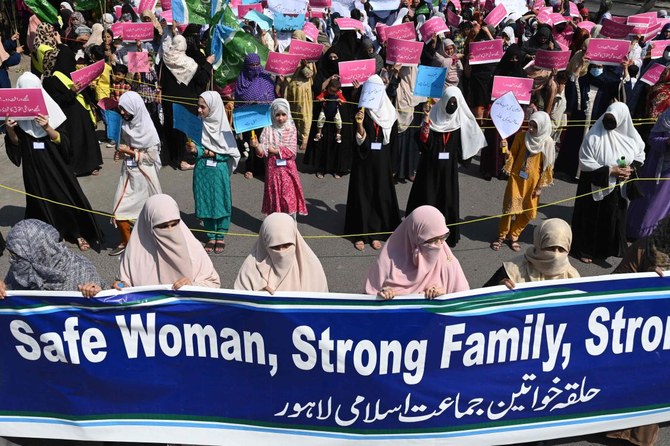
Activists of Jamaat-e-Islami (JI) party hold placards and party flags as they march during a rally to mark the International Women’s Day in Lahore on March 8, 2023. (AFP)
Short Url
Updated 08 March 2023
Follow

Thousands of women rally in Pakistan despite legal hurdles

  • Known as the Aurat (women) March, the rallies have courted controversy because of banners and placards waved by participants
  • Videos posted on social media showed several police officers baton charging participants as they tried to join the demonstration

LAHORE, Pakistan: Thousands of women took part in rallies across Pakistan on Wednesday despite efforts by authorities in several cities to block the divisive marches.
Known as the Aurat (women) March, the rallies have courted controversy because of banners and placards waved by participants that raise subjects such as divorce, sexual harassment and menstruation.
Each year, some of the most provocative banners ignite weeks of outrage and a slew of violent threats.
“The whole point of the Aurat March is to demand the security and safety that women are not afforded in this country and society,” said Rabail Akhtar, a schoolteacher who joined a crowd of around 2,000 in Lahore to mark International Women’s Day.
“We are not going to sit silently anymore. It’s our day, it’s our time.”
Videos posted on social media showed several police officers baton charging participants as they tried to join the demonstration.
In a tweet, Interior Minister Rana Sanaullah said the capital’s police chief had been summoned and the officers involved suspended.
City authorities had at the weekend refused to provide security, despite allowing a “modesty” countermarch to go ahead, before a court ordered them to back down.
“It’s ridiculous how we have to go through the same drama every year... Why are they so afraid of women demanding their rights?” asked Soheila Afzal, a graphic designer.
In Karachi, judges dismissed a legal challenge by an individual to ban a related rally scheduled for the weekend so that working women could attend.
In the capital Islamabad, organizers refused to comply with orders to confine the gathering to a city park where a woman was gang raped in February.
Hundreds of women gathered instead outside the city’s press club, where police eventually removed a barricade and allowed the march to begin.
“Women used to be quiet, but now we have women on roads talking about their rights and justice and I think that is the change they were looking for,” said 24-year-old NGO worker Aisha Masood.
The Aurat March is seen by critics as supporting elitist and Western cultural values in the Muslim country, with organizers accused of disrespecting religious and cultural sensitivities.
Countermarches are also held in most cities, where women from right-wing religious groups call for modesty and “family values” to be upheld.
“I will not defend men because we live in a patriarchal and male-dominated society. But we have to ensure an end to violence while confining ourselves within the parameters of Islamic Shariah,” said 45-year-old Asia Yaqoob, a housewife veiled in a hijab at a rally of more than 1,000 women in the capital.
“The beauty of a woman lies in covering her body in a way that our religion teaches.”
In 2020, groups of hard-line Islamist men turned up in vans and hurled stones at women participating in the Aurat March in Islamabad.
Much of Pakistani society operates under a strict code of “honor,” systemising the oppression of women in matters such as the right to choose who to marry, reproductive rights and even the right to an education.
Hundreds of women are killed by men in Pakistan every year for allegedly breaching this code.


Trump targets non-white immigrants in renewed xenophobic rants

Updated 43 min 38 sec ago
Follow

Trump targets non-white immigrants in renewed xenophobic rants

  • During a rally in Pennsylvania on Wednesday,  Trump doubled down on his tirade against Somali migrants
  • "Why is it we only take people from shithole countries,’ right? Trump told his cheering audience

WASHINGTON: Back in 2018, President Donald Trump disputed having used the epithet “shithole” to describe some countries whose citizens emigrated to the United States.
Nowadays, he embraces it and pushes his anti-immigrant and xenophobic tirades even further.
Case in point: during a rally in the northeastern state of Pennsylvania on Wednesday that was supposed to focus on his economic policy, the 79-year-old Republican openly ranted and reused the phrase that had sparked an outcry during his first term.
“We had a meeting and I said, ‘Why is it we only take people from shithole countries,’ right? ‘Why can’t we have some people from Norway, Sweden?’” Trump told his cheering audience.
“But we always take people from Somalia,” he continued. “Places that are a disaster. Filthy, dirty, disgusting, ridden with crime.”
Recently, he called Somali immigrants “trash.”
These comments are “more proof of his racist, anti-immigrant agenda,” Massachusetts Senator Ed Markey responded on X.

The Trump megaphone

Florida Republican lawmaker Randy Fine, on the other hand, defended Trump.
“Not all cultures are equal and not all countries are equal,” he said on CNN, adding “the president speaks in language that Americans understand, he is blunt.”
University of Albany history professor Carl Bon Tempo told AFP this type of anti-immigrant rhetoric has long thrived on the far-right.
“The difference is now it’s coming directly out of the White House,” he said, adding “there’s no bigger megaphone” in American politics.
On the campaign trail in 2023, Trump told a rally in New Hampshire that immigrants were “poisoning the blood of our country” — a remark that drew comparisons to Nazi dictator Adolf Hitler.
Now back in power, Trump’s administration has launched a sweeping and brutal deportation campaign and suspended immigration applications from nationals of 19 of the poorest countries on the planet.
Simultaneously, the president ordered white South African farmers to be admitted to the US, claiming their persecution.

No filter left

“Any filter he might have had is gone,” Terri Givens, a professor at the University of British Columbia in Canada and immigration policy expert, told AFP.
For Trump, it doesn’t matter whether an immigrant obeys the law, or owns a business, or has been here for decades, according to Syracuse University political science professor Mark Brockway.
“They are caught in the middle of Trump’s fight against an invented evil enemy,” Brockway told AFP.
By describing some immigrants as “killers, leeches, and entitlement junkies” — as Secretary of Homeland Security Kristi Noem did earlier this month — the White House is designating a target other than itself for American economic ire at a time when the cost of living has gone up and fears are growing over job security and loss of federal benefits.
But, Bon Tempo noted, “when immigration spikes as an issue, it spikes because of economics sometimes, but it also spikes because of these larger sort of foundational questions about what it means to be an American.”
On November 28, after an Afghan national attacked two National Guard soldiers in Washington, Trump took to his Truth Social network to call for “REVERSE MIGRATION.”
This notion, developed by European far-right theorists such as French writer Renaud Camus, refers to the mass expulsion of foreigners deemed incapable of assimilation.
Digging into the “Make America Great Again” belief system, many experts have noted echoes of the “nativist” current of politics from the 1920s in the US, which held that white, Anglo-Saxon, Protestant culture was the true American identity.
That stance led to immigration policies favoring Northern and Western Europe.
As White House senior adviser Stephen Miller recently wrote on X: “This is the great lie of mass migration. You are not just importing individuals. You are importing societies...At scale, migrants and their descendants recreate the conditions, and terrors, of their broken homelands.”