Kremlin: Reports on Nord Stream attack ‘coordinated’ effort to divert attention

1 / 2
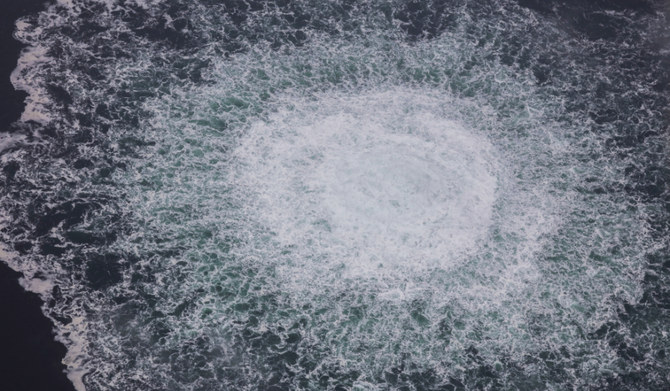
This handout photo taken on September 28, 2022 from an aircraft of the Swedish Coast Guard (Kustbevakningen) shows the release of gas emanating from a leak on the Nord Stream 1 gas pipeline, in the Swedish economic zone in the Baltic Sea. (AFP)
2 / 2
In this file photo taken on September 27, 2022 this handout picture released by the Danish Defence Command shows the gas leak at the Nord Stream 2 gas pipeline as it is seen from the Danish Defence's F-16 rejection response off the Danish Baltic island of Bornholm, south of Dueodde. (AFP)
Short Url
Updated 08 March 2023
Follow

Kremlin: Reports on Nord Stream attack ‘coordinated’ effort to divert attention

  • The United States and NATO have called the pipeline attacks ‘an act of sabotage’
  • Russia has blamed the West and called for an independent investigation

Media reports on the Nord Stream pipelines attacks are a coordinated effort to divert attention and the Kremlin is perplexed how US officials can assume anything about the attacks without investigation, the Kremlin said on Wednesday.

Intelligence reviewed by US officials indicates that a pro-Ukrainian group sabotaged the Nord Stream natural gas pipelines from Russia to Europe last September, but there was no evidence of Kyiv government involvement, the New York Times earlier reported.

The explosions seven months into the Russia-Ukraine war of underwater pipelines between Russia and Germany occurred in the exclusive economic zones of Sweden and Denmark in the Baltic Sea. Both countries have concluded the blasts were deliberate, but have not said who might be responsible.

“Obviously, the authors of the attack want to divert attention. Obviously, this is a coordinated stuffing in the media,” Kremlin spokesman Dmitry Peskov told the state RIA news agency.

“How can American officials assume anything without an investigation?”

Peskov also said that Nord Stream shareholder countries should insist on an urgent, transparent investigation.

“We are still not allowed in the investigation. Only a few days ago we received notes about this from the Danes and Swedes,” Peskov said.

“This is not just strange. It smells like a monstrous crime.”

The United States and NATO have called the pipeline attacks “an act of sabotage,” while Russia has blamed the West and called for an independent investigation. Neither side has provided evidence.

Tuesday’s New York Times report cited US officials as saying there was no evidence that Zelensky or his top aides were involved or that the perpetrators were acting at the behest of any Ukrainian government officials. No specific pro-Ukraine group was named as potentially responsible.

“Without a doubt, Ukraine is absolutely not involved in the excesses on the pipelines,” presidential aide Mykhailo Podolyak said in a statement. “It does not make the slightest bit of sense.”

Washington was waiting for investigations in Germany, Sweden and Denmark to conclude, White House spokesperson John Kirby said. Reuters could not independently verify the New York Times report.


Mystery of CIA’s lost nuclear device haunts Himalayan villagers 60 years on

Updated 56 min 44 sec ago
Follow

Mystery of CIA’s lost nuclear device haunts Himalayan villagers 60 years on

  • Plutonium-fueled spy system was meant to monitor China’s nuclear activity after 1964 atomic tests
  • Porter who took part in Nanda Devi mission warned family of ‘danger buried in snow’

NEW DELHI: Porters who helped American intelligence officers carry a nuclear spy system up the precarious slopes of Nanda Devi, India’s second-highest peak, returned home with stories that sent shockwaves through nearby villages, leaving many in fear that still holds six decades later.

A CIA team, working with India’s Intelligence Bureau, planned to install the device in the remote part of the Himalayas to monitor China, but a blizzard forced them to abandon the system before reaching the summit.

When they returned, the device was gone.

The spy system contained a large quantity of highly radioactive plutonium-238 — roughly a third of the amount used in the atomic bomb dropped by the US on the Japanese city of Nagasaki in the closing stages of the Second World War.

“The workers and porters who went with the CIA team in 1965 would tell the story of the nuclear device, and the villagers have been living in fear ever since,” said Narendra Rana from the Lata village near Nanda Devi’s peak.

His father, Dhan Singh Rana, was one of the porters who carried the device during the CIA’s mission in 1965.

“He told me there was a danger buried in the snow,” Rana said. “The villagers fear that as long as the device is buried in the snow, they are safe, but if it bursts, it will contaminate the air and water, and no one will be safe after that.”

During the Sino-Indian tensions in the 1960s, India cooperated with the US in surveillance after China conducted its first nuclear tests in 1964. The Nanda Devi mission was part of this cooperation and was classified for years. It only came under public scrutiny in 1978, when the story was broken by Outsider magazine.

The article caused an uproar in India, with lawmakers demanding the location of the nuclear device be revealed and calling for political accountability. The same year, then Prime Minister Morarji Desai set up a committee to assess whether nuclear material in the area near Nanda Devi could pollute the Ganges River, which originates there.

The Ganges is one of the world’s most crucial freshwater sources, with about 655 million people in India, Nepal, and Bangladesh depending on it for their essential needs.

The committee, chaired by prominent scientists, submitted its report a few months later, dismissing any cause for concerns, and establishing that even in the worst-case scenario of the device’s rupture, the river’s water would not be contaminated.

But for the villagers, the fear that the shell containing radioactive plutonium could break apart never goes away, and peace may only come once it is found.

Many believe the device, trapped within the glacier’s shifting ice, may have moved downhill over time.

Rana’s father told him that the device felt hot when it was carried, and he believed it might have melted its way into the glacier, remaining buried deep inside.

An imposing mass of rock and ice, Nanda Devi at 7,816 m is the second-highest mountain in India after Kangchenjunga. 

When a glacier near the mountain burst in 2021, claiming over 200 lives, scientists explained that the disaster was due to global warming, but in nearby villages the incident was initially blamed on a nuclear explosion.

“They feared the device had burst. Those rescuing people were afraid they might die from radiation,” Rana said. “If any noise is heard, if any smoke appears in the sky, we start fearing a leak from the nuclear device.”

The latent fear surfaces whenever natural disasters strike or media coverage puts the missing device back in the spotlight. Most recently, a New York Times article on the CIA mission’s 60th anniversary reignited the unease.

“The apprehensions are genuine. After 1965, Americans came twice to search for the device. The villagers accompanied them, but it could not be found, which remains a concern for the local community,” said Atul Soti, an environmentalist in Joshimath, Uttarakhand, about 50 km from Nanda Devi.

“People are worried. They have repeatedly sought answers from the government, but no clear response has been provided so far. Periodically, the villagers voice their concerns, and they need a definitive government statement on this issue.”

Despite repeated queries whenever media attention arises, Indian officials have not released detailed updates since the Desai-appointed committee submitted its findings.

“The government should issue a white paper to address people’s concerns. The white paper will make it clear about the status of the device, and whether leakage from the device could pollute the Ganges River,” Soti told Arab News.

“The government should be clear. If the government is not reacting, then it further reinforces the fear.”