61% Pakistanis have ‘good opinion’ of ex-PM Imran Khan, new Gallup survey says

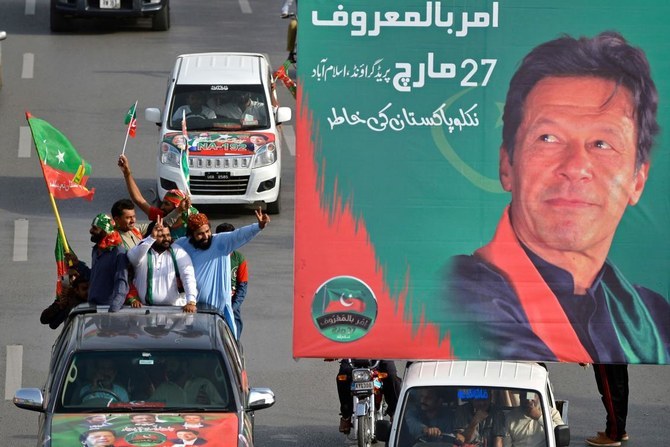
In this file photo, taken on March 27, 2022, supporters of the ruling Pakistan Tehreek-e-Insaf party arrive to attend a rally next to a billboard with a picture of Prime Minister Imran Khan in Islamabad. (Photo courtesy: AFP/File)
Short Url
Updated 07 March 2023
Follow

61% Pakistanis have ‘good opinion’ of ex-PM Imran Khan, new Gallup survey says

  • Coalition of Khan’s political opponents, the PDM, getting blamed for ongoing inflation and economic instability, survey says
  • 62 percent of Pakistanis say PDM rather than Khan’s PTI party to be blamed for current meltdown, Public Pulse report says

ISLAMABAD: Sixty-one percent of Pakistanis who were part of a recent countrywide survey said they have a “good opinion” of former prime minister Imran Khan, with the report further adding that a majority of Pakistanis blame his political opponents for Pakistan’s current economic crisis.

Khan, who was ousted from power last year following a no-trust move, has been campaigning for snap elections which are otherwise slated to take place later this year. The former premier, who claims he enjoys massive popularity across the country, has won a string of by-elections over the past couple of months against the ruling coalition government and its ally, the Pakistan Peoples Party (PPP).

As Khan ramps up his criticism of Pakistan’s powerful military and the coalition government, his speeches are banned from being broadcast in the country while he faces a slew of cases in various courts across the country.

Despite all this, respondents of the Gallup survey say Khan continues to be the most popular leader in the country.

“Imran Khan was positively rated with 61 percent of Pakistanis having a good opinion [of] him,” Gallup’s Public Pulse report said last week.

“At the second position [are] Nawaz Sharif and Bilawal Bhutto with 36 percent of Pakistanis having a good opinion about both of them.”

The survey report further revealed that the majority of the respondents blamed the ruling coalition government — the Pakistan Democratic Movement (PDM) — for Pakistan’s current economic crisis.

“62 percent of Pakistanis say they (PDM) rather than PTI (Khan’s Pakistan Tehreek-e-Insaf) is to be blamed for the current meltdown,” the report added.

The standoff between Khan and Sharif’s government has roiled Pakistan as it struggles to cope with rapidly declining reserves and a currency that has plummeted to historic lows against the US dollar. Islamabad is desperately trying to revive a stalled loan program with the International Monetary Fund (IMF) to save Pakistan from default.

Fifty-three percent of survey respondents from across Pakistan also said that if a new party, comprising “honest political members and technocrats” would be formed, they would stop supporting the party they currently support and vote for the new one instead.

In northern Pakistan, highest markhor trophy hunting permit fetches record $186,000

Updated 4 min 41 sec ago
Follow

In northern Pakistan, highest markhor trophy hunting permit fetches record $186,000

  • Gilgit-Baltistan has auctioned hunting permits for 104 endangered animals, including markhors, blue sheep and ibexes
  • Conservationists argue trophy hunting program in Pakistan prevents poaching and empowers local communities

KHAPLU, Gilgit-Baltistan: The Gilgit-Baltistan (GB) government’s wildlife department on Tuesday auctioned trophy hunting permits for 104 endangered animals, with the highest permit to hunt the Astor markhor fetching a record $186,000, a wildlife department official confirmed.
The enormous license fee to kill the rare markhor, a long-horned goat native to Pakistan and found in its snowy northern mountains, is one of the highest in the world. The trophy hunting program was first introduced by the region’s administration in GB’s Nagar Valley in 1990, attracting international hunters who have since been paying hundreds of thousands of dollars to target a limited number of wild animals in the area. The program was later extended to different areas of GB.
Trophy hunting is viewed worldwide as a controversial practice as it involves hunting of rare animals for sport and displaying their parts as trophies. Conservationists argue the trophy hunting program in northern Pakistan prevents poaching and empowers local communities. Markhors are usually found at heights of 8,000-11,000 feet, but during the winter months descend to between 5,000-6,000 feet, which is when the hunting season kicks off.
“We had four permits of markhors and the highest permit was auctioned today in the Kargah-Napura-Basin area [of GB] for $186,000,” Khadim Abbas, a conservator for GB’s wildlife department, told Arab News over the phone.
Officials say 80 percent of the money received from the trophy hunting program goes to local communities, who spend it on education, health and development projects. The trophy hunting season commences on November 1 and ends on April 25. For the 2023-2024 season, the GB government auctioned hunting permits for four Astor markhors, 12 blue sheep and 88 ibexes.
Abbas said the second-highest permit for hunting a markhor sold for $181,000, followed by another one worth $177,000. The conservator said eight international permits for blue sheep were also auctioned.
“The base value for the blue sheep [permit] was $9,000. However, the price for a single blue sheep [permit] has been recorded between $26,000 and $35,000,” he said.
For Pakistani hunters, the highest price a blue sheep permit fetched was Rs 1,800,000 ($6,440), he continued, adding that the highest rate for hunting an ibex fetched Rs 1,100,000 ($3,935).
Abbas confirmed that 80 percent of the amount collected through the permits would go to the local communities while the rest would be deposited in the national exchequer.
“Local communities use the money in the health and development sector,” he said. “They also provide scholarships to students and loans for needy members of the community in case of emergency or to start small businesses.”
Tariq Hussain, another wildlife department official, said last year the highest price fetched by a markhor hunting license was $165,000. He said the trophy hunting program was proving to be beneficial for GB’s locals.
“The trophy hunting program is spreading awareness among locals and they are playing their best role to control illegal hunting of wild animals in their areas,” Dr. Salar Ali, head of the Department of Environmental Science at the University of Baltistan, told Arab News.
He said before the trophy hunting program was launched by the government, locals were not aware of the benefits that endangered animals provided, adding that poaching activities were also on the rise then.
“Now, once they [locals] started to get income from this program, they are playing their role to protect these animals,” Ali said.


IMF team to visit Pakistan on Nov. 2 for first review of standby arrangement

Updated 25 October 2023
Follow

IMF team to visit Pakistan on Nov. 2 for first review of standby arrangement

  • Pakistan secured a $3 billion loan program in July that helped avert a sovereign debt default
  • The country is trying to navigate a tricky path to economic recovery under a caretaker setup

KARACHI: An International Monetary Fund (IMF) mission will visit Pakistan on Nov. 2 to discuss the first review of the country’s current $3 billion standby arrangement (SBA), the lender’s resident representative said on Tuesday.

The South Asian nation is trying to navigate a tricky path to economic recovery under a caretaker government in the wake of an IMF loan program, approved in July, that helped avert a sovereign debt default.

Under the program, Pakistan received $1.2 billion from the IMF as the first tranche in July.

“An International Monetary Fund team led by Mr. Nathan Porter will field a mission to Pakistan starting in November 2 on the first review under the current Stand-By Arrangement,” the IMF’s resident representative to Pakistan, Esther Perez Ruiz, told Reuters.


Pakistan asks UN Security Council to hold Israel accountable for ‘war crimes’ in Gaza

Updated 25 October 2023
Follow

Pakistan asks UN Security Council to hold Israel accountable for ‘war crimes’ in Gaza

  • Ambassador Munir Akram calls for ‘immediate and unconditional cease-fire,’ warning of wider and more dangerous conflict
  • The Pakistani envoy maintains resistance to foreign occupation cannot be described as terrorism under international law

ISLAMABAD: Pakistan criticized the United Nations Security Council (UNSC) for failing to seek an end to Israel’s Gaza airstrikes on Tuesday, asking its member states to hold all those responsible for committing “war crimes” in the area by targeting civilians and residential neighborhoods.
Israel besieged the Gaza Strip and launched airstrikes after a surprise attack initiated by Hamas on October 7 in retribution to the deteriorating condition of Palestinian people living under Israeli occupation.
According to the health ministry in Gaza, at least 5,791 Palestinians have so far been killed in the Israeli attacks.
Discussing the situation in the Middle East, Pakistan’s Permanent Representative to the United Nations Ambassador Munir Akram called for an immediate cease-fire to deescalate the conflict.
“The Israeli attacks on civilians, civilian objects and infrastructure, the blockade of water, fuel and food, as well as the forced transfer of people from the occupied territory are flagrant violations of international humanitarian law and amount to war crimes,” he told the UNSC. “Those responsible for these atrocity crimes must be held accountable.”
“Pakistan calls for an immediate and unconditional cease-fire,” he added. “The continuation of Israeli campaign in Gaza will lead to further massive civilian casualties and could trigger a wider and more dangerous conflict.”


Akram expressed Pakistan’s disappointment that the UNSC had not sought an end to the conflict, adding that those who were causing its continuation carried a heavy responsibility.
He also criticized those who described Palestinian resistance as terrorism.
“Any attempt to create a false equivalence between Israel, the occupying power, and Palestinians, the victims of this occupation, is untenable – legally, morally, and politically,” he continued. “Pakistan condemns terrorism in all its forms and manifestations. Yet, under international law, the struggle of people living under foreign occupation for self-determination and national liberation is legitimate and cannot be equated with terrorism.”
“It is the suppression of the struggle which is illegal,” he added.
Akram noted that colonial powers had always described resistance to their rule as terrorism.
He recognized the UN charter gave its members right to self-defense while pointing out that a state which was forcibly occupying a foreign territory could not invoke that principle against those whose territory it was occupying.
“The perpetuation of Israeli occupation will not bring peace to the Holy Land,” he said. “Durable peace will emerge from the internationally agreed two-state solution.”


Forced to leave Pakistan, Afghan nationals wary of what lies ahead in Afghanistan

Updated 21 min 16 sec ago
Follow

Forced to leave Pakistan, Afghan nationals wary of what lies ahead in Afghanistan

  • Many Afghan nationals born in Pakistan say they have never been to Afghanistan before
  • Pakistan has given illegal immigrants in the country till Nov. 1 to leave or face deportation

TORKHAM: As his family went to get their documents scanned at a center near Pakistan’s main border crossing with Afghanistan, Rehmatullah sat with their luggage inside a truck. Sipping tea and preoccupied with thoughts, he was one among many in Torkham waiting to cross the border into a land they had never called home: Afghanistan.

Hundreds of trucks carrying pieces of luggage of Afghan men, women and children were parked a few kilometers from the Torkham border in northwestern Pakistan’s Khyber district.

The border has been a busy one over the past few days, with many Afghan nationals using it to cross into Afghanistan since Pakistani authorities issued an ultimatum to illegal immigrants earlier this month: leave by Nov. 1 or face deportation.

That creates problems for many Afghans in Pakistan like Rehmatullah, 27, who have never been to Afghanistan. Born in Rawalpindi, he referred to Pakistan as his homeland.

“This is the first time in my life I’m going to Afghanistan, and that too because we are forced to,” he told Arab News. “Now, leaving here feels like I’m leaving my own village, my own country.”

Pakistan remains one of the world’s largest refugee host countries and has experienced multiple influxes of Afghan refugees. These span the period from the Soviet invasion of Afghanistan in 1979 to the Taliban takeover in 2021, after which some 600,000 Afghan refugees fled to Pakistan, according to the UN Refugee Agency. Before the Taliban takeover of Kabul, Pakistan was already hosting over 1.5 million Afghan refugees.

Rehmatullah’s family arrived in Pakistan around 48-49 years ago. A mechanic by profession, the Afghan national said his struggles in Pakistan have “gone to waste.”

“I have to go to Afghanistan and start a new life,” he lamented. “I have never been there before and I have no knowledge of the place.”

A recent surge in militancy and economic turmoil in Pakistan has made Islamabad wary of the presence of Afghan nationals in the country. Caretaker Interior Minister Sarfraz Bugti said earlier this month that of the 24 suicide blasts that have taken place in Pakistan since January, 14 were conducted by Afghans.

Pakistani authorities have clarified that only illegal immigrants, those without Afghan Citizen Cards (ACC) or Proof of Registration (PoR) documents, would be deported.

Rehmatullah, who neither possessed an ACC nor PoR card, said Afghan nationals who have legal documents allowing them to stay in Pakistan are also being targeted by authorities. 

“They raided people’s houses, and a couple of houses in our neighborhood,” Rehmatullah said. “They told people to evacuate and leave.

“For a person, nothing is more important than dignity, so we thought it’s better to leave with dignity.”

UN Refugee Agency spokesperson Qaiser Afridi said Afghan nationals who have PoR cards and voluntarily choose to leave Pakistan are first provided $375 per head. Later, after arriving in Afghanistan, each family is given $700 when they spend three to four months in the country.

“This is our voluntary repatriation process; this is how we facilitate the return of PoR card holders,” Afridi told Arab News. 

Afridi requested the Pakistani government to work on a “sustainable comprehensive mechanism” for Afghans who arrived in Pakistan after August 2021 and whose lives could be in danger if they returned to their country.

“Our stance is that the return should be voluntary, with dignity and with safety,” he said.

Muhammad Arif, 25, used to sell fresh fruit juices and milkshakes in the northwestern Pakistani city of Haripur. The Afghan national said he was compelled to leave after police and locals started harassing him and his family.

“The landlord told us to leave the house, claiming we didn’t have any documentation,” Arif told Arab News. “We showed the PoR cards we received in 2016.”

When he later went to Pakistan’s National Database and Registration Authority (NADRA), Arif was told his card had expired. 

Rehmatullah said he tried to obtain a Pakistani identity card as he was born here, adding that he did not want an Afghan Citizen Card.

“If I have to live here in Pakistan as an Afghan, then it’s better that I return to Afghanistan,” he said.


Pakistan, US discuss enhancing economic cooperation through bilateral trade, investment

Updated 25 October 2023
Follow

Pakistan, US discuss enhancing economic cooperation through bilateral trade, investment

  • Pakistan’s caretaker commerce minister holds virtual meeting with US Trade Representative Katherine Tai
  • Tai described Pakistan as an important trading partner of the US, says Pakistan’s commerce ministry

ISLAMABAD: Caretaker Commerce Minister Dr. Gohar Ejaz and US Trade Representative Ambassador Katherine Tai discussed enhancing economic cooperation between the two countries on Tuesday through bilateral trade and investment, Pakistan’s Ministry of Commerce said in a statement.

The two representatives held a virtual meeting to discuss progress made by both sides after the 9th Pakistan-United States Trade and Investment Framework Agreement (TIFA) Council meeting, which was held in February. The high-level trade talks between the two countries took place this year after a gap of seven years, with the last one taking place in Islamabad in 2016.

TIFA provides a forum for the two countries to discuss bilateral trade and investment, and explore access for Pakistani exports to the US market.

“Both sides agreed to work closely on the various bilateral trade and investment matters with the objective of enhancing the economic cooperation between Pakistan and the USA,” the commerce ministry said.

The photo shows Pakistan's Caretaker Commerce Minister Dr. Gohar Ejaz (right) and US Trade Representative Ambassador Katherine Tai holding a virtual meeting on October 24, 2023. (Photo courtesy: Ministry of Commerce)

Ejaz informed Tai of steps taken by the Pakistani government to improve the country’s business climate, the statement said. The minister also urged Tai to consider allowing duty free access of Pakistani textile and garments exports to the US, adding that Pakistan imports a major chunk of cotton from the US.

He urged Tai to explore a joint venture between the two countries in textile and industrial manufacturing to add value to bilateral trade between Washington and Islamabad, the statement added.

“Ambassador Tai highlighted the importance of Pakistan as an important trading partner of the US. and acknowledged that the continuous engagement between both countries is always encouraging,” the commerce ministry said.

Once close allies, Islamabad’s and Washington’s ties deteriorated over the years mostly due to concerns about Pakistan’s alleged support to the Taliban in Afghanistan. Islamabad vehemently denies sheltering the Taliban in sanctuaries, something Washington has always regarded with suspicion.

Relations between the two countries further deteriorated when former prime minister Imran Khan last year accused Washington of having a hand in his ouster. Khan alleged the US colluded with his political rivals and Pakistan’s army last year in what he said was a “foreign conspiracy” to remove him from power. Khan said Washington had decided to oust him since his administration was forging closer ties with Russia. Washington and Pakistan’s army have both denied Khan’s allegations.