

AI will have its day in court — but human judges will always rule

The Legal Dimension of Artificial Intelligence (AI) is the third session theme of the International Conference on Justice, which is held at the Ritz Carlton in Riyadh. (Twitter @MojKsa)
Short Url
Updated 06 March 2023
Follow

AI will have its day in court — but human judges will always rule

  • Tech experts discuss pros and cons of using artificial intelligence in legal systems during Riyadh conference

RIYADH: Artificial intelligence could soon become a useful tool in courts but the world is a long way from algorithms passing judgment on humans, experts have said during an event in Riyadh.

Experts at the International Conference on Justice, at the Ritz Carlton, discussed how the technology can be applied safely during a debate titled the “Legal Dimension of Artificial Intelligence.”

Andrea Isoni, Director of the AI Technologies consultancy, told Arab News that there were many ways that it could be of benefit, but there are pitfalls to consider.


Lawrence Lessig, Professor of Law and Leadership at Harvard Law School. (Twitter @MojKsa)

“Preparation of documents, reading information from documents because those require a lot of reading, and extracting information from documents. All these processes are low-level security issues that (could) use the efficiency of AI,” he said.  

“The body of law is not ready yet to allow AI to judge people. Even in exams, if an AI scores you, then who is responsible? It is the same with the law and judging in court.

“Even if the technology is ready, the body of law needs to change substantially to determine who’s responsible. Someone has to be responsible if the AI goes wrong.”


Professor Ryan Abbott of the University of Surrey. (Twitter @MojKsa)

Isoni, who is also his consultancy’s Chief AI Officer, said that many countries’ judicial systems should look at AI to speed up court procedures.

In the session, speakers discussed the benefits and challenges of using AI in law.  

Lawrence Lessig, Professor of Law and Leadership at Harvard Law School, referenced an AI in California that had gathered enough legal knowledge to pass the state’s bar exam.  
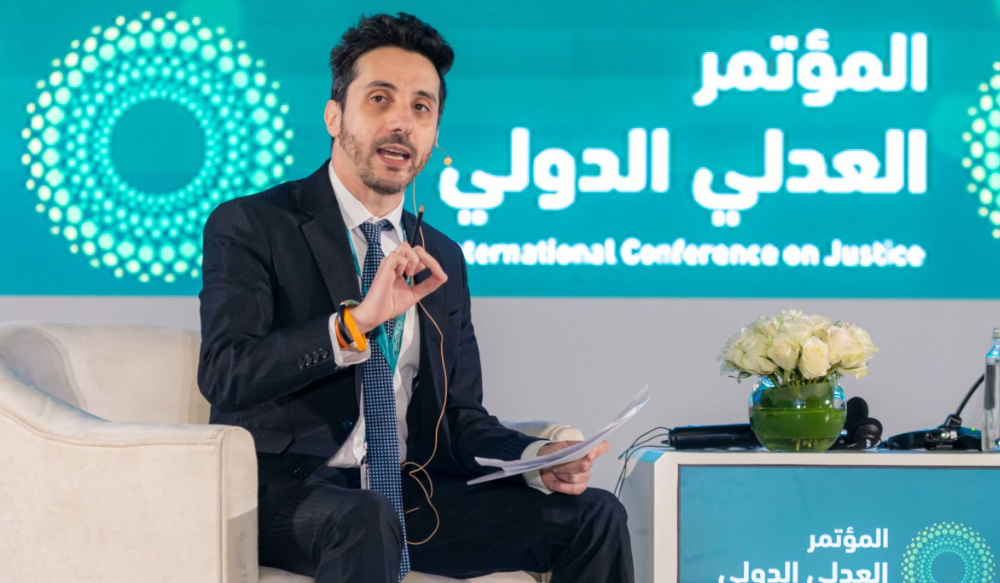


The session was moderated by Andrea Isoni, Director and Chief Ai Officer at AI Technologies. (Twitter @MojKsa)

“In 10 years, this technology will make possible the automation of what I think, 75 percent of what lawyers do. The most important thing for us to do now is to make sure that humans retain control,” he said.

“The system, though it will automate the vast majority of what lawyers do, (must) preserve a role for judgment and justice and an opportunity for those who are wronged by the technology to right those wrongs.”

Christopher Markou, a PhD candidate in the Faculty of Law at the University of Cambridge, believes that AI may know the letter of the law but cannot capture its “spirit.”

“The spirit of the law is really something mushy and in a gray area. The part that requires interpretation, that requires a cultured individual to be able to help make sense of what this rule not just said, but what it really is meant to do or achieve in society,” Markou told the audience.

Professor Ryan Abbott of the University of Surrey said that governments must consider proper regulation of AI.

“You might have an AI that could give an equally good answer to a question as a human being, and we will have to address how the regulatory system should deal with that,” said Abbott.

“When the law treats people and machines differently in terms of their behavior, it sometimes has negative outcomes for human beings and social wellbeing.”

Anupam Chander, Scott K Ginsburg Professor of Law at Georgetown University Law Center, warned that it had been shown that machine-learning AI is prone to exacerbate biases already prevalent in society due to the material it learns from.  

He cited the example of Amazon’s AI hiring system, which the company later scrapped because it had learned to favor male applicants due to the material it had been fed.

“The AI was favoring men over women, and the reason was, it has been fed ten years of data of past residents which were heavily male and therefore not properly representing the characteristics that women might bring to the table.”

Abbott said AI has progressed in many areas, such as language and making music and art, but the law slipped into a gray area if an AI invents new technology without human interaction.

“If an invention does not have a human inventory, it cannot be patented,” Abbott said. “So, if a drug company could use a very sophisticated AI to find a new treatment for COVID, they could not get a patent on that drug, and they would not have the right incentives to commercialize,” he said.

So far, patent applications have been accepted in Saudi Arabia and South Africa and in pending status in some countries.  

“The Ministry of justice here and that regulators around the world are going to have to consider. What do we do when machines behave like people and how do we encourage machines to behave in ways that are socially useful?” Abbott added.


Prince William’s visit signals ‘importance of relationship with Saudi Arabia to UK,’ ex-envoy tells Arab News

Updated 4 sec ago
Follow

Prince William’s visit signals ‘importance of relationship with Saudi Arabia to UK,’ ex-envoy tells Arab News

  • Simon Collis: ‘Saudi Arabia is the most significant Arab country, the most significant regional country, but it’s also a global power’
  • Ties between the royal families are ‘almost 100 years old’ and run at a ‘longer wavelength than the day-to-day politics’

LONDON: Prince William’s three-day visit to Saudi Arabia this week reflects deep British interest in the “expectation of an important future” with the Kingdom, a former ambassador told Arab News on Monday.

Ties between the two royal families are “almost 100 years old, and it’s the kind of relationship that runs at a sort of deeper and longer wavelength than the day-to-day politics,” said Simon Collis, ambassador to Saudi Arabia from 2015 to 2020.

“Prince William’s grandmother, the late Queen Elizabeth, visited Saudi Arabia and hosted several of the kings of Saudi Arabia on their state visits to the UK.

“King Charles, as prince of Wales, visited Saudi Arabia many times — over a dozen times — and actually his last visit came shortly after I arrived in Riyadh as ambassador.

“When Crown Prince Mohammed bin Salman visited London in 2018, he had lunch with the queen, the late queen, and dinner, and that was at Buckingham Palace. He had dinner at Clarence House with Charles as prince of Wales, and William was there at that dinner.”

Similarities between the two heirs apparent on a personal level could also spur deeper diplomatic ties, Collis said.

“They have a lot in common: environmental interests, green energy interests, a lot of the things that have expanded in Saudi Arabia over the last 10 years in particular … as the economic transformation has moved forward under Vision 2030,” he added.

“So, areas like the core (interests), which were always there — these issues like defense, security, and energy — but what has opened up as a result of the changes in Saudi Arabia much more are other areas like education, culture, healthcare, environmental issues, heritage, sports ... all of these kind of soft power issues.”

Since King Salman assumed the throne in 2015, more than a dozen UK prime ministers and foreign secretaries have come and gone, Collis said, highlighting the “continuity” that William’s royal status can bring to the bilateral relationship.

“Links between the royal families are something special, and the fact that the prince of Wales is now visiting at the request of the British government clearly sends a signal of the importance of the relationship with Saudi Arabia to the UK,” he added.

Through a little-known government body, the Royal Visits Committee, William will have been briefed on the nature of the British-Saudi relationship, and how he can use his royal leverage to develop ties with a “priority” partner, Collis said.

“All official visits by members of the British royal family involve advice from the government about the priorities.”

The RVC meets and brings together No. 10, the Foreign Office and other relevant government departments with the staff at Buckingham Palace and the other royal households.

“They review together the countries that have been visited recently, both inward and outward visits: What are the countries that are a priority for a visit? Prince William hasn’t made a lot of these visits yet … King Charles was taking the lead on that for a long time,” Collis said.

“It’s not surprising that Saudi Arabia was seen as a priority for an early visit by Prince William as prince of Wales,” he added.

“The decision to prioritize the Kingdom for a visit reflects the overall bilateral importance to each other, the regional significance of Saudi Arabia and its position as a global player, increasingly so as Vision 2030 moves forward and as the country opens up,” Collis said.

“Saudi Arabia is the most significant Arab country, the most significant regional country, but it’s also a global power; it’s one of what people call the middle powers.

“Its views — not just on regional issues but on the global agenda, climate change, security, all of these global issues — matter.”

The pace of change in Saudi Arabia is so fast that Western observers are still playing catch-up, Collis said.

The direction of travel between the two countries means that although differences in traditions may exist, “values have certainly become closer than they were historically,” he added.

“When I arrived here (in 2015), there were religious police still on the streets, music in public places was banned and women were under the guardianship system ... The Western headline was always ‘they can’t drive.’ Women couldn’t travel, they couldn’t get a job, they couldn’t even access healthcare without the approval of a male guardian.

“Under the leadership of King Salman and of the crown prince, all of that has changed; it’s been completely transformed.”

The individual and personal nature of the visit presents an opportunity to help the two peoples develop their mutual interests, Collis said, highlighting the popularity of the UK as a destination for Saudi university students.

“You (also) see that in the growing number of British companies entering Riyadh, putting their regional headquarters in Riyadh,” he added.

“You can see that movement happening in so many ways across so many sectors. I think this visit is an opportunity to recognize, celebrate and draw attention to all of that.”