‘Aurat Azadi Jalsa’ in Islamabad calls for rehabilitation, economic justice for women hit by last year's floods

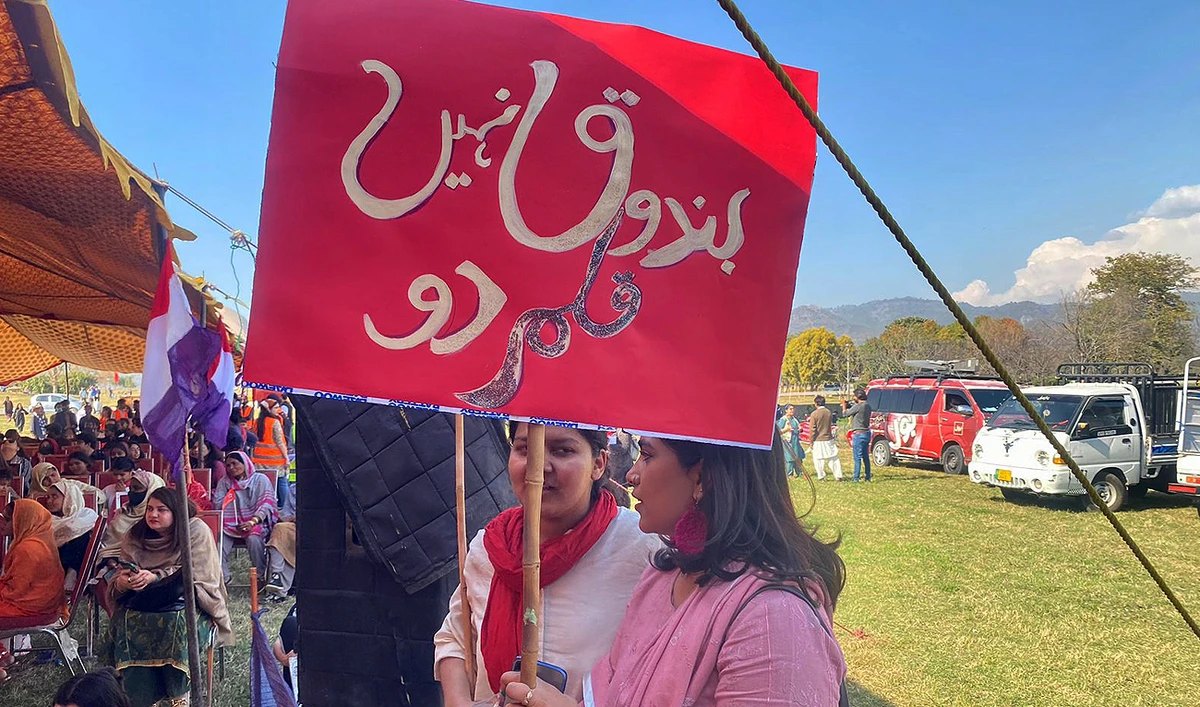
Activists of "Aurat Azadi March" carry placards during a gathering in Islamabad, Pakistan, on March 5, 2023. (AN Photo)
Short Url
Updated 05 March 2023
Follow

‘Aurat Azadi Jalsa’ in Islamabad calls for rehabilitation, economic justice for women hit by last year's floods

  • Students, women, men, and civil society members gather at Islamabad's largest park to demand economic justice
  • Participants call for rehabilitation of flood-affected families, regularization of shanty houses to empower women

ISLAMABAD: Women activists demanded economic justice and rehabilitation for victims of last year's devastating floods at Islamabad's largest capital on Sunday, calling for an end to patriarchal violence and femicide in areas affected by militancy.

Cataclysmic floods last year, triggered by unusually heavy rains in the monsoon season, displaced over 33 million people in Pakistan and left over 1,700 dead. Millions of homes and critical infrastructure were destroyed, as Pakistan estimated damages to be over $30 billion.

In commemoration of the 113th International Working Women's Day, the socialist-feminist movement Women Democratic Front (WDF) and the Aurat Azadi March (AAM) organized a gathering titled "Aurat Azadi Jalsa" at the Fatima Jinnah Park in Islamabad.

The gathering was attended by women activists, domestic workers, students, trade unions, lawyers, and political organizations who identify with progressive ideologies. AAM [Women's Independence March] was established in Islamabad in 2018, and the WDF has been organizing it in all provinces for the past five years.

“Our theme for this year is restoring the economy, [rehabilitating] flood affectees, and peace which is also very important for the women as all these points directly impacted women's lives,” Ismat Raza Shahjahan, WDF president and one of the organizers, told Arab News.
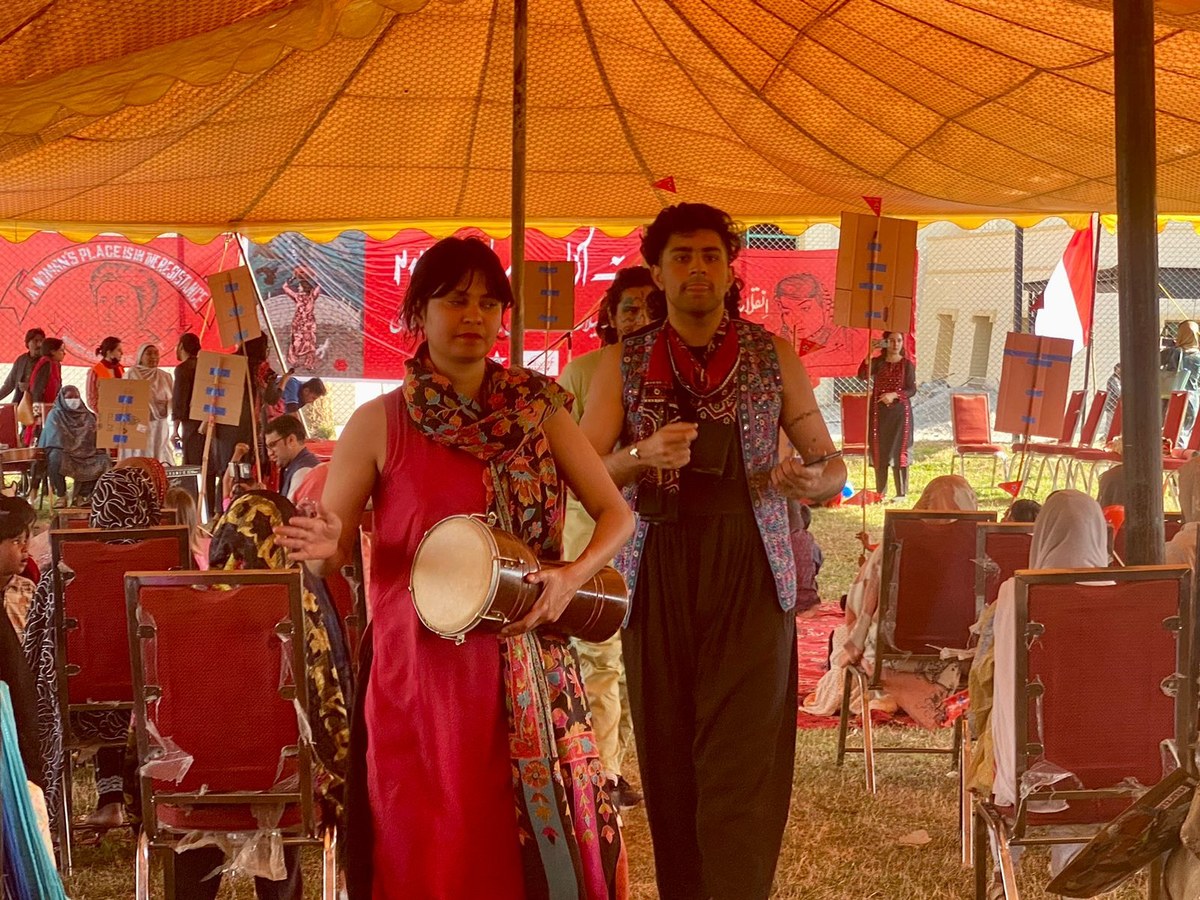


"Aurat Azadi March" member beats the drum during the event in Islamabad, Pakistan, on March 5, 2023. (AN Photo)

She said it was important to celebrate this day in Pakistan as many anti-feminist forces — without elaborating who — were active in Pakistan. Shahjahan said societies cannot progress without free education and healthcare for all, demanding an end to privatization and huge subsidies for the elite.

Many women held placards in their hands as they chanted slogans calling for economic justice and equality of the sexes.

Gulzar Begum, leader of the All Katchi Abadi Alliance, called for the regularization of all Kachi Abadis (shanty houses) and villages where people from war-torn areas, feudal heartlands, and poverty-stricken villages take refuge.

“Our kachi abadis are not only drowned in floods but also [in] the sea of inflation,” she said, demanding a decrease in the price of basic commodities. Begum also called for urban land reforms to create housing spaces for the working class.
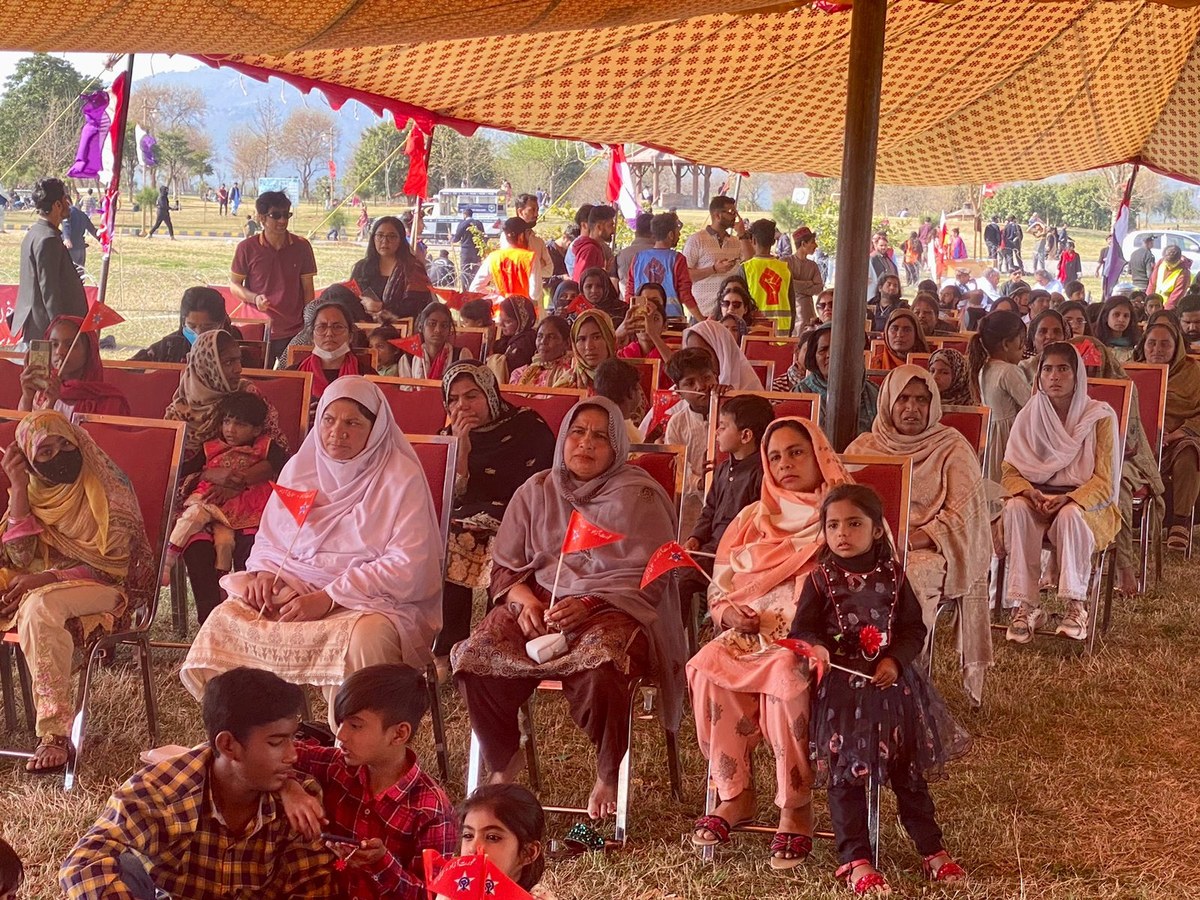


Women from kachi abadis (shanty houses or slums) participate in "Aurat Azadi March" gathering to demand regularisation of their colonies in Islamabad, Pakistan, on March 5, 2023. (AN Photo)

Fatima Shehzad, general secretary of the Progressive Student Federation, said women were especially affected by the deluges as they were now homeless which spiked the dangers of violence against women and sexual crimes.

“Our main demand is to rehabilitate such women and empower them by providing employment or resources to earn so that is why we came to support this theme in this gathering today,” she told Arab News.

Farman Ali, information secretary of the Awami Workers Party, said it was not only women’s responsibility to speak against injustices towards women, but rather men should also speak up.

“Women are our mothers, sisters, wives, and colleagues so I came here to support them and their right to get equal opportunities in society,” he told Arab News.

Working women had to work twice more, he said, adding that after coming home from a hard day's work, they had to do household chores and received little support from society and their in-laws.

“Therefore, sane voices in men also feel it and support them in this patriarchal society,” Ali added.
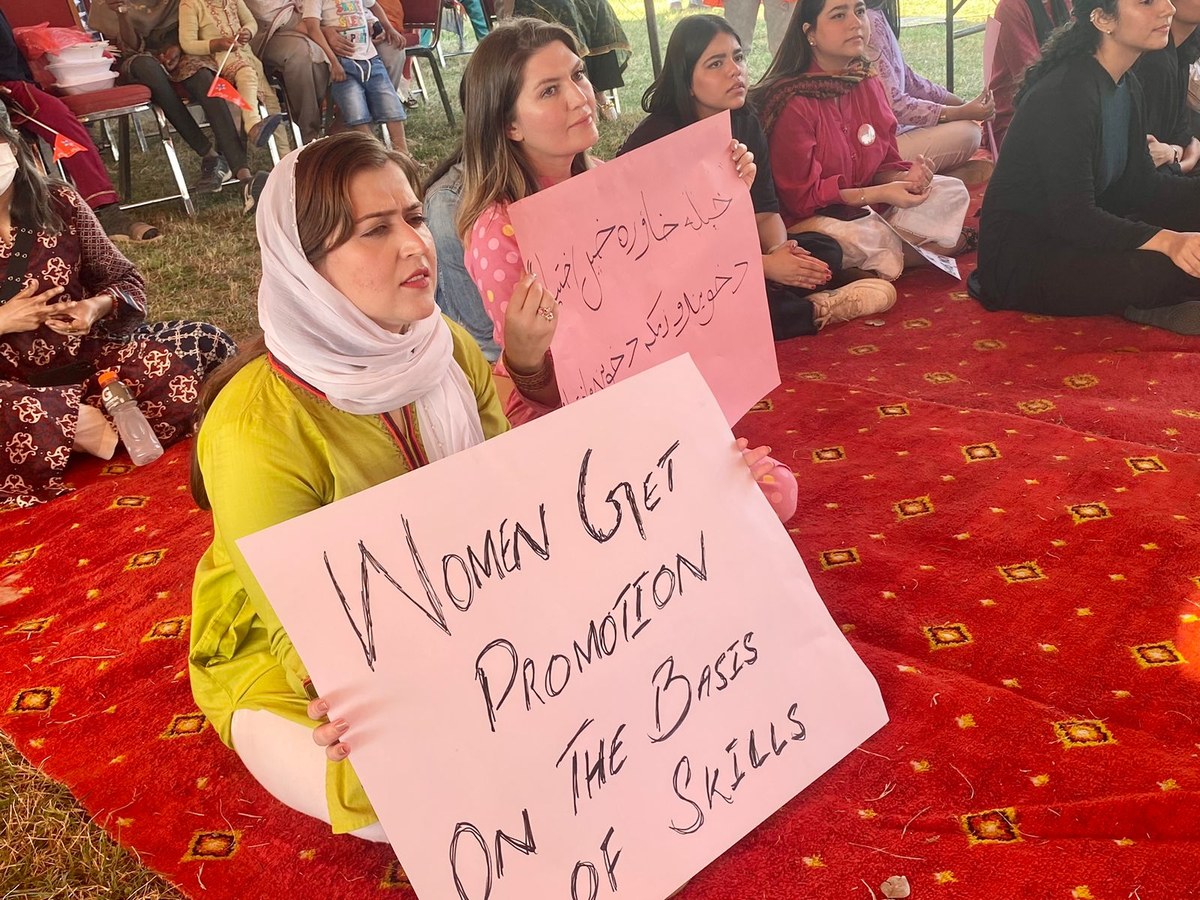
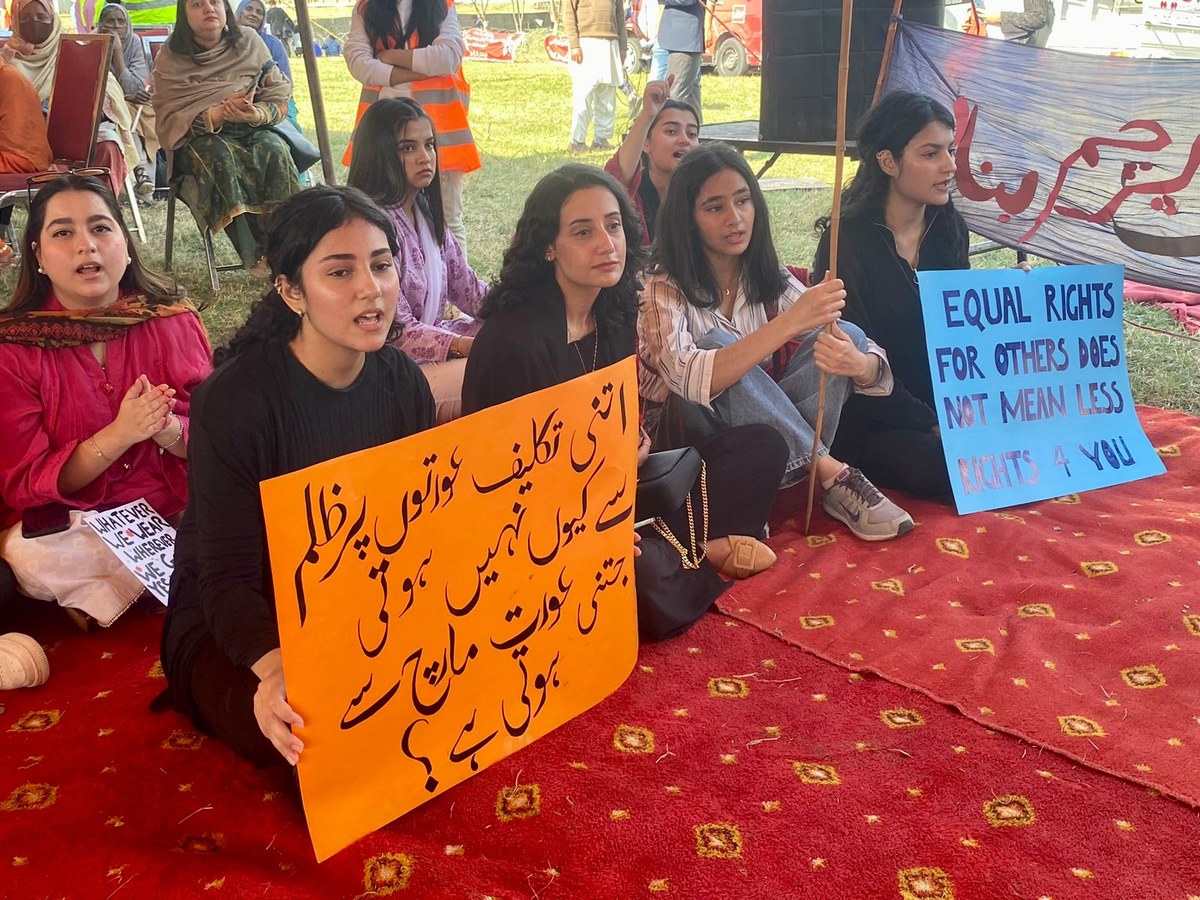
Activists of "Aurat Azadi March" carry placards during a gathering in Islamabad, Pakistan, on March 5, 2023. (AN Photo)


Activists of "Aurat Azadi March" carry placards during a gathering in Islamabad, Pakistan, on March 5, 2023. (AN Photo)


Islamabad says surge in aircraft orders after India standoff could end IMF reliance

Updated 06 January 2026
Follow

Islamabad says surge in aircraft orders after India standoff could end IMF reliance

  • Pakistani jets came into the limelight after Islamabad claimed to have shot down six Indian aircraft during a standoff in May last year
  • Many countries have since stepped up engagement with Pakistan, while others have proposed learning from PAF’s multi-domain capabilities

ISLAMABAD: Defense Minister Khawaja Asif on Tuesday said Pakistan has witnessed a surge in aircraft orders after a four-day military standoff with India last year and, if materialized, they could end the country’s reliance on the International Monetary Fund (IMF).

The statement came hours after a high-level Bangladeshi defense delegation met Pakistan’s Air Chief Marshal Zaheer Ahmed Baber Sidhu to discuss a potential sale of JF-17 Thunder aircraft, a multi-role fighter jointly developed by China and Pakistan that has become the backbone of the Pakistan Air Force (PAF) over the past decade.

Fighter jets used by Pakistan came into the limelight after Islamabad claimed to have shot down six Indian aircraft, including French-made Rafale jets, during the military conflict with India in May last year. India acknowledged losses in the aerial combat but did not specify a number.

Many countries have since stepped up defense engagement with Pakistan, while delegations from multiple other nations have proposed learning from Pakistan Air Force’s multi-domain air warfare capabilities that successfully advanced Chinese military technology performs against Western hardware.

“Right now, the number of orders we are receiving after reaching this point is significant because our aircraft have been tested,” Defense Minister Asif told a Pakistan’s Geo News channel.

“We are receiving those orders, and it is possible that after six months we may not even need the IMF.”

Pakistan markets the Chinese co-developed JF-17 as a lower-cost multi-role fighter and has positioned itself as a supplier able to offer aircraft, training and maintenance outside Western supply chains.

“I am saying this to you with full confidence,” Asif continued. “If, after six months, all these orders materialize, we will not need the IMF.”

Pakistan has repeatedly turned to the IMF for financial assistance to stabilize its economy. These loans come with strict conditions including fiscal reforms, subsidy cuts and measures to increase revenue that Pakistan must implement to secure disbursements.

In Sept. 2024, the IMF approved a $7 billion bailout for Pakistan under its Extended Fund Facility (EFF) program and a separate $1.4 billion loan under its climate resilience fund in May 2025, aimed at strengthening the country’s economic and climate resilience.

Pakistan has long been striving to expand defense exports by leveraging its decades of counter-insurgency experience and a domestic industry that produces aircraft, armored vehicles, munitions and other equipment.

The South Asian country reached a deal worth over $4 billion to sell military equipment to the Libyan National Army, Reuters report last month, citing Pakistani officials. The deal, one of Pakistan’s largest-ever weapons sales, included the sale of 16 JF-17 fighter jets and 12 Super Mushak trainer aircraft for basic pilot training.