

Christie’s launches the Art+Tech summit at Art Dubai 

All three panelists showed enthusiasm for the digitization of art. (Instagram)
Short Url
Updated 03 March 2023
Follow

Christie’s launches the Art+Tech summit at Art Dubai 

DUBAI: On the second day of Art Dubai, renowned auction house Christie’s launched the Art+Tech summit, inviting international speakers to dive into a hot topic of the contemporary art world — the intersection of art and ever-evolving technology. The fair itself is running for the second time its Digital section, presenting non-fungible tokens and video art by artists from the US, the Middle East, Asia and Europe.

One of the discussions at the summit, entitled “The Role of Technology in the Lives of Creatives: Collecting, Curating and Creating,” invited three panelists to discuss the impact of technology on art: generative art collector AC; Lukas Amacher, the managing director of 1of1 Collection Gallery; and Turkish-American artist Refik Anadol, who is showcasing at the fair his artificial intelligence-generated immersive room video installation, “Glacier Dreams.”

Embracing the new, all three panelists showed enthusiasm for the digitization of art. 

“This is kind of a new era, where collecting and creating (have) evolved. I’ve never seen another better period,” said AC to the audience.

Amacher pointed out its controversial aspect, weighing it against traditional and physical art. “It feels that the art world – the world in general – is kind of divided,” he said. “There’s the fraction that doesn’t pay attention, and then there’s the fraction that is generally curious and generally interested in what could be.”
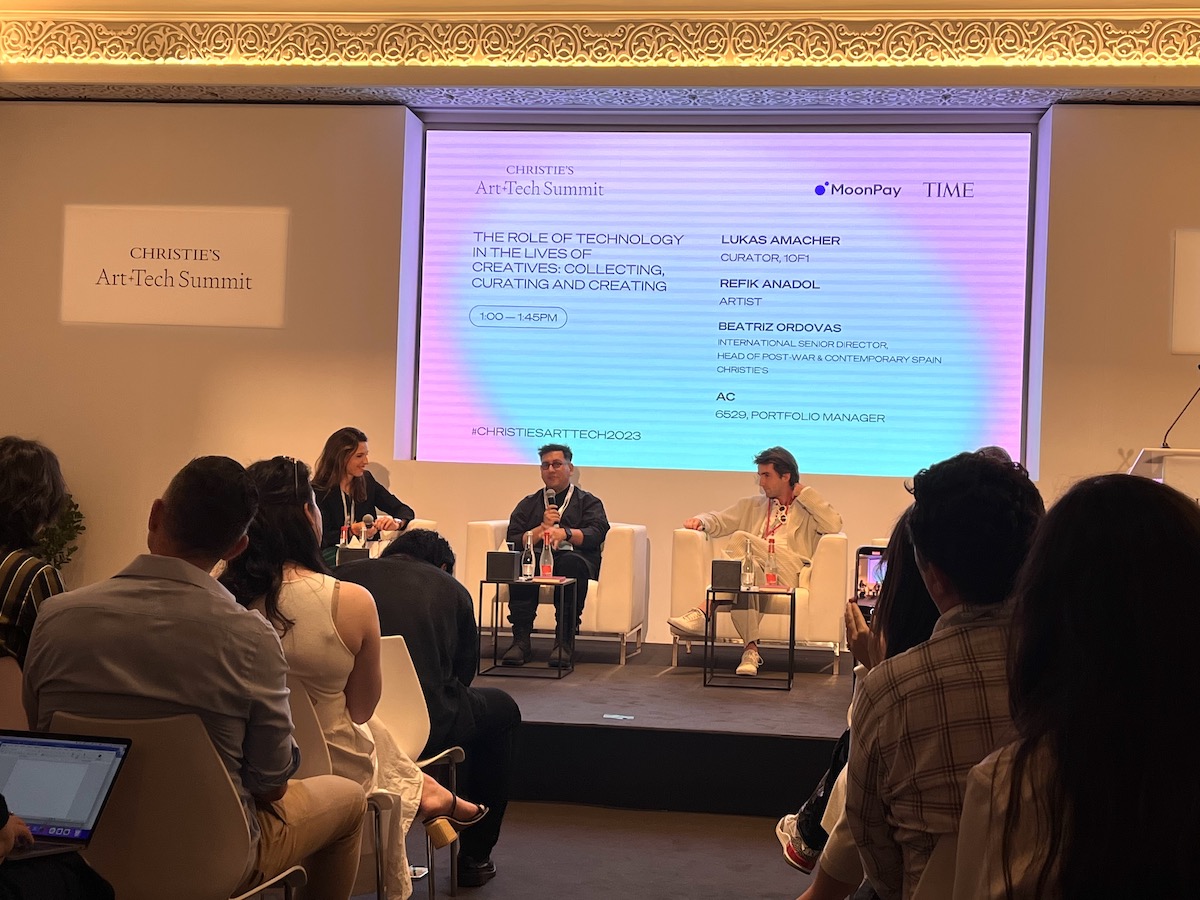


One of the discussions at the summit was entitled “The Role of Technology in the Lives of Creatives: Collecting, Curating and Creating.” (Supplied)

He made a point of how digitization has revolutionized access to art. “The fact that we all have mini computer screens in our pockets that we carry around — and that it has surface area and accessibility to all kinds of artwork everywhere — that is what excites me, that I have a museum in my pocket,” he added. 

Anadol wowed the audience with his video presentation, showing his digital art projected on the facade of the iconic Casa Batlló (designed by Antoni Gaudí) in Barcelona, watched by thousands of people in the city. He concluded the talk with his advice for digital artists, who might meet resistance along their journey.

“You will always find people who are skeptical,” he said. If artists face rejection, it is likely that they are “making something new…(and) opening doors for new people and new generations.”


Lebanese filmmaker turns archival footage into a love letter to Beirut

Updated 28 February 2026
Follow

Lebanese filmmaker turns archival footage into a love letter to Beirut

LONDON: Lebanese filmmaker Lana Daher’s debut feature “Do You Love Me” is a love letter of sorts to Beirut, composed entirely of archival material spanning seven decades across film, television, home videos and photography.

The film premiered at the 82nd Venice International Film Festival in September and has since traveled to several regional and international festivals.

Pink Smoke (2020) by Ben Hubbard. (Supplied)

With minimal dialogue, the film relies heavily on image and sound to reconstruct Lebanon’s fragmented history.

“By resisting voiceover and autobiography, I feel like I had to trust the image and the shared emotional landscape of these archives to carry the meaning,” Daher said.

A Suspended Life (Ghazal el-Banat) (1985) by Jocelyne Saab. (Supplied)

She explained that in a city like Beirut “where trauma is rarely private,” the socio-political context becomes the atmosphere of the film, with personal memory expanding into a collective experience — “a shared terrain of emotional history.”

Daher said: “By using the accumulated visual representations of Beirut, I was, in a way, rewriting my own representation of home through images that already existed."

Whispers (1980) by Maroun Bagdadi. (Supplied)

Daher, with editor Qutaiba Barhamji, steered clear of long sequences, preferring individual shots that allowed them to “reassemble meaning” while maintaining the integrity of their own work and respecting the original material, she explained.

The film does not feature a voice-over, an intentional decision that influenced the use of sound, music, and silence.

The Boombox (1995) by Fouad Elkoury. (Supplied)

“By resisting the urge to fill every space with dialogue or score, we created room for discomfort,” Daher said, adding that silence allows the audience to sit with the image and enter its emotional space rather than being guided too explicitly.

 The film was a labor of love, challenging Daher personally and professionally.

“When you draw from personal memory, you’re not just directing scenes, you’re revisiting parts of yourself and your childhood,” she said. “There’s vulnerability in that.”