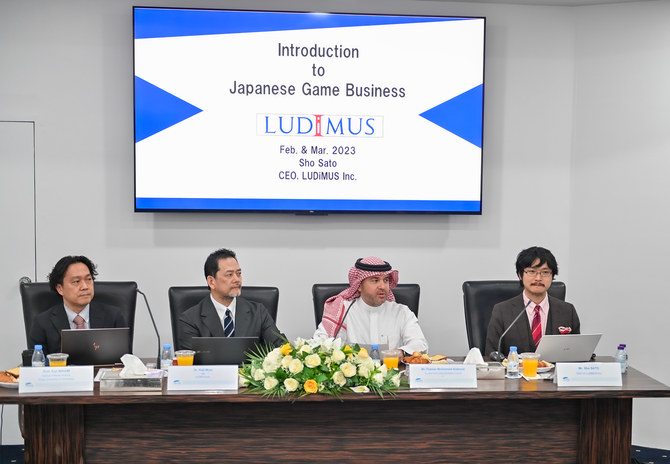
JEDDAH: A seminar was conducted on Wednesday at the Jeddah Chamber of Commerce and Industry headquarters to discuss business opportunities in the gaming industry.
Held in collaboration with the Japanese Consulate and Japan Cooperation Center for the Middle East, the event was attended by Izuru Shimmura, the consul-general of Japan; Thamir Al-Abood, representative of the Tourism and Culture Committee in Jeddah Chamber; as well as representatives from the Jeddah Chamber, students, and members of the media.
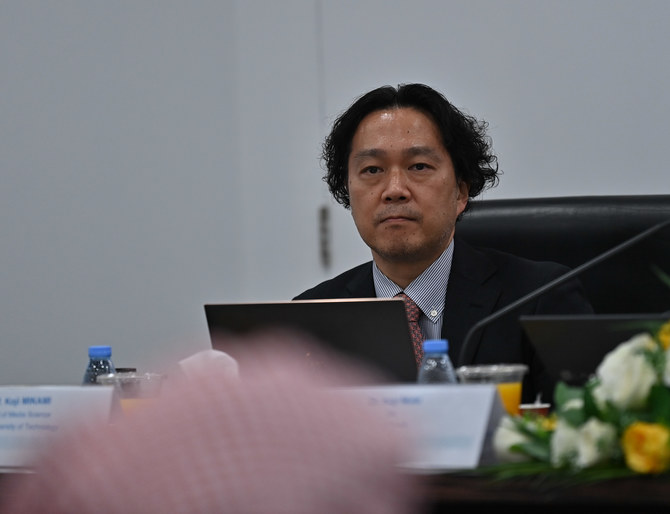
Presented by Koji Mikami, professor of media science at Tokyo University of Technology, and Sho Sato, CEO of LUDiMUS, the seminar discussed Japanese gaming industry trends between 2022 and 2023.
For more than 10 years, Sato worked as a researcher in emerging game markets and industries like ASEAN, MENA, and LATAM, reporting updated information to Japanese game platforms and publishers.
He said that in a recent study by GameAGE, “(the) Steam market in Japan is around $347.6 million, similar market size to Canada in 2022.”
In a comparison between console and PC game sales ranking in 2022, the top games were “Pokemon Scarlet” and “Pokemon Violet,” published by Pokemon in Japan, “FIFA 23” published by Electronic Arts in Germany, and “Call of Duty: Modern Warfare II” published by Activision Blizzard in the US.
Sato also previewed a comparison of the 2022 top three Steam sales, with the US at $3.8 billion, Germany $513 million, and Japan $400 million.
Steam user volume worldwide this January was also previewed, with the biggest percentage being games in English, at 36.87 percent, while Japanese language games ranked eighth with just 2.18 percent.
Sato explained that despite its comparatively small PC game market and language barrier, the Japanese indie game market was expanding rapidly for international game developers.
“Since the greater part of Japanese fans, developers, publishers, and even media cannot read English, localization is an essential factor to enter the market,” Sato said.
“The Japanese market is a top priority of Japanese game companies, and they’ve delegated the MENA market to European subsidiaries (like SIEE) or regional traders. However, because of investment by Misk and PIF and growing market trends in emerging countries, they get more interested in the Saudi market.”
According to Statista.com, the most followed game for e-sports in Saudi Arabia in 2022 was “FIFA” at about 38 percent, followed by “Call of Duty” at about 27 percent, while “Apax Legends” ranked last with 13 percent, despite ranking third in Japan during both 2022 and 2023 for the best sales of PC online games.
Recently, Saudi Arabia’s sovereign wealth fund has increased its stake in Japanese video game developing company Nintendo to 7.1 percent according to a bourse filing.
It was in May 2022 that the Public Investment Fund acquired a 5 percent stake in Nintendo, and in January 2023 it increased that to 6.07 percent in line with the Kingdom’s Vision 2030 goal to emerge as a global hub in the gaming industry.
Nintendo is one of the most prominent names in the global video games industry, with a portfolio of titles including “Pokemon,” “The Legend of Zelda,” and “Mario.”
The PIF also has stakes in noted video game companies Nexon, Capcom, and Koei Tecmo.
Saudi Arabia is aiming to become a global gaming hub, and the most crucial step to achieve this mission was made in September 2022, as Crown Prince Mohammed bin Salman launched the Savvy Games Group’s strategy.
Although the gaming industry is full of investment and development opportunities, Mikami explained the significance of collaboration between the gaming industry and academia create health and awareness solutions.
“The gaming industry needs to build good relations with society, as problems may arise that need to be solved, and these problems need to be addressed based on scientific knowledge,” he said.
Mikami, who is a researcher and developer of 2D and 3D animation as well as games and interactive content, shared his insights with Arab News from an academic point of view and explained the notable growth of the gaming industry in the Kingdom. He also highlighted the importance of involving the culture of the country when it comes to elevating in game developing industry.
“I see many students from Saudi Arabia who are very interested in gaming, not only playing but also developing games. They are very eager to develop their original games.
“Most of the games in Saudi Arabia are from China or (South) Korea, however the smartphone base game and console games are from Japan — the collaboration is on how to find your original game, or how to import foreign games. If you really want to generate a Saudi type of game, the younger game developers are playing a significant role.
“To generate a Saudi game, I recommend playing a lot of types, not only Japanese games, but also Korean, China, European, and American, as maybe this experience will expand the sense of the game within the developers,” he said.
“I really want to develop a game which is very original for Saudi Arabia, because the game is kind of a medium that concentrates on many people, in this case, the game tamer and concept and also the style of the expression depends on the culture.
“So if the Saudi Arabian culture, has a part in the games, then I want to play because I can already experience gaming in Japan, but I couldn’t experience the Saudi Arabian game. So if you developed a nice game, I want to try this is the same as motion pictures or other manga or other industries.
“Sometimes if you concentrate on your own culture, maybe other people from other cultures would be interested in these types of things. Now our collaboration will be on how to develop the existing Japanese game and why not Saudi developers create quite original games,” he said.
Mikami explained that the latest technology trends and future projections in the gaming field are important for the industry-academia collaboration, and cooperation with other industries.
“It is important for society to have a positive impression of the game industry and to realize the relationship that attracts human resources and technology,” he added.
Shimmura said in the concluding remarks: “Japan is one of the most advanced countries in the gaming industry, and it is ready to share it experience with Saudi Arabia for the benefit of its people in general and young ones in particular.”


![]()
![]()

Japanese gaming experts discuss the industry and its opportunities
Short Url
https://arab.news/ceg4p
Japanese gaming experts discuss the industry and its opportunities
- For more than 10 years, Sato worked as a researcher in emerging game markets and industries like ASEAN, MENA, and LATAM
- Sato also previewed a comparison of the 2022 top three Steam sales, with the US at $3.8 billion, Germany $513 million, and Japan $400 million


Latest updates


Recommended


© 2026 SAUDI RESEARCH & PUBLISHING COMPANY, All Rights Reserved And subject to Terms of Use Agreement.