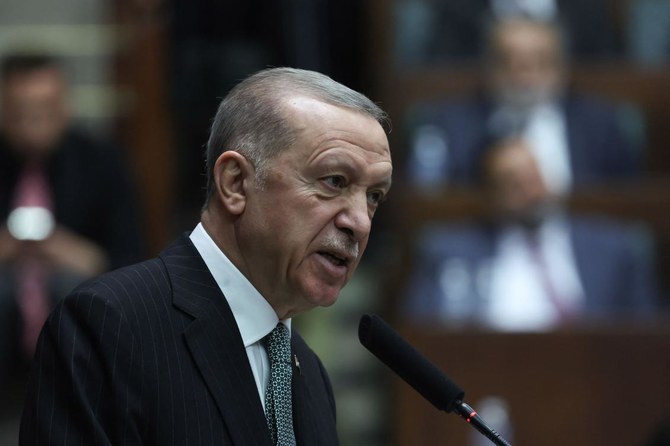
ANKARA: Turkish President Recep Tayyip Erdogan indicated on Wednesday that his government still intends to hold elections a month earlier than scheduled despite an earthquake last month that devastated parts of southern Turkiye.
In an address to legislators of his ruling party, Erdogan chided critics of the government’s handling of the earthquake’s aftermath and said the people would give their response to those critics on May 14 — the election date his ruling party had tentatively set for before the deadly tremor hit.
The Feb. 6 earthquake and strong aftershocks that struck Turkiye and Syria have killed around 50,000 people — the vast majority in Turkiye.
Close to 204,000 buildings either collapsed or were severely damaged in Turkiye, leaving hundreds of thousands of people homeless.
Officials say 14 million people were affected by the quake and millions of people have either left or had been evacuated from the quake-stricken region.
Erdogan didn’t provide information on how the elections could be organized in the quake zone or say whether displaced survivors would be able to cast ballots in their new locations.
The Turkish leader, who has been in power since 2003, is seeking a third term in office as president.
The presidential and general elections, which need to be held no later than June 18, come at a tough time for Erdogan who has seen a decline in his ratings because of skyrocketing inflation.
Erdogan has conceded shortcomings in the initial stages of the response but has blamed them on adverse weather conditions as well as the destruction the earthquake caused to roads and infrastructure.
On Wednesday, he reiterated a promise to rebuild more than 400,000 homes within the year.
“We will remove the debris, we will heal the wounds. We will improve on what was destroyed and present a better life for our people,” he said.
Erdogan also said a so-called National Risk Shield meeting would convene on Friday to review the country’s building stock that don’t comply with construction codes.
Experts point to lax enforcement of building codes as a major reason why the quake caused so much destruction.
The World Bank has estimated that the earthquake has caused an estimated $34.2 billion in direct physical damage — the equivalent of 4 percent of the country’s 2021 gross domestic product.
The World Bank said recovery and reconstruction costs would be much larger, potentially twice as large, and that GDP losses associated to economic disruptions would also add to the cost of the earthquakes.


![]()

Turkiye intends to hold elections on May 14 despite quake
Short Url
https://arab.news/929b5
Turkiye intends to hold elections on May 14 despite quake
- The Feb. 6 earthquake and strong aftershocks that struck Turkiye and Syria have killed around 50,000 people
- The presidential and general elections come at a tough time for Erdogan who has seen a decline in his ratings because of skyrocketing inflation


Latest updates


© 2026 SAUDI RESEARCH & PUBLISHING COMPANY, All Rights Reserved And subject to Terms of Use Agreement.