Greta Thunberg detained by Norway police during pro-Sami protest

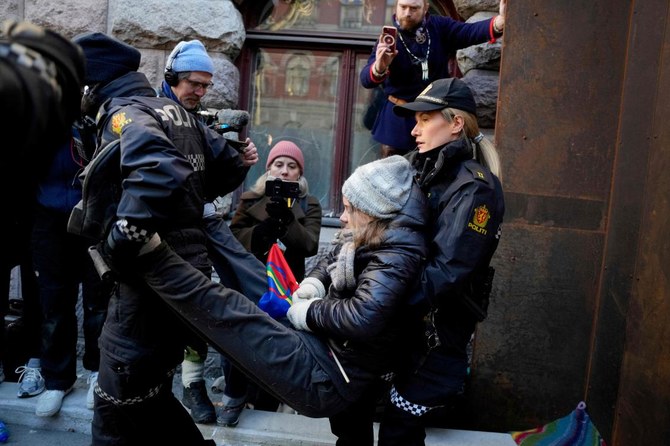
Policewomen carry away Swedish climate activist Greta Thunberg, center, as she and other campaigners to protest against wind turbines built on land traditionally used to herd reindeer in Oslo, Norway on March 1, 2023. (NTB/AFP)
Short Url
Updated 01 March 2023
Follow

Greta Thunberg detained by Norway police during pro-Sami protest

  • Police remove her and other activists from the finance ministry and later the environment ministry
  • The demonstrators have in recent days blocked access to some government buildings

OSLO: Environmental campaigner Greta Thunberg was twice detained during a demonstration in favor of Indigenous rights in Oslo on Wednesday, with police removing her and other activists from the finance ministry and later the environment ministry.
Thunberg had on Monday joined protesters demanding the removal of 151 wind turbines from reindeer pastures used by Sami herders in central Norway. They say a transition to green energy should not come at the expense of Indigenous rights.
The demonstrators have in recent days blocked access to some government buildings, putting the center-left minority government on a crisis footing and prompting Energy Minister Terje Aasland to call off an official visit to Britain.
Norway’s supreme court ruled in 2021 that the turbines, erected on two wind farms at Fosen and part of Europe’s largest onshore wind power complex, violated Sami rights under international conventions, but they remain in operation more than 16 months later.
Thunberg, holding a red, blue, yellow and green Sami flag, was lifted and carried away by police officers from the finance ministry while hundreds of demonstrators chanted slogans.
“We want to make it very clear that it is the Norwegian state that is committing the real crime here, for violating human rights,” she said minutes before she was removed.
Thunberg and other demonstrators later blocked the entrance to the climate and environment ministry and were again removed by police.
Thunberg, for many a global standard-bearer of the campaign to end the world’s reliance on carbon-based energy, was released along with other activists who had also been detained.
Reindeer herders say the sight and sound of the giant wind power machinery frighten their animals and disrupt age-old traditions.
The energy ministry has said the turbines present a legal quandary despite the supreme court ruling and is hoping to find a compromise, but that it could take another year to make a new decision in the Fosen case.
Activists on Tuesday said they had raised close to $100,000 in recent days to help individual demonstrators pay police fines.


Old Delhi iftars revive Mughal heritage, one course at a time

Updated 4 sec ago
Follow

Old Delhi iftars revive Mughal heritage, one course at a time

  • Dastarkhwan-e-Jahaanuma iftars have been held in Old Delhi since 2017
  • Muslim and non-Muslim participants arrive from across India and abroad

NEW DELHI: On a rooftop in Delhi’s historic walled city, guests from across India sit on cushions around a low table overlooking Jama Masjid, waiting for its sunset call to prayer — the signal to start a special iftar that will take them back four centuries, to the Mughal era, if only for a while.

Mughals ruled the Indian subcontinent between the 16th and 19th centuries. Originally from Central Asia, they carried traditions borrowed from Arabs, Persians and Ottomans, which they merged with the various local Indian styles — a fusion that marked the global revival of Islamic architecture and culture.

Jama Masjid is one of the most iconic examples of the Mughal style — a scenic background to the curated iftars that bring 40 to 50 people from across India to share a meal, knowledge and experience.

“People getting together from different walks of life, different parts of the country, different religions, different cultures coming together — it was absolutely and completely amazing,” said Arvind Sirohi, who took part in the event with his wife.

“Lovely storytelling, amazing food, and end of the day, right next to Jama Masjid in Old Delhi. The ambience, the environment, the atmosphere came together so beautifully.”

The community-led iftar experience is called Dastarkhwan-e-Jahaanuma — from Urdu words meaning a “spread of food” and “showing the world.”

For Veena Sirohi, it did exactly what the name promised by bringing together people from different communities, different parts of India, and abroad.

“I think that’s a great way of synthesizing different cultures, bringing people together, bringing the human aspect of what we all are ... we are actually all one,” she told Arab News.

“And we had some wonderful comperes who told us about … the history of Ramadan, what goes behind it, how the food is curated, and how each and every item has a specific place in the menu.”

Served in gilded bowls and plates from traditional Indian crockery, with rose petals dotting the dastarkhwan cloth, the dishes were some of the festive Ramadan delicacies, offering a taste of Mughal culinary heritage.

Among them was mutanjan, or fragrant rice cooked with ghee, sugar, saffron, cardamom, and studded with nuts, which for many Indian Muslims is traditionally the first dish to break the fast.

It was followed by shabde, a rich, slow-cooked aromatic meat stew or the Delhi biryani — a fragrant, mildly spiced saffron rice and meat dish, where marinated chicken or mutton is layered with basmati rice and cooked slowly.

The hearty feast closed with nihari, a hearty stew simmered overnight with spices and bone marrow, which emerged in the 18th century and was originally eaten by Mughal royals for breakfast.

“These are the traditional dishes which are not usually available in the market, but are specially prepared by the bawarchees (cooks) of Old Delhi. Some of the dishes are occasional dishes,” said Abu Sufiyan Khan, the founder of Tales of City, the cultural experience company that has been curating Dastarkhwan-e-Jahaanuma since 2017.

The special iftars are hosted once a week throughout the fasting month, usually on weekends. There are variations in dishes served as they come from different kitchens, as Tales of City collaborates with various local artisans and cooks.

“We are curating this with different experts and every time the menu changes,” Khan said.

“We bring all these dishes onto a single dastarkhwan, and we share this meal with the people coming from all over India to break bread together in the holy month of Ramadan, know each other, learn about each other’s culture, and create a dialogue space where we can have more meaningful conversations and an opportunity to get to know each other.”

Those who take part, like Ayandrali Dutta, a food critic, appreciate everything about the experience, especially as it takes place in Old Delhi, where the vibe is always “jovial, lively, in all positive ways” during Ramadan.

“You get to meet interesting people, you get to hear interesting stories ... It’s a great initiative to show what Ramadan is, what kind of food is eaten, talk about the cultures between Lucknow and Delhi and other parts of the country. And it just brings a lot of happiness,” she said.

“I loved it. My heart is happy, my belly is full. Nothing else I can ask for.”