

In Pakistani capital, a walk-in aviary offers home for birds, pleasure for visitors

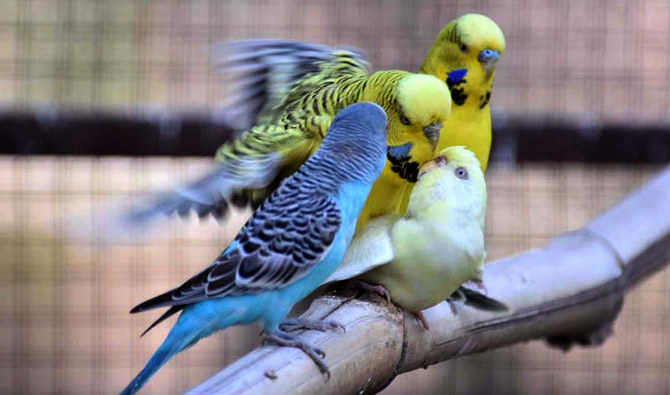
This picture, taken on March 19, 2022, shows a flock of Australian parrots at the walk-in aviary bird at Lake View Park on the outskirts of Islamabad. (Photo courtesy: APP)
Short Url
Updated 28 February 2023
Follow

In Pakistani capital, a walk-in aviary offers home for birds, pleasure for visitors

  • Enclosure houses around 7,000 birds of 400 species, including white peacocks, emus, pelicans and cranes 
  • 80% birds at the aviary are imported, trees, ponds, nests and incubation on site to imitate natural habitat

ISLAMABAD: At a huge walk-in aviary in the Pakistani capital of Islamabad last week, visitor Sufyan Shafqat fed white peacocks as they played with the national bird of Brazil, the rufous-bellied thrush, as well as large, bluish-grey Victoria crowned pigeons and vibrantly coloured mandarin ducks.

The 80-foot-high enclosure, located at the Lake View Park in the heart of Islamabad, is the world’s third-largest aviary and houses around 7,000 birds of 400 different species in a protected environment, according to its caretaker.

Other than a safe environment for mostly imported birds, the aviary also offers a "great learning experience" to the hundreds of students and foreign and local tourists who visit the facility daily.

“I have seen the white peacock here for the first time and I am loving it,” intermediate student Shafqat, who had come from Multan, over 500 kilometres from Islamabad, told Arab News.

“I have a special liking for birds, read about them in the books and see them on social media, but it is quite amazing to see them here physically.” 

The aviary is home to a number of varieties of peacocks, cranes, pelicans, ducks, parrots, cockatoos, emus, ostriches, pigeons and other birds imported from Brazil, Australia, Malaysia, and the Americas. 

“We have around twenty percent local and eighty percent imported birds in the aviary and they all are provided with food, water and shelter,” Zubair Ahmed, the aviary in-charge, told Arab News.  “All birds roam freely here in a protected environment and visitors can interact with them and even feed them.” 

With its hundreds of trees, ponds, nests and incubation areas, the enclosure offers a natural habitat to most birds while some are kept in cages and cabins specially designed so visitors can interact with them closely. 

“The good thing is they [the management] have planted fruit trees here and birds could pluck them for food,” Shafqat said. 

There is also a tame birds' section in the aviary where visitors can bring their own pet birds while around 50 trained staffers remain available on the premises to offer any assistance.

A well-equipped hatchery on the premises helps with artificial incubation in a controlled temperature for breeding and a state-of-the-art hospital provides quarantine for new birds.  

“We quarantine new birds for seven to fourteen days in the hospital, vaccinate and treat them before releasing them in the aviary,” Ahmed said.

For children’s entertainment, one section of the aviary offers pony rides, with the management taming and training the animals with the help of skilled instructors. 

“It is a tough job to tame and train the horses, take care of all the birds round the clock,” Ahmed said, "but we are doing it for the pleasure of our visitors.”


Pakistan engages Saudi Arabia, China in bid to ease surging Middle East tensions 

Updated 10 March 2026
Follow

Pakistan engages Saudi Arabia, China in bid to ease surging Middle East tensions 

  • Pakistan’s foreign minister stresses need for de-escalation in conversations with Chinese, Saudi counterparts
  • Tensions in the Middle East continue to remain high as conflict between US, Israel and Iran intensifies

ISLAMABAD: Pakistan’s Deputy Prime Minister Ishaq Dar spoke to the foreign ministers of Saudi Arabia and China on Tuesday, stressing the importance of diplomatic engagement to de-escalate tensions in the Middle East as the Iran war intensifies. 

Pakistan has constantly engaged regional countries in efforts to broker a ceasefire in the Middle East, after the US and Isreal launched coordinated strikes against Iran on Feb. 28. 

Iran launched fresh attacks on Gulf countries on Tuesday morning, where it has targeted US military bases in recent weeks. In addition to firing missiles and drones at Israel and American bases in the region, Iran has also been targeting energy infrastructure which, combined with its stranglehold on the Strait of Hormuz, has sent oil prices soaring worldwide. 

Dar spoke to Saudi Foreign Minister Prince Faisal bin Farhan to discuss developments in the Middle East and ongoing deliberations at the UN Security Council, Pakistan’s foreign office said in a statement. 

“DPM/FM shared Pakistan’s perspective, underscoring the importance of continued coordination and diplomatic engagement to support de-escalation and promote peace and stability across the region and beyond,” the statement said. 

Dar, who also serves as Pakistan’s foreign minister, spoke to Chinese foreign minister Wang Yi over the telephone separately. The two discussed the evolving regional situation and broader global developments.

Dar underscored the need to ease tensions in the Middle East and the wider region during the conversation, the foreign office said. 

Yi appreciated Pakistan’s constructive efforts aimed at promoting de-escalation and stability in the region, it added. 

“The two leaders stressed the importance of de-escalation and emphasized the need to pursue dialogue and diplomacy in accordance with the principles of the UN Charter,” the foreign office’s statement said. 

The conflict in the Middle East has hit Pakistan hard as well, forcing Islamabad to hike petrol and diesel prices by Rs55 per liter last Friday. 

Pakistan’s government has also announced a set of austerity measures, which include closing schools and cutting down on government expenditures, as it evaluates petrol stocks and looks for alternative supply routes.