

In Pakistani capital, a walk-in aviary offers home for birds, pleasure for visitors

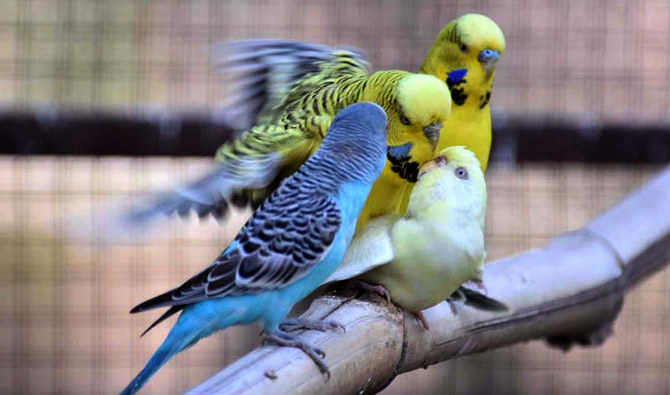
This picture, taken on March 19, 2022, shows a flock of Australian parrots at the walk-in aviary bird at Lake View Park on the outskirts of Islamabad. (Photo courtesy: APP)
Short Url
Updated 28 February 2023
Follow

In Pakistani capital, a walk-in aviary offers home for birds, pleasure for visitors

  • Enclosure houses around 7,000 birds of 400 species, including white peacocks, emus, pelicans and cranes 
  • 80% birds at the aviary are imported, trees, ponds, nests and incubation on site to imitate natural habitat

ISLAMABAD: At a huge walk-in aviary in the Pakistani capital of Islamabad last week, visitor Sufyan Shafqat fed white peacocks as they played with the national bird of Brazil, the rufous-bellied thrush, as well as large, bluish-grey Victoria crowned pigeons and vibrantly coloured mandarin ducks.

The 80-foot-high enclosure, located at the Lake View Park in the heart of Islamabad, is the world’s third-largest aviary and houses around 7,000 birds of 400 different species in a protected environment, according to its caretaker.

Other than a safe environment for mostly imported birds, the aviary also offers a "great learning experience" to the hundreds of students and foreign and local tourists who visit the facility daily.

“I have seen the white peacock here for the first time and I am loving it,” intermediate student Shafqat, who had come from Multan, over 500 kilometres from Islamabad, told Arab News.

“I have a special liking for birds, read about them in the books and see them on social media, but it is quite amazing to see them here physically.” 

The aviary is home to a number of varieties of peacocks, cranes, pelicans, ducks, parrots, cockatoos, emus, ostriches, pigeons and other birds imported from Brazil, Australia, Malaysia, and the Americas. 

“We have around twenty percent local and eighty percent imported birds in the aviary and they all are provided with food, water and shelter,” Zubair Ahmed, the aviary in-charge, told Arab News.  “All birds roam freely here in a protected environment and visitors can interact with them and even feed them.” 

With its hundreds of trees, ponds, nests and incubation areas, the enclosure offers a natural habitat to most birds while some are kept in cages and cabins specially designed so visitors can interact with them closely. 

“The good thing is they [the management] have planted fruit trees here and birds could pluck them for food,” Shafqat said. 

There is also a tame birds' section in the aviary where visitors can bring their own pet birds while around 50 trained staffers remain available on the premises to offer any assistance.

A well-equipped hatchery on the premises helps with artificial incubation in a controlled temperature for breeding and a state-of-the-art hospital provides quarantine for new birds.  

“We quarantine new birds for seven to fourteen days in the hospital, vaccinate and treat them before releasing them in the aviary,” Ahmed said.

For children’s entertainment, one section of the aviary offers pony rides, with the management taming and training the animals with the help of skilled instructors. 

“It is a tough job to tame and train the horses, take care of all the birds round the clock,” Ahmed said, "but we are doing it for the pleasure of our visitors.”


Curfew extended in Gilgit-Baltistan, probe ordered after deadly Khamenei protests

Updated 03 March 2026
Follow

Curfew extended in Gilgit-Baltistan, probe ordered after deadly Khamenei protests

  • At least 15 people were killed in clashes with law enforcement agencies over the weekend in Gilgit-Baltistan
  • Government also announces a de-weaponization campaign, crackdown on hate speech and cybercrime in region

ISLAMABAD: The government in Pakistan’s Gilgit-Baltistan (GB) region on Tuesday extended a curfew in Gilgit district and ordered a judicial probe into violent protests over the killing of Iranian Supreme Leader Ali Khamenei in US-Israeli strikes last week, an official said.

At least 15 people were killed in clashes with law enforcement agencies over the weekend in GB, where protesters torched and vandalized several buildings, including United Nations regional offices, an army-run school, software technology park and a local charity building.

The violence prompted regional authorities to impose curfew in Gilgit and Skardu districts on March 2-4 as officials urged people to stay indoors and cooperate with law enforcers, amid widespread anger in Pakistan, particularly among members of the Shiite minority, over Khamenei’s killing.

On Tuesday, the GB government convened to review the situation and announced the extension of curfew in Gilgit among a number of security measures as well as ordered the establishment of a judicial commission to investigate the weekend violence in the region.

“The government has made it clear that the law will strictly take its course against elements involved in vandalism at government institutions, private properties and incidents of vandalism in Gilgit and Skardu and no kind of mischief will be tolerated,” Shabbir Mir, a GB government spokesperson, said in a statement.

“In view of the security situation, curfew will remain in force in Gilgit, while the decision to extend the curfew in Skardu will be taken keeping the ground realities and the changing situation in view.”

The statement did not specify how long the curfew will remain in place in Gilgit.

Besides the formation of the judicial commission to investigate the violent clashes, the government also decided to launch a large-scale de-weaponization campaign in the entire Gilgit district, for which relevant institutions have been directed to immediately complete all necessary arrangements, according to Mir.

In addition, a crackdown has been ordered on hate speech, spread of fake news and cybercrime.

“The aim of these decisions is to ensure the rule of law, protect the lives and property of citizens and crack down on miscreants,” he said. “Approval has also been given to immediately survey the affected infrastructure and start their restoration work on priority basis.”

Demonstrators in Pakistan’s southern port city of Karachi also stormed the US Consulate on Sunday, smashing windows and attempting to burn the building. Police responded with batons, tear gas, and gunfire, leaving 10 people dead and more than 50 injured.

Pakistani authorities have since beefed up security at US diplomatic missions across the country, including around the US consulate building in Peshawar, to avoid any further violence.