

Iranian schoolgirls being ‘deliberately poisoned,’ deputy health minister says
Iranian schoolgirls being ‘deliberately poisoned,’ deputy health minister says/node/2259181/middle-east
Iranian schoolgirls being ‘deliberately poisoned,’ deputy health minister says
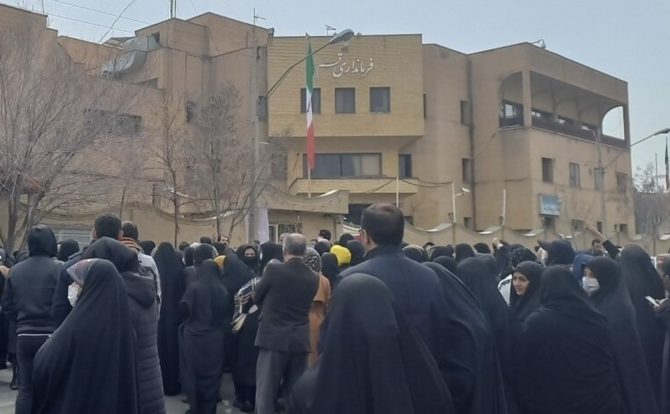
Families of the Qom students rallied outside the city governor’s office earlier this month demanding an explanation for the posionings. (Screenshot/Twitter)
Iranian schoolgirls being ‘deliberately poisoned,’ deputy health minister says
Younes Panahi claims ‘certain individuals’ seeking closure of all schools
15 girls hospitalized in Qom in past week alone
Updated 27 February 2023
Arab News
LONDON: Iranian schoolgirls are being deliberately poisoned to keep them away from their studies, a government minister claimed in a report by the Fars News Agency.
Younes Panahi, Iran’s deputy health minister, said that “certain individuals sought the closure of all schools, especially girls’ schools,” and that pupils were being “deliberately poisoned with chemical compounds.”
In the city of Qom, hundreds of cases of respiratory poisonings have been reported since November, with 15 girls hospitalized over the past week alone.
In Borujerd, a city in the west of the country, 82 students were hospitalized with suspected carbon monoxide poisoning. Their symptoms included nausea, headaches, coughing, breathing issues and an irregular heartbeat.
Similar cases have been reported at more than a dozen schools in four other cities, including Tehran.
Families of the Qom students rallied outside the city governor’s office earlier this month demanding an explanation and chanting: “We don’t want unsafe schools” and “schools must be secured.”
While no one has claimed responsibility for the poisonings, they come amid a wave of anti-government protests sparked by the death in police custody of 22-year-old Mahsa Amini in September.
Young women, many of them students, have played a key role in the nationwide uprising which seeks to overthrow the clerical regime that has been in power since the Islamic Revolution of 1979.
Human rights groups have accused Iran’s security forces of killing more than 500 people and imprisoning thousands across the country.
NGOs fear ‘catastrophic impact’ of new Israel registration rules
NGOs working in Israel and occupied Palestinian territories have until December 31 to register under the new framework
Save the Children is among the charities already barred under the new rules
Updated 3 sec ago
AFP
PARIS: New rules in Israel for registering non-governmental organizations, under which more than a dozen groups have already been rejected, could have a catastrophic impact on aid work in Gaza and the West Bank, relief workers warn. The NGOs have until December 31 to register under the new framework, which Israel says aims not to impede aid distribution but to prevent “hostile actors or supporters of terrorism” operating in the Palestinian territories. The controversy comes with Gaza, which lacks running water and electricity, still battling a humanitarian crisis even after the US-brokered October ceasefire in the war between Israel and Hamas, sparked by the Palestinian militant group’s October 7, 2023 attack on Israel. Israel’s Ministry of Diaspora Affairs and Combating Antisemitism told AFP that, as of November 2025, approximately 100 registration requests had been submitted and “only 14 organization requests have been rejected... The remainder have been approved or are currently under review.” Requests are rejected for “organizations involved in terrorism, antisemitism, delegitimization of Israel, Holocaust denial, denial of the crimes of October 7,” it said.
‘Very problematic’
The amount of aid entering Gaza remains inadequate. While the October 10 ceasefire agreement stipulated the entry of 600 trucks per day, only 100 to 300 are carrying humanitarian aid, according to NGOs and the United Nations. The NGOs barred under the new rules include Save the Children, one of the best known and oldest in Gaza, where it helps 120,000 children, and the American Friends Service Committee (AFSC). They are being given 60 days to withdraw all their international staff from the Gaza Strip, the occupied West Bank and Israel, and will no longer be able to send humanitarian supplies across the border to Gaza. In Gaza, Save the Children’s local staff and partners “remain committed to providing crucial services for children,” such as psychosocial support and education, a spokeswoman told AFP. The forum that brings together UN agencies and NGOs working in the area on Thursday issued a statement urging Israel to “lift all impediments,” including the new registration process, that “risk the collapse of the humanitarian response.” The Humanitarian Country Team of the Occupied Palestinian Territory (HCT) warned that dozens of NGOs face deregistration and that, while some had been registered, “these NGOs represent only a fraction of the response in Gaza and are nowhere near the number required just to meet immediate and basic needs.” “The deregistration of NGOs in Gaza will have a catastrophic impact on access to essential and basic services,” it said. NGOs contacted by AFP, several of whom declined to be quoted on the record due to the sensitivity of the issue, say they complied with most of Israel’s requirements to provide a complete dossier. Some, however, refused to cross what they described as a “red line” of providing information about their Palestinian staff. “After speaking about genocide, denouncing the conditions under which the war was being waged and the restrictions imposed on the entry of aid, we tick all the boxes” to fail the registration, predicted the head of one NGO. “Once again, bureaucratic pressure is being used for political control, with catastrophic consequences,” said the relief worker. Rights groups and NGOs including Amnesty International and Human Rights Watch have accused Israel of carrying out a genocide against Palestinians in Gaza, a term vehemently rejected by the Israeli government. “If NGOs are considered to be harmful for passing on testimonies from populations, carrying out operational work and saying what is happening and this leads to a ban on working, then this is very problematic,” said Jean-Francois Corty, president of French NGO Medecins du Monde.
- ‘Every little criticism’ -
The most contentious requirement for the NGOs is to prove they do not work for the “delegitimization” of Israel, a term that appears related to calling into question Israel’s right to exist but which aid workers say is dangerously vague. “Israel sees every little criticism as a reason to deny their registration... We don’t even know what delegitimization actually means,” said Yotam Ben-Hillel, an Israeli lawyer who is assisting several NGOs with the process and has filed legal appeals. He said the applications of some NGOs had already been turned down on these grounds. “So every organization that operates in Gaza and the West Bank and sees what happens and reports on that could be declared as illegal now, because they just report on what they see,” he told AFP. With the December 31 deadline looming, concerns focus on what will happen in early 2026 if the NGOs that are selected lack the capacity and expertise of organizations with a long-standing presence. Several humanitarian actors told AFP they had “never heard of” some of the accredited NGOs, which currently have no presence in Gaza but were reportedly included in Trump’s plan for Gaza. “The United States is starting from scratch, and with the new registration procedure, some NGOs will leave,” said a European diplomatic source in the region, asking not to be named. “They might wake up on January 1 and realize there is no-one to replace them.”