

Fresh turmoil as four judges recuse themselves from hearing case on Punjab, KP elections

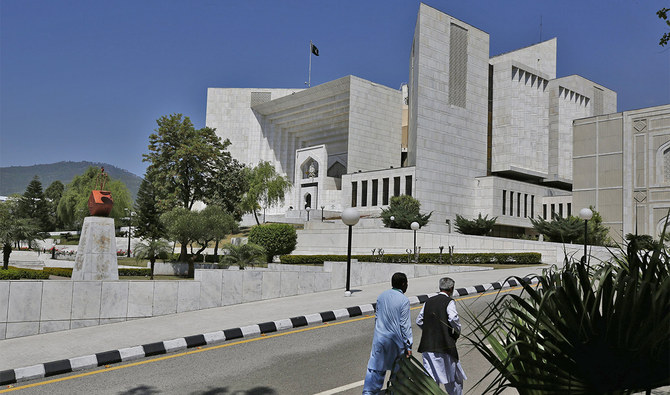
People walks past the Supreme Court in Islamabad, Pakistan, on April 4, 2022. (AP/File)
Short Url
Updated 27 February 2023
Follow

Fresh turmoil as four judges recuse themselves from hearing case on Punjab, KP elections

  • Supreme Court is hearing case on delay in setting date for general elections in the Punjab and Khyber Pakhtunkhwa provinces
  • Ex-PM Khan's party dissolved the two provincial assemblies in January seeking to force Pakistan to hold an early national election

ISLAMABAD: Four Supreme Court judges on a nine-member bench on Monday recused themselves from hearing a high-profile case pertaining to a date for general elections for the Punjab and Khyber Pakhtunkhwa assemblies, bringing fresh uncertainty to the South Asian nation at a time the economy is in deep trouble.

Seeking to force Pakistan to hold an early national election, former prime minister Imran Khan dissolved the provincial government in Khyber Pakhtunkhwa in January, just days after his allies did the same in Punjab province. The two regions account for more than half of the country’s 220 million population and Khan’s Pakistan Tehreek-e-Insaf (PTI) party is gambling on the national government being unable to afford to hold the provincial elections separately from a national election, which is otherwise due by October.

Under Pakistani law, fresh polls for the two provincial assemblies should be held within 90 days, but in recent weeks, PTI senior leaders have variously said the current coalition government of Prime Minister Shehbaz Sharif was trying to delay elections in the two provinces. Last week, President DR Arif Alvi announced that elections in both provinces should be held on April 9. 

Following that, the chief justice took suo motu notice of the delay in holding polls in Punjab and Khyber Pakhtunkhwa, saying there appeared to be a “lack of clarity” on the matter.

On Monday, a five-judge bench headed by chief justice Umar Ata Bandial resumed hearing in the case, saying Justice Ijaz Ul Ahsan, Justice Sayyed Mazahar Ali Akbar Naqvi, Justice Athar Minallah and Justice Yahya Afridi had recused themselves from hearing the case to ensure unbiased adjudication. 

"The remaining bench will continue the hearing," the chief justice said at the outset of the hearing, flanked by Justice Munib Akhtar, Justice Muhammad Ali Mazhar, Justice Shah and Justice Mandokhail.

"We will continue the hearing for the interpretation of the constitution as what the constitution says depends on its interpretation," the chief justice said, saying the case required "swiftness."

During the hearing, advocate Ali Zafar, who is representing the PTI party, urged the court to issue directions either to the Election Commission of Pakistan or the Punjab Governor for the election date as ECP representatives and the governor had already failed to reach an agreement on the polls date.

Earlier on Feb. 10, the Lahore High Court also directed the ECP to announce the election date but the regulator later challenged the verdict in the court.

The chief justice said the court would resume hearing tomorrow, Tuesday, at 9:30am and try to conclude the case.

Pakistan is due to hold general elections later this year, but Khan has been calling for elections since he was ousted in April after losing a parliamentary vote of confidence. The 70-year-old former international cricketer has also led nationwide protests against his successor, PM Sharif.

Local elections in both provinces, in addition to general elections later this year, would be an expensive and logistically complicated exercise for a government fighting a balance of payments crisis and heavily dependent on foreign aid after devastating floods last year.


Sindh assembly passes resolution rejecting move to separate Karachi

Updated 21 February 2026
Follow

Sindh assembly passes resolution rejecting move to separate Karachi

  • Chief Minister Shah cites constitutional safeguards against altering provincial boundaries
  • Calls to separate Karachi intensified amid governance concerns after a mall fire last month

ISLAMABAD: The provincial assembly of Pakistan’s southern Sindh province on Saturday passed a resolution rejecting any move to separate Karachi, declaring its territorial integrity “non-negotiable” amid political calls to carve the city out as a separate administrative unit.

The resolution comes after fresh demands by the Muttahida Qaumi Movement (MQM) and other voices to grant Karachi provincial or federal status following governance challenges highlighted by the deadly Gul Plaza fire earlier this year that killed 80 people.

Karachi, Pakistan’s largest and most densely populated city, is the country’s main commercial hub and contributes a significant share to the national economy.

Chief Minister Syed Murad Ali Shah tabled the resolution in the assembly, condemning what he described as “divisive statements” about breaking up Sindh or detaching Karachi.

“The province that played a foundational role in the creation of Pakistan cannot allow the fragmentation of its own historic homeland,” Shah told lawmakers, adding that any attempt to divide Sindh or separate Karachi was contrary to the constitution and democratic norms.

Citing Article 239 of Pakistan’s 1973 Constitution, which requires the consent of not less than two-thirds of a provincial assembly to alter provincial boundaries, Shah said any such move could not proceed without the assembly’s approval.

“If any such move is attempted, it is this Assembly — by a two-thirds majority — that will decide,” he said.

The resolution reaffirmed that Karachi would “forever remain” an integral part of Sindh and directed the provincial government to forward the motion to the president, prime minister and parliamentary leadership for record.

Shah said the resolution was not aimed at anyone but referred to the shifting stance of MQM in the debate while warning that opposing the resolution would amount to supporting the division of Sindh.

The party has been a major political force in Karachi with a significant vote bank in the city and has frequently criticized Shah’s provincial administration over its governance of Pakistan’s largest metropolis.

Taha Ahmed Khan, a senior MQM leader, acknowledged that his party had “presented its demand openly on television channels with clear and logical arguments” to separate Karachi from Sindh.

“It is a purely constitutional debate,” he told Arab News by phone. “We are aware that the Pakistan Peoples Party, which rules the province, holds a two-thirds majority and that a new province cannot be created at this stage. But that does not mean new provinces can never be formed.”

Calls to alter Karachi’s status have periodically surfaced amid longstanding complaints over governance, infrastructure and administrative control in the megacity, though no formal proposal to redraw provincial boundaries has been introduced at the federal level.