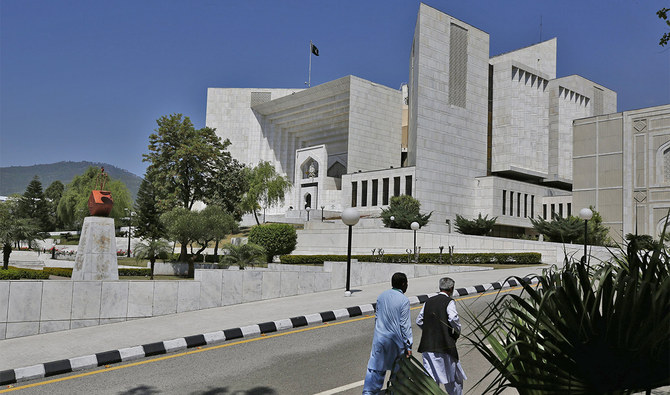

ISLAMABAD: Four Supreme Court judges on a nine-member bench on Monday recused themselves from hearing a high-profile case pertaining to a date for general elections for the Punjab and Khyber Pakhtunkhwa assemblies, bringing fresh uncertainty to the South Asian nation at a time the economy is in deep trouble.
Seeking to force Pakistan to hold an early national election, former prime minister Imran Khan dissolved the provincial government in Khyber Pakhtunkhwa in January, just days after his allies did the same in Punjab province. The two regions account for more than half of the country’s 220 million population and Khan’s Pakistan Tehreek-e-Insaf (PTI) party is gambling on the national government being unable to afford to hold the provincial elections separately from a national election, which is otherwise due by October.
Under Pakistani law, fresh polls for the two provincial assemblies should be held within 90 days, but in recent weeks, PTI senior leaders have variously said the current coalition government of Prime Minister Shehbaz Sharif was trying to delay elections in the two provinces. Last week, President DR Arif Alvi announced that elections in both provinces should be held on April 9.
Following that, the chief justice took suo motu notice of the delay in holding polls in Punjab and Khyber Pakhtunkhwa, saying there appeared to be a “lack of clarity” on the matter.
On Monday, a five-judge bench headed by chief justice Umar Ata Bandial resumed hearing in the case, saying Justice Ijaz Ul Ahsan, Justice Sayyed Mazahar Ali Akbar Naqvi, Justice Athar Minallah and Justice Yahya Afridi had recused themselves from hearing the case to ensure unbiased adjudication.
"The remaining bench will continue the hearing," the chief justice said at the outset of the hearing, flanked by Justice Munib Akhtar, Justice Muhammad Ali Mazhar, Justice Shah and Justice Mandokhail.
"We will continue the hearing for the interpretation of the constitution as what the constitution says depends on its interpretation," the chief justice said, saying the case required "swiftness."
During the hearing, advocate Ali Zafar, who is representing the PTI party, urged the court to issue directions either to the Election Commission of Pakistan or the Punjab Governor for the election date as ECP representatives and the governor had already failed to reach an agreement on the polls date.
Earlier on Feb. 10, the Lahore High Court also directed the ECP to announce the election date but the regulator later challenged the verdict in the court.
The chief justice said the court would resume hearing tomorrow, Tuesday, at 9:30am and try to conclude the case.
Pakistan is due to hold general elections later this year, but Khan has been calling for elections since he was ousted in April after losing a parliamentary vote of confidence. The 70-year-old former international cricketer has also led nationwide protests against his successor, PM Sharif.
Local elections in both provinces, in addition to general elections later this year, would be an expensive and logistically complicated exercise for a government fighting a balance of payments crisis and heavily dependent on foreign aid after devastating floods last year.