

UK and EU leaders to meet amid hope of Brexit trade spat fix

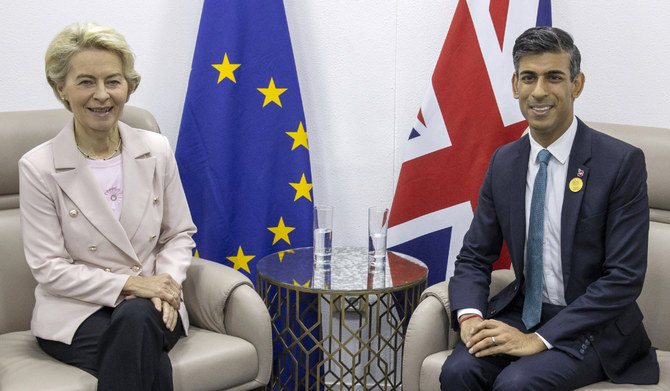
European Commission President Ursula von der Leyen, left, and British Prime Minister Rishi Sunak meet during the COP27 climate summit in Sharm el-Sheikh, Egypt, Nov. 7, 2022. (AP)
Short Url
Updated 26 February 2023
Follow

UK and EU leaders to meet amid hope of Brexit trade spat fix

  • The British government introduced a bill that would let it unilaterally rip up parts of the Brexit agreement, a move the EU called illegal

LONDON: British Prime Minister Rishi Sunak and European Union leader Ursula von der Leyen are set to hold face-to-face talks, with expectations high they will seal a deal to resolve a thorny post-Brexit trade dispute.
That would mark a breakthrough after months of bitter wrangling that has soured UK-EU relations, sparked the collapse of the Belfast-based regional government and and threatened to set back Northern Ireland’s decades-old peace process.
In a joint statement on Sunday the UK and the EU said European Commission President von der Leyen will travel to Britain on Monday so the leaders can work toward “shared, practical solutions for the range of complex challenges around the Protocol on Ireland and Northern Ireland.”
UK Deputy Prime Minister Dominic Raab said earlier Sunday that the two sides were on the “cusp” of striking an agreement over trade rules known as the Northern Ireland Protocol.
Northern Ireland is the only part of the UK that shares a border with an EU member, the Republic of Ireland. When the UK left the bloc in 2020, the two sides agreed to keep the Irish border free of customs posts and other checks because an open border is a key pillar of Northern Ireland’s peace process.
Instead there are checks on some goods entering Northern Ireland from the rest of the UK That angered British unionist politicians in Belfast, who say the new trade border in the Irish Sea undermines Northern Ireland’s place in the United Kingdom.
The Democratic Unionist Party collapsed Northern Ireland’s Protestant-Catholic power-sharing government a year ago in protest and has refused to return until the rules are scrapped or substantially rewritten.
Relations between the UK and the EU, severely tested during years of Brexit wrangling, chilled still further amid disputes over the Northern Ireland Protocol. The British government introduced a bill that would let it unilaterally rip up parts of the Brexit agreement, a move the EU called illegal. The bloc accused the UK of failing to honor the legally binding treaty it had signed.
The mood between London and Brussels improved after Sunak, a pragmatic Brexit supporter, took office in October, replacing more belligerent predecessors Boris Johnson and Liz Truss.
Striking a deal would let Sunak “get Brexit done” in a way that eluded Johnson, who won a landslide election victory on that very slogan in 2019, three years after British voters narrowly opted in a referendum to leave the bloc.
Johnson did lead the UK out of the now 27-nation EU in 2020, but with a divorce deal that left Northern Ireland still bound to some EU rules and standards in a way that caused headaches for businesses and upset Northern Ireland’s delicate political balance.
UK and EU negotiators have been inching toward a solution during weeks of intense talks, but any deal with the bloc carries political risk for Sunak. Hints of compromise toward the EU have sparked opposition from hard-line euroskeptics in Sunak’s governing Conservative Party, including Johnson.
The DUP also has warned it will oppose any deal that does not meet its demand for “significant, substantive change.”
A deal is likely to remove customs checks on the vast majority of goods moving between the UK and Northern Ireland.
The thorniest issue is the role of the European Court of Justice in resolving any disputes that arise over the rules. Britain and the EU agreed in their Brexit divorce deal to give the European court that authority, but the DUP and Conservative Brexiteers insist the court must have no jurisdiction in UK matters.
Sunak insisted a deal would meet unionist demands.
“As someone who believes in Brexit, voted for Brexit, campaigned for Brexit, I want to demonstrate that Brexit works and it works for every part of the United Kingdom,” he told the Sunday Times.
“There’s unfinished business on Brexit and I want to get the job done.”


Nigerian police deny church attacks as residents insist 168 people are held by armed groups

Updated 11 sec ago
Follow

Nigerian police deny church attacks as residents insist 168 people are held by armed groups

Kaduna State Police Commissioner Muhammad Rabiu described news reports of the attacks as rumors
It is common for police and locals to have contradicting accounts of attacks in Nigeria’s hard-hit villages

KADUNA, Nigeria: Nigerian police denied reports of simultaneous church attacks in northwestern Kaduna state over the weekend, even as residents shared accounts of kidnappings at the churches in interviews Tuesday.
A state lawmaker, Usman Danlami Stingo, told The Associated Press on Monday that 177 people were abducted by an armed group Sunday. Eleven escaped and 168 are still missing, according to the lawmaker and residents interviewed by AP.
Kaduna State Police Commissioner Muhammad Rabiu described news reports of the attacks as rumors, saying the police visited one of the three churches in the district of Kajuru and “there was no evidence of the attack.”
It is common for police and locals to have contradicting accounts of attacks in Nigeria’s hard-hit villages.
“I am one of the people who escaped from the bandits. We all saw it happen, and anyone who says it didn’t happen is lying,” said Ishaku Dan’azumi, the village head of Kurmin Wali.
Nigeria is struggling with several armed groups that launch attacks across the country, including Boko Haram and Daesh-WAP, which are religiously motivated, and other amorphous groups commonly called “bandits.”
Rights group Amnesty International condemned the “desperate denial” of the attack by the police and government.
“The latest mass abduction clearly shows President Bola Tinubu and his government have no effective plan for ending years of atrocities by armed groups and gunmen that killed thousands of people,” the group said in a statement.
A Kaduna-based Christian group, the Christian Solidarity Worldwide Nigeria, said in a press release that security operatives did not allow its members to visit the sites of the attacks.
“The military officer who stopped the CSWN car said there was a standing order not to allow us in,” Reuben Buhari, the group’s spokesperson, said.
The Chikun/Kajuru Active Citizens Congress, a local advocacy group, published a list of the hostages. The list could not be independently verified by the AP. Police did not respond to a request for questions on the list.
The Christian Association of Nigeria also verified the attacks and has a list of the hostages, according to a senior Christian leader in the state who spoke on condition of anonymity for fear of his safety.
“This happened, and our job is to help them. These people came, attacked and picked people from churches,” he said. “But I think they prefer to play the politics of denying, and I don’t think that’s what we want.”
Attacks against religious worship centers are common in Nigeria’s conflict-battered north. They are a part of the country’s complex security crisis that also affects schools, such as in November when hundreds of schoolchildren and their teachers were abducted in another part of Kaduna.
In the past few months, the West African nation has been in the crosshairs of the US government, which has accused the Nigerian government of not protecting Christians in the country, leading to a diplomatic rift. The USlaunched an attack against an alleged Daesh group members on Nigerian territory on Dec. 25, an operation the Nigerian government said it was aware of.