Turkiye begins to rebuild for 1.5 million homeless after disaster

1 / 3
This photograph taken on February 22, 2023, shows a crane demolishing a building destroyed by the Feb. 6 earthquakes in Diyarbakir, southeastern Turkiye. (AFP)
2 / 3
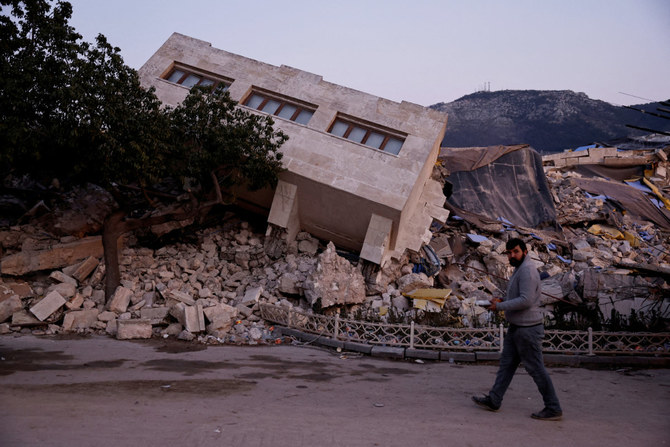
A destroyed building is seen at night, in the aftermath of a deadly earthquake, in Antakya, Hatay province, Turkiye, on February 21, 2023. (REUTERS)
3 / 3
A view shows Disaster and Emergency Management Presidency's temporary shelter for earthquake survivors in Kirikhan, Turkiye on February 8, 2023, in the aftermath of the M-7.8 earthquake that hit the country's south. (REUTERS/File Photo)
Short Url
Updated 26 February 2023
Follow

Turkiye begins to rebuild for 1.5 million homeless after disaster

  • Over 160,000 buildings containing 520,000 apartments collapsed or were severely damaged
  • Initial plan is to build 200,000 apartments and 70,000 village houses at a cost of at least $15 billion

ANKARA: Turkiye has begun work to rebuild homes following this month’s devastating earthquakes as the combined death toll in Turkiye and Syria surpassed 50,000.

Over 160,000 buildings containing 520,000 apartments collapsed or were severely damaged in the Feb. 6 earthquakes that killed tens of thousands in Turkiye and Syria.

The Disaster and Emergency Management Authority announced the death toll in Turkiye rose to 44,218 on Friday night. With Syria’s latest announced death toll of 5,914, the combined death toll in the two countries rose to above 50,000.

President Recep Tayyip Erdogan has pledged to rebuild homes within a year, although experts have said the authorities should put safety before speed. Some buildings that were meant to withstand tremors crumbled in the latest earthquakes.

“For several projects, tenders and contracts have been done. The process is moving very fast,” an official said, speaking on condition of ano- nymity, adding there would be no compromise on safety.
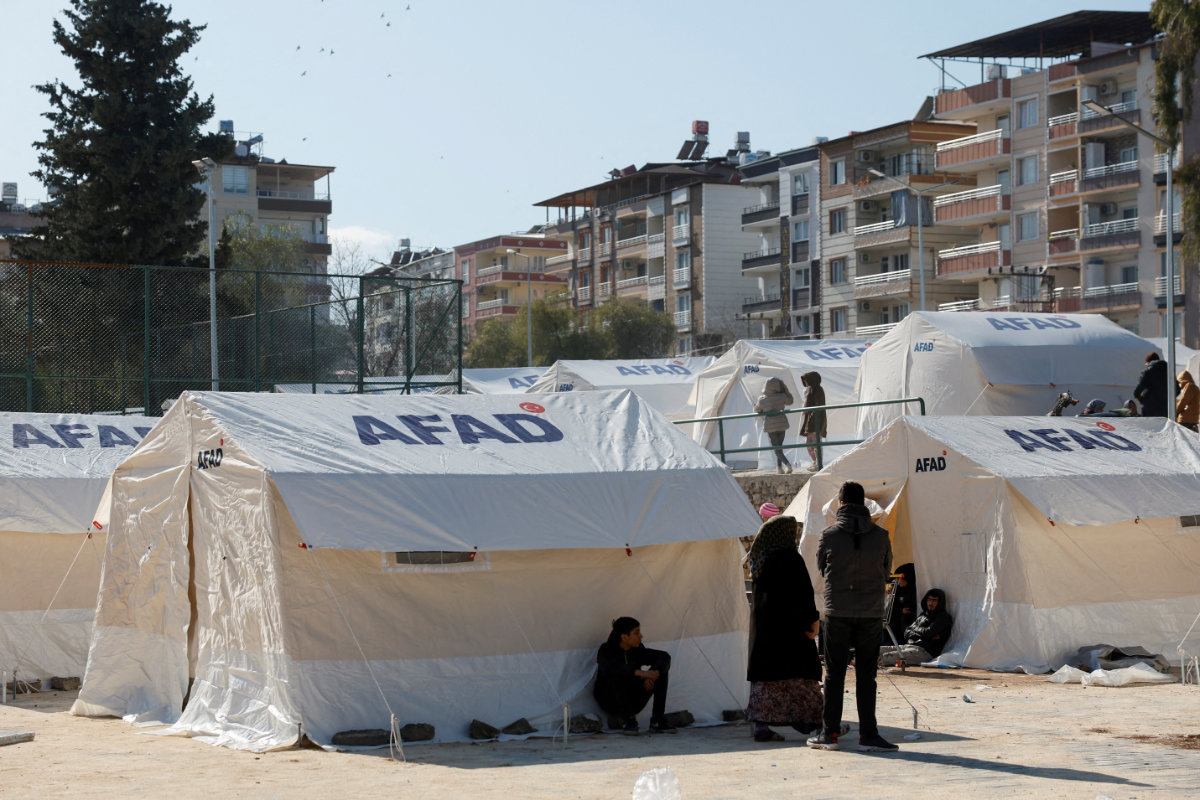


A view shows Disaster and Emergency Management Presidency's temporary shelter for earthquake survivors  in Kirikhan, Turkiye on February 8, 2023, in the aftermath of the M-7.8 earthquake that hit the country's south. (REUTERS/File Photo)

Authorities say tents have been dispatched for the many who are homeless, but people have reported trouble accessing them.

“I have eight children. We are living in a tent. There is water on top (of the tent) and the ground is damp. We are asking for more tents and they don’t give them to us,” Melek, 67, who was waiting in a line to collect aid outside a high school in the town of Hassa.

The school was being used as an aid distribution center by a group of volunteers called Interrail Turkiye.

One volunteer, Sumeyye Karabocek, said the shortage of tents remained the biggest problem.

Erdogan’s government has endured a wave of criticism over both its response to the devastation and what many Turks say were years of non-enforcement of construction quality control.

The Turkish government’s initial plan now is to build 200,000 apartments and 70,000 village houses at a cost of at least $15 billion, he said.

US bank JPMorgan had estimated rebuilding houses and infrastructure will cost $25 billion.

Turkiye also issued new regulations under which companies and charities can build homes and workplaces to donate to the Urbanization Ministry for people in need.

Investigations have been launched against more than 600 people in relation to buildings that collapsed in Turkiye’s quake.

Justice Minister Bekir Bozdag said 184 of the 612 suspects had been jailed pending trial. Those in custody include construction contractors and building owners or managers, he said in televised comments from a coordination center in Diyarbakir in southeast Turkiye.

“The detection of evidence in the buildings continues as a basis for criminal investigation,” Bozdag added.


Palestinians retrieve belongings from West Bank camp before home demolitions

Updated 7 sec ago
Follow

Palestinians retrieve belongings from West Bank camp before home demolitions

  • Israel plans to demolish 25 buildings housing up to 100 families
  • Follows IDF operation earlier this year against camps in the northern occupied West Bank
NUR SHAMS, Palestinian Territories: Dozens of residents from the West Bank’s emptied Nur Shams refugee camp returned on Wednesday to retrieve belongings ahead of the Israeli military’s demolition of 25 residential buildings there.
Early this year, the military launched an ongoing operation it said was aimed at rooting out Palestinian armed groups from camps in the northern occupied West Bank — including Nur Shams, Tulkarem and Jenin.
Loading furniture, children’s toys and even a window frame onto small trucks, Palestinian residents hurried Wednesday to gather as much as they could under the watchful eye of Israeli soldiers, according to an AFP journalist at the scene.
Troops performed ID checks and physical searches, allowing through only those whose houses were set to be demolished.
Some who were able to enter salvaged large empty water tanks, while others came out with family photos, mattresses and heaters.
More than 32,000 people remain displaced from the now-empty camps, where Israeli troops are stationed, according to the UN’s agency for Palestinian refugees, UNRWA.
Mahmud Abdallah, who was displaced from Nur Shams and was able to enter a part of the camp on Wednesday, said he witnessed for the first time the destruction that had taken place after he was forced to leave.
“I was surprised to find that there were no habitable houses; maybe two or three, but they were not suitable for living,” he said.
“The camp is destroyed.”

‘Determined to return’

The demolitions, affecting 25 buildings housing up to 100 families, were announced earlier this week and are scheduled for Thursday.
They are officially part of a broader Israeli strategy of home demolitions to ease its military vehicles’ access in the dense refugee camps of the northern West Bank.
Israel has occupied the Palestinian territory since 1967.
Ahmed Al-Masri, a camp resident whose house was to be demolished, told AFP that his request for access was denied.
“When I asked why, I was told: ‘Your name is not in the liaison office records’,” he said.
UNRWA’s director for the West Bank and east Jerusalem, Roland Friedrich, said an estimated 1,600 houses were fully or partially destroyed during the military operation, making it “the most severe displacement crisis that the West Bank has seen since 1967.”
Nur Shams, along with other refugee camps in the West Bank, was established after the creation of Israel in 1948, when hundreds of thousands of Palestinians were displaced from their homes in what is now Israel.
“We ask God to compensate us with palaces in paradise,” said Ibtisam Al-Ajouz, a displaced camp resident whose house was also set to be destroyed.
“We are determined to return, and God willing, we will rebuild. Even if the houses are demolished, we will not be afraid — our morale is high.”