

At Peshawar Literary Festival, a dedicated stall celebrates Arab culture and history

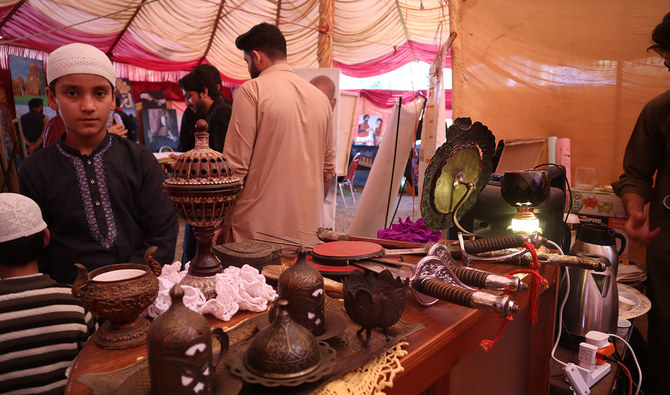
A young boy visits the desk of antique itmes of Arabic Culture at University of Peshawar on February 24, 2023. (AN Photo)
Short Url
Updated 25 February 2023
Follow

At Peshawar Literary Festival, a dedicated stall celebrates Arab culture and history

  • The unique initiative to set up the stall was taken by the Department of Arabic at the Peshawar University
  • The organizers say they are trying to promote Arabic language and tell people how they can benefit from it

PESHAWAR: People visiting the Peshawar Literary Festival this week were attracted by a stall that projected various dimensions of Arab culture and welcomed visitors with traditional Middle Eastern music and fragrant qahwa.

The Department of Arabic at the Peshawar University took the initiative to set up the stall, though it executed the plan in collaboration with the Khyber Pakhtunkhwa Culture Department and Dosti Welfare Organization.

At the university, which is also hosting the five-day festival which started on Tuesday, the organizers of the stall were dressed in traditional Arab attire and said their aim was to acquaint people with the beauty of the predominant Middle Eastern culture.

Dr. Ahmed Saeed Jan, a faculty member of the Arabic department, said the stall was divided in several different areas.

“We have arranged a stall for books, the second has the model of Kaaba [the black cubical structure at the heart of the Grand Mosque in Makkah], the third stall represents pure Arab culture and here we see many kinds of swords and [antiques] and instruments which belong to Arab culture,” he added. “And at the fourth stall, we are arranging qahwa which we offer to the visitors with dates.”
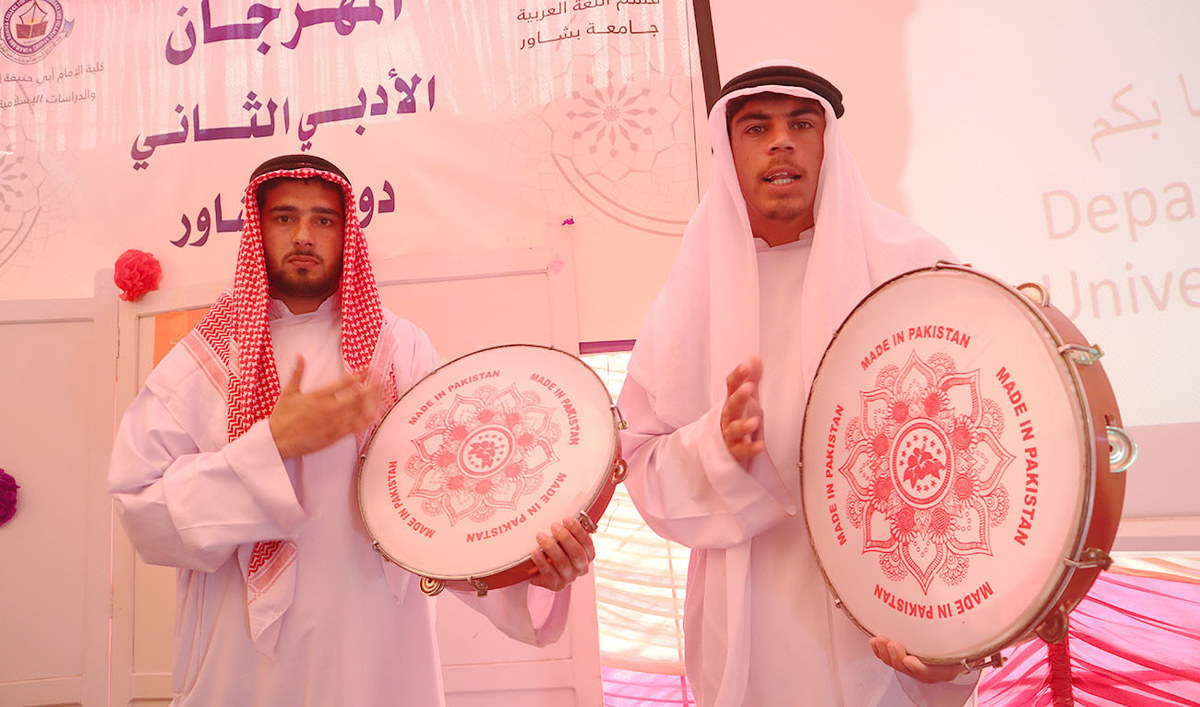


Organizers singing traditional Arabic Music and Playing Duff at University of Peshawar on February 24, 2023. (AN Photo).

Jan said the stall was set up to convey Islam’s message of peace while also projecting how people in the Arab world lived.

A student of Peshawar University and member of the organizing committee that set up the enclosure, Sana Ullah said one of the many reasons why it was decided to carry out the activity was to tell people why they should learn Arabic language and how it could benefit them.

He added the Department of Arabic was well placed to do that since it was one of the oldest sections of the university which was established in 1952.

“We are trying to promote the love for Arabic language in Pakistan,” he said. “People coming over here also show interest in learning the language.”
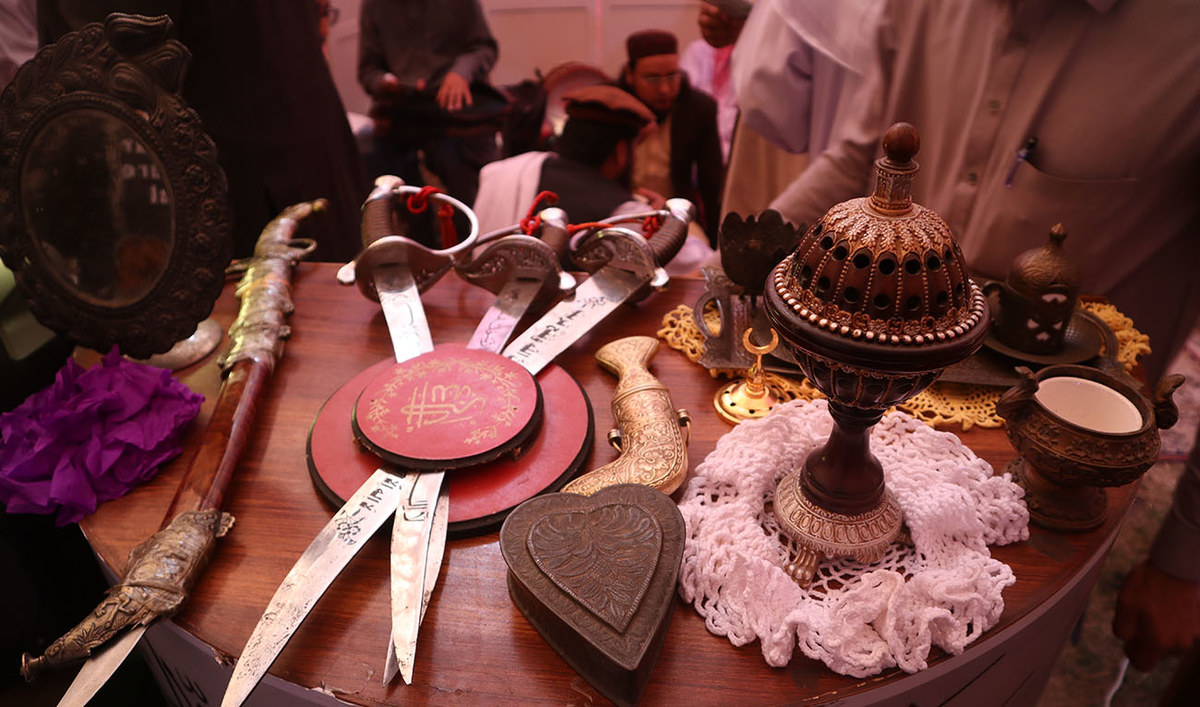


Swords and other antiques desplayed for the visitors at University of Peshawar on February 24, 2023. (AN Photo)

Dr. Uzma Dayan, a lecturer at the Institute of Education and Research, said Arab culture was not unfamiliar to people in a city like Peshawar which had immense diversity.

“Among all these stalls, I found this one the most interesting,” she told Arab News. “The one thing I liked [about this enclosure] the most is that they are trying to motivate visitors [to learn about Arab culture] while offering them qahwa and dates.”

She pointed out there were a number of other oriental departments teaching Pashto, Persian and Urdu, adding that none of them had built such a stall.


Sindh assembly passes resolution rejecting move to separate Karachi

Updated 6 sec ago
Follow

Sindh assembly passes resolution rejecting move to separate Karachi

  • Chief Minister Shah cites constitutional safeguards against altering provincial boundaries
  • Calls to separate Karachi intensified amid governance concerns after a mall fire last month

ISLAMABAD: The provincial assembly of Pakistan’s southern Sindh province on Saturday passed a resolution rejecting any move to separate Karachi, declaring its territorial integrity “non-negotiable” amid political calls to carve the city out as a separate administrative unit.

The resolution comes after fresh demands by the Muttahida Qaumi Movement (MQM) and other voices to grant Karachi provincial or federal status following governance challenges highlighted by the deadly Gul Plaza fire earlier this year that killed 80 people.

Karachi, Pakistan’s largest and most densely populated city, is the country’s main commercial hub and contributes a significant share to the national economy.

Chief Minister Syed Murad Ali Shah tabled the resolution in the assembly, condemning what he described as “divisive statements” about breaking up Sindh or detaching Karachi.

“The province that played a foundational role in the creation of Pakistan cannot allow the fragmentation of its own historic homeland,” Shah told lawmakers, adding that any attempt to divide Sindh or separate Karachi was contrary to the constitution and democratic norms.

Citing Article 239 of Pakistan’s 1973 Constitution, which requires the consent of not less than two-thirds of a provincial assembly to alter provincial boundaries, Shah said any such move could not proceed without the assembly’s approval.

“If any such move is attempted, it is this Assembly — by a two-thirds majority — that will decide,” he said.

The resolution reaffirmed that Karachi would “forever remain” an integral part of Sindh and directed the provincial government to forward the motion to the president, prime minister and parliamentary leadership for record.

Shah said the resolution was not aimed at anyone but referred to the shifting stance of MQM in the debate while warning that opposing the resolution would amount to supporting the division of Sindh.

The party has been a major political force in Karachi with a significant vote bank in the city and has frequently criticized Shah’s provincial administration over its governance of Pakistan’s largest metropolis.

Taha Ahmed Khan, a senior MQM leader, acknowledged that his party had “presented its demand openly on television channels with clear and logical arguments” to separate Karachi from Sindh.

“It is a purely constitutional debate,” he told Arab News by phone. “We are aware that the Pakistan Peoples Party, which rules the province, holds a two-thirds majority and that a new province cannot be created at this stage. But that does not mean new provinces can never be formed.”

Calls to alter Karachi’s status have periodically surfaced amid longstanding complaints over governance, infrastructure and administrative control in the megacity, though no formal proposal to redraw provincial boundaries has been introduced at the federal level.