QUETTA: Dozens of tribesmen in Pakistan’s southwestern Balochistan province on Friday announced to call off their protest which they launched in the wake of a triple murder case in the region for which they blamed a powerful provincial minister while seeking justice.
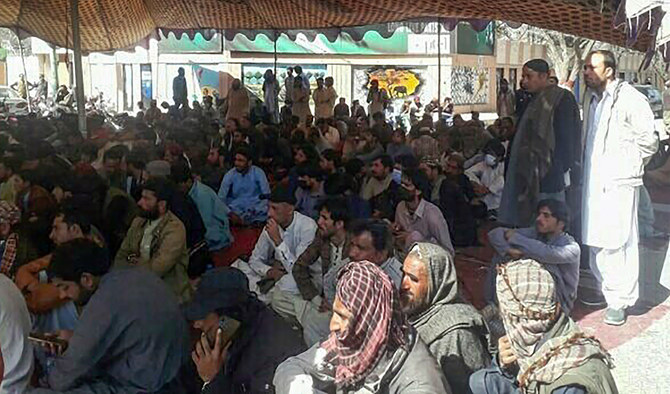
The tribesmen set up the protest camp in Quetta after a paramilitary force discovered three mutilated bodies in a well in the Hajji Kot area of Barkhan district on Monday night. The victims were said to belong to the family of a local tribesman, Khan Muhammad Marri, who accused Communications and Works Minister Sardar Abdul Rehman Khetran of holding his family hostage in “private jails” and eventually killing them. Khetran is currently under arrest.
The tribesmen refused to bury the bodies, allegedly belonging to a woman, Giran Naz, and her sons, Muhammad Nawaz and Abdul Qadir. Prior to the bodies being discovered, a video went viral of Naz accusing Khetran of detaining her family and requesting Pakistani authorities to secure their release.
In a dramatic twist in the case, however, authorities in Balochistan announced the women, who was thought to be dead, had been found alive from the remote Kohlu area along with her other children.
“We have called off the protest today because the provincial government has recovered Khan Muhammad Marri’s family and shifted them to Quetta,” Jahangir Marri, the secretary general of the Marri Ittehad Pakistan that organized the sit-in, told Arab News.
“Now we are going to pick up the bodies of Marri’s two sons, Muhammad Nawaz and Abdul Qadir, for burial,” he continued. “However, discussions are still going on to decide whether they will be buried in Kohlu or Quetta.”
The identity of the dead woman, who was previously thought to be Naz, is still not clear. However, a postmortem report revealed the body belonged to 17-18 years old girl who was shot after being raped.
Balochistan is Pakistan’s largest and poorest province. The arid western region is rich in minerals but plagued by violence, with powerful tribes long having held sway over political and social life in the region. Separatist militants also run amok in the area, carrying out frequent attacks on security forces and accusing the federal government of looting the region’s resources while leaving its people in poverty.
After meeting his wife and children, Marri requested the protesters to end the sit-in.
“I am very thankful to all tribes and communities that supported me and my family,” he said in a video statement released Friday evening.
Despite the announcement of Marri Ittehad Pakistan to call off the protest, some demonstrators have decided to continue while refusing to hand over the bodies for burial.
“We will not hand over the bodies for burial until the government completes the identification of the [unknown] woman and determine the causes of her murder,” Tanveer Marri, an advocate who is now leading the protest in Quetta, told Arab News.


![]()

Tribesmen in Pakistan’s southwest announce to call off protest in triple murder case
Short Url
https://arab.news/rk6yq
Tribesmen in Pakistan’s southwest announce to call off protest in triple murder case
- The protest began earlier this week after three mutilated bodies were found in Barkhan district
- A powerful provincial minister was accused of killing the three people from the same family
Latest updates


Recommended


© 2026 SAUDI RESEARCH & PUBLISHING COMPANY, All Rights Reserved And subject to Terms of Use Agreement.