

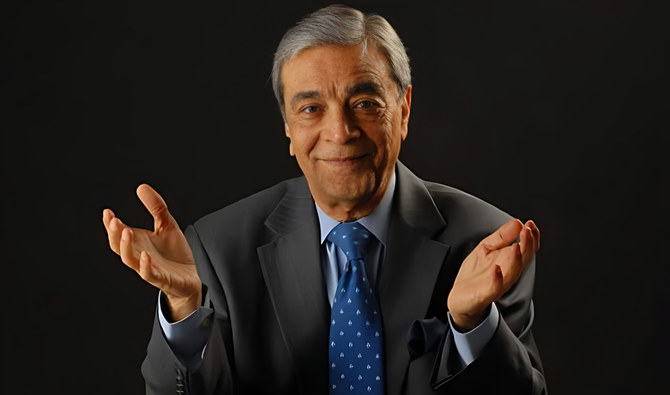

KARACHI: Family members and colleagues of veteran British-Pakistani actor Zia Mohyeddin came together in Karachi this week to pay a tribute to the icon of Pakistan’s art and culture landscape who passed away on Feb. 13, saying there would be none like him for ” a long time.”
Mohyeddin, a legendary actor, televangelist and author, passed away at the age of 91 in Karachi last week. The British-Pakistani actor, who made his Hollywood debut in the 1962 classic ‘Lawrence of Arabia,’ had been ill and admitted to the intensive care unit of a private hospital in the southern Pakistani port city.
In a bid to celebrate the late actor’s life and achievements, the National Academy of Performing Arts (NAPA) has been hosting the “Zia Mohyeddin Festival” from Feb 22 till Feb 25 in Karachi. The first two days of the festival saw a huge lineup of panelists, including his family members and colleagues, who talked about Mohyeddin’s work as well as his personality.
The discussions comprised a sweet blend of family anecdotes related to jokes about the late actor’s three marriages as well as his “wicked sense of humor.” Mohyeddin’s colleagues, on the other hand, shared their observations and reflections on him with the audience.
“There won’t be another [Zia Mohyeddin] for a very, very long time,” actress Sania Saeed, who was part of the panel, told Arab News on Thursday.
“I don’t think people [now] look at themselves the way people of that time, and people like Zia sahib, in particular [did]. Someone who does so much work on himself as well as his craft and does that until his last days.”
Saeed recalled that the late actor was found reading all the time.
“If you ever go to his office, he [was] always reading. Two books would be open in front of him. And in between reading these books, he used to meet people,” she told the audience.
“I am his fan and a follower of his work. We used to listen to his recitation, his readings would play at our home. I can’t say I knew him personally, neither I worked with him ever but there was an association with him [as he was] a theater practitioner. The theater world acknowledges him, even the ones who weren’t associated with him in any capacity. They know the stature the man [had].”
Mohyeddin’s wife, children, and nephew were also part of the panel discussion, titled ‘Zia Mohyeddin – As I Knew Him,’ on the second day of the festival.
“There was a notable difference [in him], compared to the concept of a conventional husband in our part of the world,” shared his wife, Azra Mohyeddin.
“There might have been some changes in his nature over the years but when he became a part of my life, he was really good. My sisters used to complain to him that he doesn’t say anything to me or stop me from anything.”
Mohyeddin’s son, Risha Mohyeddin, shared that his father never asked him to fix his Urdu.
“He was not very expressive. He kept his feelings inside a lot of times, especially when we were growing up,” he said.
“In the last few years, he definitely opened up so his personality also evolved as his career evolved.”
Poetess Zehra Nigah was in awe of Mohyeddin’s demeanor which, according to her, was incomparable and “impossible to find” in current times.
“You cannot, at any point, in any way, criticize his manners or his demeanor whether he was standing, sitting, talking, entering, or seeing off. We used to notice these little things that he might make a mistake somewhere,” Nigah said, recalling her time with the legendary actor.
Nigah shared when she had asked Mohyeddin once to explain a stanza to her, he had asked for some time. Upon inquiring what would he do if the same had been asked on stage, he replied: “’I never read anything onstage without understanding’.”
“He used to say ‘words have their own personality. Where does it have to stop, which word moves, [and] which word stands’,” she quoted Mohyeddin as saying.
“All these details are there in every language and only someone like Zia [Mohyeddin] could understand this. Today, people ignore all of this,” she added.
In addition to the panel discussions, the four-day festival incorporates screenings, music and dance performances. The screenings include ‘Parhant’ and ‘Here and Now’ by Mohyeddin as well as a documentary on him.
Born in the eastern Pakistani city of Faisalabad, Mohyeddin spent his early years in Lahore and was trained at London’s Royal Academy of Dramatic Art from 1953 to 1956. He began his career in theater, making his debut at London’s West End in 1960 through the role of Dr. Aziz in “A Passage to India.”
In the 1962 blockbuster “Lawrence of Arabia,” he played the ill-fated Arab guide named Tafas. Directed by David Lean, the British epic historical drama is widely regarded as one of the greatest films ever made and won seven Oscars at the 1963 Academy Awards.
He was also seen in Behold the Pale Horse in 1964 by director Fred Zinnemann, and in Immaculate Conception in 1992, directed by Amil Dehlavi. He also authored three books, A Carrot is a Carrot, Theatrics and The God of My Idolatry Memories, and Reflections.
Mohyeddin returned to Pakistan in the late 1960s and gained national popularity through a television talk show, “The Zia Mohyeddin Show,” which ran from 1969 until 1973.
Mohyeddin was also widely known for his poetry and prose recitations as well as acting and theater direction, and one of his last works was directing the first Urdu adaptation of Shakespeare’s “Romeo and Juliet,” which was performed last year at NAPA, which he helped set up in 2005.


