

As Pakistan, Sri Lanka seek bailouts, India urges G20 to focus on unsustainable debt

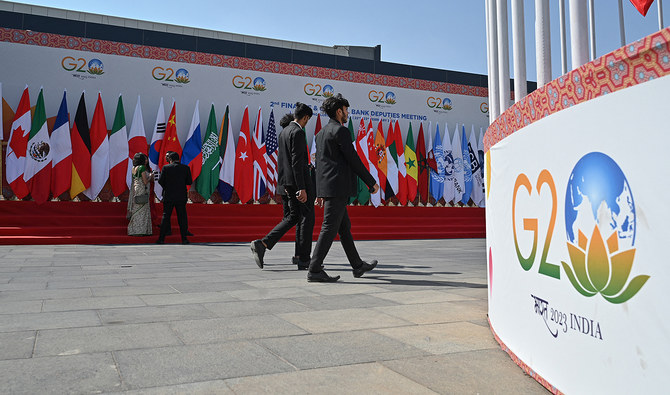
Officials walk past flags of participating countries and organisations erected at the Prestige Golfshire, the venue where the second meeting of the G20 Finance and Central Bank Deputies under India’s G20 Presidency has begun in Bengaluru on February 22, 2023. (Photo courtesy: AFP)
Short Url
Updated 24 February 2023
Follow

As Pakistan, Sri Lanka seek bailouts, India urges G20 to focus on unsustainable debt

  • Trust in international financial institutions has eroded because lenders have been slow to reform, Modi says
  • India wants to help debtor nations by asking lenders like China to take large haircut or accept losses on loans

MUMBAI: The financial viability of many countries is being threatened by unsustainable debt, India’s Prime Minister Narendra Modi said on Friday, as he called for the Group of 20 (G20) to focus on the world’s most vulnerable citizens.

Trust in international financial institutions has eroded, partly because the lenders had been slow to reform themselves, Modi said in a video message at the beginning of a two-day meeting of G20 finance ministers and central bank governors.

“Food and energy security have become major concerns across the world. Even the financial viability of many countries is threatened by unsustainable debt levels,” Modi said.

The meeting at a hill resort on the outskirts of the tech hub of Bengaluru is the first major event of India’s G20 presidency and coincided with the first anniversary of Russia’s invasion of Ukraine, which Modi alluded to.

“We are also witnessing rising geo-political tensions in different parts of the world. There are disruptions in global supply chains. Many societies are suffering due to rising prices,” Modi said in his address to delegates.

India’s presidency of the bloc comes as neighboring South Asian countries Sri Lanka, Bangladesh and Pakistan have been seeking bailouts from the International Monetary Fund (IMF) due to an economic slowdown caused by the COVID-19 pandemic and the Ukraine conflict.

Reuters reported last week that India is drafting a proposal for G20 countries to help debtor nations by asking lenders, including China, the world’s largest sovereign creditor, to take a large haircut, or accept losses, on loans.


Venezuela aims to boost oil output but sanctions stand in the way, VP says

Updated 58 min 21 sec ago
Follow

Venezuela aims to boost oil output but sanctions stand in the way, VP says

  • Sanchez called the recent capture of Nicolas Maduro a “dark day” for the country

DUBAI: Venezuela’s Vice President for Economy Calixto Ortega Sanchez said on Wednesday that his country needed vast foreign investment and sanctions relief to tap its huge oil reserves and restart its ailing economy.

“We know that the reference for Venezuela is that (it is) the country with the biggest oil reserves, and we want to stop being known for this, and we want to be known as one of the countries with the highest production levels,” Sanchez said.

Responding to questions by American journalist Tucker Carlson, Sanchez called the recent capture of Nicolas Maduro a “dark day” for the country but said Venezuela was working to reestablish a relationship with the US, which he described as a “natural partner” for the country.

“The Venezuelan people and authorities have shown that they are ready to peacefully move forward and to build opportunities,” he said during a session at the World Government Summit.

Sanchez, who headed Venezuela’s central bank, said the most pertinent issue facing his country is continued US sanctions.

Despite failing to result in regime change, the sanctions had effectively stifled the economy from growing, he added.

He said the Venezuelan government was now working to reform its laws to allow foreign investment and hoped the US would ease sanctions to aid their work.

“The first decisions that interim President Rodriguez took was to go to the National Assembly and ask for reform to the hydrocarbon law … this law will allow international investors to go to Venezuela with favorable conditions, with legal assurance of their investments,” he added.

“The economy is ready for investment. The economy is ready for the private sector; it is ready to build up a better future for the Venezuelan people.”

Sanchez played down inferences by Carlson that his government had been taken over, insisting that the regime still held authority in the country. He said the country had set up two funds to receive money from oil production that would fund better welfare and social conditions for Venezuelans.

“Allow us to have access to our own assets … we don’t have access to our own money,” he added.

“If you allow us to function like a regular country, Venezuela will show extraordinary improvement and growth.”