

Pakistani brothers released from Guantanamo and sent home

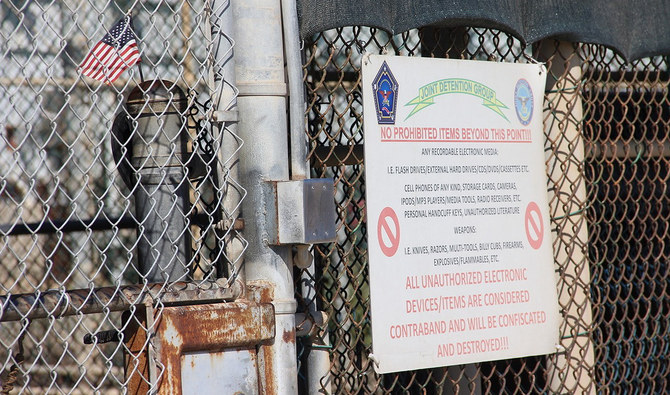
In this file photo taken on January 26, 2017, a US national flag is placed in the fencing of Camp 5 at the US Military's Prison in Guantanamo Bay, Cuba. (Photo courtesy: AFP/File)
Short Url
Updated 24 February 2023
Follow

Pakistani brothers released from Guantanamo and sent home

  • Abdul Rabbani, born in 1967, is believed to have been one of the oldest inmates at Guantanamo Bay
  • Both were arrested in Karachi in Sept 2002 by Pakistani authorities, a Senate intelligence report says

WASHINGTON: Two Pakistani brothers, Abdul and Mohammed Rabbani, have been freed from the US military prison at Guantanamo Bay after more than 20 years in detention and repatriated, the Pentagon said Thursday.

Abdul Rabbani, who was born in 1967, is believed to have been one of the oldest inmates at the facility on a US base in Cuba.

US officials accused him of working for avowed 9/11 mastermind Khalid Sheikh Mohammed (KSM) and operating an Al-Qaeda safe house in Karachi, but his detainee assessment indicates he was not believed to have had “specific insight into Al-Qaeda operational plans.”

Mohammed Rabbani, born in 1969, was accused of recruiting his older brother into extremist circles. He is believed to have organized travel and funds for KSM and Abd Al-Rahim Al-Nashiri, the mastermind of the October 2000 suicide bombing of the USS Cole missile destroyer, which left 17 US sailors dead.

The pair were arrested in Karachi in September 2002 by Pakistani authorities, according to a Senate intelligence committee report that also names Mohammed Rabbani as one of 17 detainees subjected to torture at overseas CIA secret prisons, known as black sites.

Both men arrived at Guantanamo Bay in 2004 and were approved for release in 2021, the Defense Department said in a statement.

Their release brings to 32 the number of detainees left at Guantanamo Bay. Of those, 18 are eligible for transfer, three are eligible for review, nine are on trial in US military commissions and two have been convicted.



Pakistan calls jailing of rights lawyers ‘domestic affair’ as EU flags free speech concerns

Updated 44 min 15 sec ago
Follow

Pakistan calls jailing of rights lawyers ‘domestic affair’ as EU flags free speech concerns

  • EU says the convictions of Imaan Mazari-Hazir, Hadi Ali Chattha violate freedom of expression
  • Both lawyers were arrested last week over social media posts under Pakistan’s cybercrime laws

ISLAMABAD: The European Union on Thursday criticized Pakistan over the conviction of two human rights lawyers for their social media activity, saying the ruling ran counter to core democratic principles that Islamabad is committed to uphold, a charge the government denied while calling the development its “domestic affair.”

Imaan Mazari-Hazir and her husband Hadi Ali Chattha were arrested last Friday as they were on their way to a court appearance and were later remanded to two weeks in judicial custody.

Authorities accused them of violating the Prevention of Electronic Crimes Act (PECA) over posts on X that they said incited ethnic divisions and portrayed the military as being involved in “terrorism.” Both deny the allegations.

“The conviction of human rights lawyers Imaan Mazari and Hadi Ali Chattha over social media activity goes against freedom of expression and independence of lawyers,” Anouar El Anouni, the EU’s spokesperson for foreign affairs and security policy, said in a post on X. “These are not only key democratic principles but also part of Pakistan’s international human rights commitments.”

Pakistan is one of the largest beneficiaries of the EU’s Generalized Scheme of Preferences Plus (GSP+), which grants duty-free access to most European markets in return for implementing 27 international conventions covering human rights, labor standards, environmental protection and good governance.

Pakistan’s GSP+ status came under scrutiny in the past after, in April 2021, the European Parliament adopted a resolution calling for an immediate review, citing concerns over violence against religious minorities, curbs on media freedom and broader human rights issues.

Responding to the EU concern, Pakistan’s foreign office spokesperson Tahir Andrabi described the development as Pakistan’s “domestic affair.”

“The conviction, under our local laws, has taken place through a judicial process,” he said during his weekly media briefing. “The relevant individuals have a right to appeal, have a right to a judicial recourse.”

“There’s local remedy available for these individuals, and Pakistan while, is remains engaged with the EU on all issues, does make a distinction about our domestic affairs,” he added.