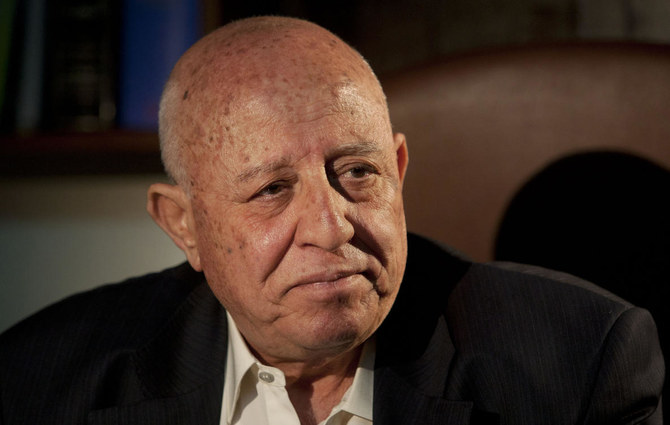
RAMALLAH: Ahmed Qureia, a former Palestinian prime minister and one of the architects of interim peace deals with Israel, has died at age 85.
A key player in the 1993 Oslo peace accords, Qureia witnessed the rise of the dream of Palestinian statehood that surged during the negotiations. But he also saw those hopes recede, with the prospect of a two-state solution to the Israeli-Palestinian conflict drifting further than ever.
Palestinian President Mahmoud Abbas confirmed Qureia’s death on Wednesday. The cause of death was not immediately made public, but Qureia had been ill for some time with a heart condition.
“Abu Alaa stood in the lead defending the causes of his home and people,” Abbas said in a statement carried by the official Wafa news agency, using Qureia’s nickname.
Born in 1937 in Abu Dis, suburb of east Jerusalem in the occupied West Bank, Qureia joined the Fatah movement in 1968.
He rose quickly through the ranks under the leadership of its founder, late Palestinian President Yasser Arafat, and became a member of its decision-making body, the Central Committee, in 1989. He was also a member of the PLO Executive Committee.
Qureia headed the Palestinian delegation to Oslo, where intensive talks with Israel led to the peace accords in 1993, which created the Palestinian Authority and set up self-rule areas in the Palestinian territories. During ensuing rounds of negotiations with Israelis, he met all Israeli prime ministers who were in office before 2004, including Yitzhak Rabin, Ariel Sharon, Shimon Peres, Benjamin Netanyahu and Ehud Olmert, and US Presidents Bill Clinton and George W. Bush.
Peace talks have collapsed in the three decades since the accords. Israel has driven up settlement building in the West Bank, and imposed a blockade on the Gaza Strip after the Islamic militant Hamas took power there after it routed forces loyal to Fatah. Violence is again flaring up between the sides, especially in the West Bank.
In a 2013 interview with the Associated Press marking two decades since the Oslo agreements, Qureia said that if he knew then what he knows now he wouldn’t have agreed to the accords.
“With such kinds of blocs of settlements? No. With the closure of Jerusalem? No. Not at all,” Qureia said in an interview at his office in the Jerusalem suburb of Abu Dis.
After the establishment of the PA, Qureia won a seat in the first parliamentary elections in 1996 and chaired the Palestinian Legislative Council.
After Abbas resigned as the PA’s first prime minister in 2003, Arafat replaced him with Qureia. He held the post until 2006, when the militant Hamas group scored a landslide victory in the second Palestinian elections.
During his tenure as prime minister, Qureia was the subject of controversy after reports accused his family of having financial interest in a company that sold Egyptian cement to Israel, which the latter used to build the West Bank separation barrier.


Ahmed Qureia, top Palestinian negotiator with Israel, dies
https://arab.news/ru5pw
Ahmed Qureia, top Palestinian negotiator with Israel, dies

- A key player in the 1993 Oslo peace accords, Qureia witnessed the rise of the dream of Palestinian statehood that surged during the negotiations


EU warns Israel suspending Gaza NGOs would block ‘life-saving aid’
BRUSSELS: The EU warned Wednesday that Israel's threat to suspend several aid groups in Gaza from January would block "life-saving" assistance from reaching the population.
"The EU has been clear: the NGO registration law cannot be implemented in its current form," EU humanitarian chief Hadja Lahbib posted on X, after Israel said several groups would be barred for failing to provide details of their Palestinian employees.
"IHL (international humanitarian law) leaves no room for doubt: aid must reach those in need," Lahbib wrote.
NGOs had until December 31 to register under the new framework, which Israel says aims to prevent "hostile actors or supporters of terrorism" operating in the Palestinian territories, rather than impede aid.
Israeli authorities announced Tuesday that organisations which "refused to submit a list of their Palestinian employees in order to rule out any links to terrorism" had received notice that their licences would be revoked as of January 1, with an obligation to cease all activities by March 1.
Israel has not disclosed the number of groups facing a ban, but it has specifically called out Doctors Without Borders (MSF) for failing to meet the rules. It accused the medical charity of employing two individuals with links to Palestinian armed groups.
The Israeli government told AFP earlier this month that 14 NGO requests had been rejected as of November 25.
Several NGOs said the new rules will have a major impact on aid distribution in Gaza, with humanitarian organisations saying the amount of aid entering Gaza remains inadequate.
While an accord for a ceasefire that started on October 10 stipulated the entry of 600 trucks per day, only 100 to 300 are carrying humanitarian aid, according to NGOs and the United Nations.
COGAT, the Israeli defence ministry body responsible for Palestinian civilian affairs, said last week that on average 4,200 aid trucks enter Gaza weekly, which corresponds to around 600 daily.


