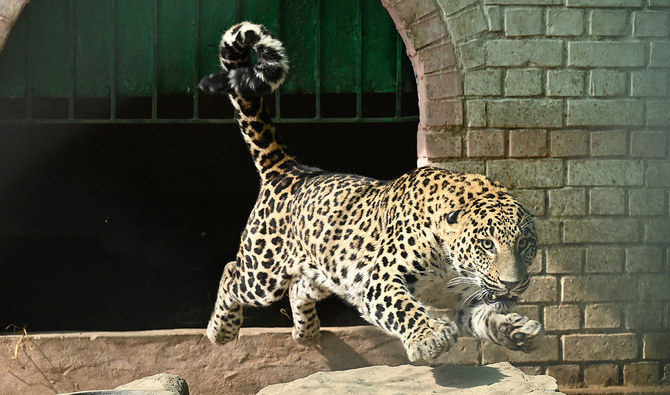
Leopard that ran amok in Islamabad came from the wild, was not a pet — wildlife board

Short Url
Updated 22 February 2023
Follow

Leopard that ran amok in Islamabad came from the wild, was not a pet — wildlife board

  • Wildlife official says rescued leopard showed ‘no signs of being domesticated’
  • Asks people not to believe in ‘fake news’ about the cat being someone’s pet

ISLAMABAD: The wildlife board in Pakistan’s capital city of Islamabad revealed on Wednesday that a leopard that ran amok in the city, injuring and terrorizing people last week, was not a pet as per rumours but it came from the wild as it showed “no signs of being domesticated.”

Last week, videos circulating on social media showed a leopard frantically roaming across the upscale Defense Housing Authority (DHA) neighborhood in Islamabad. The leopard ran amock for hours, terrorizing citizens before it was shot with a sedation dart.

The Islamabad Wildlife Management Board (IWMB) had said four people sustained “minor injuries” while trying to rescue the animal, adding that it was investigating how it entered the urban area.

Social media users claimed the cat was kept as a pet by a senior army officer living in DHA, after which the Islamabad Capital Territory (ICT) police said it had registered a case against an "unidentified" individual for allegedly keeping a leopard in their house.

“IWMB’s experts have now determined DHA leopard did come from [the] wild. He’s not showing any signs of being domesticated,” Rina Saeed Khan, honorary chairperson of the Islamabad Wildlife Management Board, wrote in a Twitter post.

“We believe he came at night from Kahuta’s forests around 6 km from DHA-2. Forests in [the] area are under stress. Good news as he can be returned to wild,” she said.

Khan also requested people not to “believe [in] any fake news”, and added that it took a few days for experts to study the leopard’s behavior to be sure of his origin.

“It took a team effort to successfully save this leopard. Lessons were learnt [and the] IWMB will have a better response in case of any future incident. IWMB’s injured staff [and] volunteers are its real heroes!” she added.

Pakistan last year banned the import of exotic mammals after large numbers were brought in or bred in recent years, causing problems for wildlife officials.

Big cats are seen as symbols of wealth and power in the country.

Islamabad is bordered by the Margalla Hills where a preservation zone has been set up to protect wild leopards in the area.


In rural Sindh, a woman-led business finds a low-cost answer to tomato price swings

Updated 9 sec ago
Follow

In rural Sindh, a woman-led business finds a low-cost answer to tomato price swings

  • The company turns tomatoes into powder using a manual, sun-drying process that cuts production costs
  • It seeks partnerships with major food brands to expand beyond rural markets, tap into large urban centers

MIRPURKHAS: A small but fast-growing woman-led food company in southern Pakistan is using a simple, low-cost production method to turn tomatoes into powder, a product its founder says could cut costs for major food companies by as much as 50 percent while helping stabilize prices for consumers.

The business operates without electricity-driven drying machines, relying instead on manual labor and natural sunlight to dry tomatoes during periods of oversupply, when prices collapse and farmers are forced to discard produce.

The company, Red Royal Foods (RRF), is based in Jhuddo village in Sindh’s Mirpurkhas district and produces organic powder from ripe tomatoes that are sliced by hand, sun-dried over several days and treated with sea salt, without the use of artificial preservatives, additives or machines.

Founded and led by 24-year-old Zainab Munawar, RRF has grown from a small local operation into a supplier serving markets in Mirpurkhas and Hyderabad. Munawar now aims to sell her product to large local and international food brands operating in Pakistan’s major cities.

“Our target is to do business with National and Shan [Foods],” Munawar, nicknamed Nainsukh, told Arab News while standing inside her factory, which she recently acquired from a wedding lawn owner.

“We also target to collaborate with the brands on an international level like McDonald’s and Kababjees which are very much in demand right now in Pakistan,” she added.

McDonald’s is a major US multinational fast-food chain, while Kababjees is a Pakistani restaurant brand that has expanded beyond traditional barbecue into fried chicken and pizza.

Food manufacturers in Pakistan have been under pressure from rising input costs, driven by higher energy prices, climate-related disruptions to agricultural supply chains and inflation. Corporate taxes can also reach 40 percent, further squeezing margins for those in the business.

Munawar, who holds a master’s degree in medical physics, said RRF’s appeal lies in its ability to sharply reduce production costs by eliminating electricity and heavy machinery from the drying process.

“Ours is a manual technique in which you don’t have to add the electricity and machinery costs and that’s why the rates we offer are 50 percent cheaper than the market,” she added.

Tomatoes, a staple ingredient in Pakistani cooking and food processing, have become a symbol of food inflation in recent years, with prices swinging sharply between periods of glut and shortage.

“We have a time when tomato sales are very high like currently. We are receiving tomatoes at Rs7 per kilogram as these are high in supply and people are even throwing them,” she explained. “We buy tomatoes these days, make powder out of it and preserve it.”

When supplies tighten, prices can soar.

“Then there is a time when tomatoes go short in supply and are retailed at a price as high as Rs400 per kilogram,” she said.

“We then sell our tomato powder at the same price,” she added, referring to Rs100 per 80-gram packet.

For consumers, the powder has become a practical hedge against price volatility.

Inflation stood at 6.1 percent in November, with core inflation described by the State Bank of Pakistan as “relatively sticky.”

Ganga, a 45-year-old RRF worker who lives with her brothers, said the product has changed how households cope with seasonal shortages.

“In the off season, the tomato prices become so high that you can’t even buy a kilogram of it,” she said.

“Then we buy a packet of this tomato powder for Rs100 which lasts for four to five days.”

RRF’s production process is deliberately simple. Tomatoes are sliced by hand, dried in open spaces under the sun for four to six days depending on sunlight intensity and then ground using basic household-type machines.

The initiative received support after the devastating floods of 2022, which destroyed crops and livelihoods across southern Sindh.

Mahdi Hassan, a livelihood officer at the Sindh Rural Support Organization (SRSO), said RRF was backed through post-flood recovery programs implemented with Germany’s Malteser International.

“After the floods of 2022, there was a lot of destruction in Jhuddo because of which people’s livelihoods were greatly affected,” he said, adding that SRSO had supported around 24 similar initiatives in the area, mostly led by women, with about Rs30 million ($107,000) in funding.

Beyond livelihoods, RRF is also trying to reduce Pakistan’s reliance on imported food products.

“No company is producing this dried-tomato powder in Pakistan yet,” said Ahsan Khan, the company’s technical supervisor.

“What is available in the market is being imported ... We are trying to manufacture this dried tomato powder locally and give competitive rates to our buyers.”

During peak seasons, RRF sells up to four tons of tomato powder per month. Munawar said she expects that volume to rise, noting that entry into Karachi’s large food market could significantly boost revenues from last year’s Rs650,000 ($2,319).

“Last year we were in collaboration with Al-Noor Foods while now we have sent requests [business proposals] to National Foods and Shan Foods, who will become our customers after approving those requests,” she said.
RRF has also sent proposals to international brands such as McDonald’s.

“We would be targeting to double, triple our revenues this year if we get approvals from these brands,” she added.