Pakistan conducted over 6,000 operations against militants in last three months — state media 

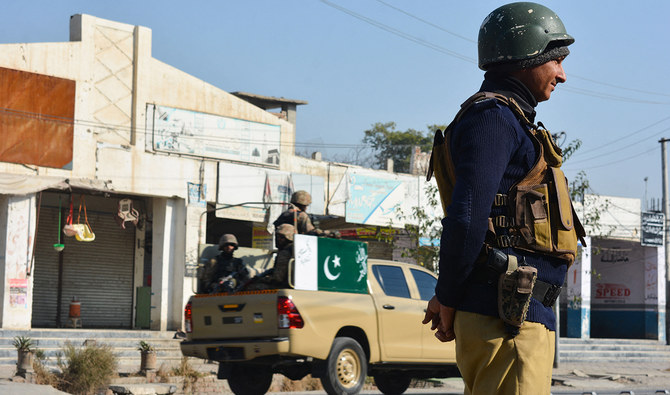
A policeman (R) and army soldiers (L) stand guard along a road in Bannu on December 21, 2022, a day after the seize of a Pakistan police station ended. (Photo courtesy: AFP/FILE)
Short Url
Updated 21 February 2023
Follow

Pakistan conducted over 6,000 operations against militants in last three months — state media 

  • Security forces have killed 142 suspected militants, arrested another 1,007 in these intelligence-based operations 
  • The efforts come amid a renewed wave of militant attacks after the Pakistani Taliban called off their cease-fire 

ISLAMABAD: Pakistani security forces have conducted 6,921 operations in the last three months to purge the country of militant violence, state media reported on Tuesday, with 142 suspected militants killed and 1,007 arrested in these raids. 

The development comes amid a renewed wave of militant attacks in the South Asian country, particularly in its northwestern and southwestern regions that border Afghanistan and Iran. 

The number of attacks increased after the Pakistani Taliban, or the proscribed Tehreek-e-Taliban Pakistan (TTP), called off a fragile, months-long truce with the government in November last year. 

The anti-militancy efforts were expedited after the recent surge in attacks, during which the security forces not only arrested militants and their facilitators, but also foiled several attacks, the state-run APP news agency reported, citing sources. 

“In Khyber Pakhtunkhwa, some 1,960 operations were conducted including 1,516 area domination operations, 301 intelligence-based operations, and 143 area sanitization operations. During the operations, 98 terrorists were killed and 540 were arrested,” the report read. 

“In Balochistan, 3,414 operations were carried out comprising of 2,980 area domination operations, 67 intelligence-based operations, and 367 area sanitization while 40 terrorists were killed and 112 were arrested.” 

More than 750 operations were conducted in the southern Sindh province, wherein three suspects were killed and another 244 arrested, according to the report. 

In Punjab, 165 intelligence-based operations were conducted that resulted in the killing of one suspect and arrest of 11 others. 

“The security forces were continuing operations to prevent terrorism across the country,” the report added. 

The Pakistani Taliban have claimed some of the major attacks in Pakistan since calling off their cease-fire, which was brokered by the Afghan Taliban in May 2022. 

These attacks included suicide bombing at a mosque inside a heavily guarded police compound in the northwestern city of Peshawar that killed more than 80 people. 

Another attack killed at least four people, when a Taliban suicide squad barged into the police headquarters in the country’s commercial hub of Karachi last week. 

Low-level militancy, often targeting security checkpoints in the north and west, has been steadily rising since the Afghan Taliban seized control in neighboring Afghanistan in August 2021. The Pakistani Taliban share a common lineage and ideals with the Afghan Taliban. 

Pakistani officials have announced that no talks could be held with militants who refuse to submit to the state’s writ. 


Pakistan discovers new oil, gas reserves in push to cut costly imports

Updated 5 sec ago
Follow

Pakistan discovers new oil, gas reserves in push to cut costly imports

  • Exploration firm announces modest discovery of 225 barrels of oil, 1.01 MMSCFD of gas per day
  • Multiple discoveries together could boost domestic production and reduce reliance on imports

ISLAMABAD: Pakistan has announced a modest discovery of new oil and gas reserves in its northwestern Khyber Pakhtunkhwa (KP) province, state media reported on Friday, amid the country efforts to boost exploration to cut costly imports.

Pakistan faces a widening energy gap due to rising demand and limited domestic output, forcing reliance on costly fuel imports that expose the economy to global price swings. Its petroleum, oil, and lubricants import bill fell 4.39 percent to $9.046 billion in July 2025-January 2026.

The discovery was made at Lumshiwal Formation of Baragzai X-01 exploratory well. During Cased Hole Drill Stem Test (CHDST-04) conducted in the Hangu and Lumshiwal formations, the well produced 225 barrels of oil per day (BOPD) and 1.01 million standard cubic feet per day (MMSCFD) of gas through a 32/64’’ choke at a wellhead flowing pressure of 190 psig.

“Baragzai X-01 (Slant) was spudded on December 30, 2024, as an exploratory well to assess the hydrocarbon potential of multiple formations, including Lockhart, Hangu, Lumshiwal, Samana Suk, Shinawari, Datta and Kingriali.

The well was successfully drilled to a total depth of 5,170 meters into the Kingriali Formation,” the state-run APP news agency reported, citing the Oil and Gas Development Company (OGDC).

“Based on wireline log evaluations, three earlier cased hole drill stem tests were conducted in the Kingriali, Datta, and Samana Suk plus Shinawari formations, which also resulted in oil and gas discoveries. The latest test over Lumshiwal further confirms the commercial viability and hydrocarbon prospectivity of the block.”

The discovery was made under the Nashpa Exploration License. OGDC has a 65 percent working interest in the license, in partnership with Pakistan Petroleum Limited (30 percent) and Government Holdings Private Limited (5 percent).

“This discovery will strengthen Pakistan’s energy security by enhancing indigenous hydrocarbon production,” the exploration firm said. “It will add to the reserves base of OGDC and its joint venture partners while contributing toward narrowing the country’s energy supply-demand gap.”

Pakistan has reported several oil and gas discoveries recently. Although modest individually, their combined potential could boost domestic production and reduce reliance on imported energy.

In January, a discovery regarding an exploratory well, flowing at the rate of 4,100 barrels of oil per day (BOPD) and 10.5 million standard cubic feet per day (MMSCFD) of gas, was made in Kohat. In September 2025, Pakistan Petroleum Limited announced a discovery in Attock district, while Mari Energies reported a new gas find in North Waziristan.

Pakistan’s Sindh province dominates gas production with a 62 percent share and contributes 40 percent to oil output, while Khyber Pakhtunkhwa accounts for 41 percent of crude oil production. Punjab produces 18 percent of the nation’s oil, and Balochistan contributes just one percent, according to Topline Securities.