The history of Saudi Arabia seen through its culinary culture

1 / 4
Traditional Jareesh with wheat and chicken stock photo. Arab Food, Arabic Food. Photo: (Shutterstock)
2 / 4
A traditional Saudi food known as jareesh. (SHUTTERSTOCK)
3 / 4
Qursan – a dish made from vegetables and dough: (Shutterstock)
4 / 4
Qursan with chicken: (Shutterstock)
Short Url
Updated 22 February 2023
Follow

The history of Saudi Arabia seen through its culinary culture

  • Diet in the 18th century mainly consisted of whatever was most available to a community
  • Meat was a delicacy and rarely consumed outside of special occasions such as Eid celebrations

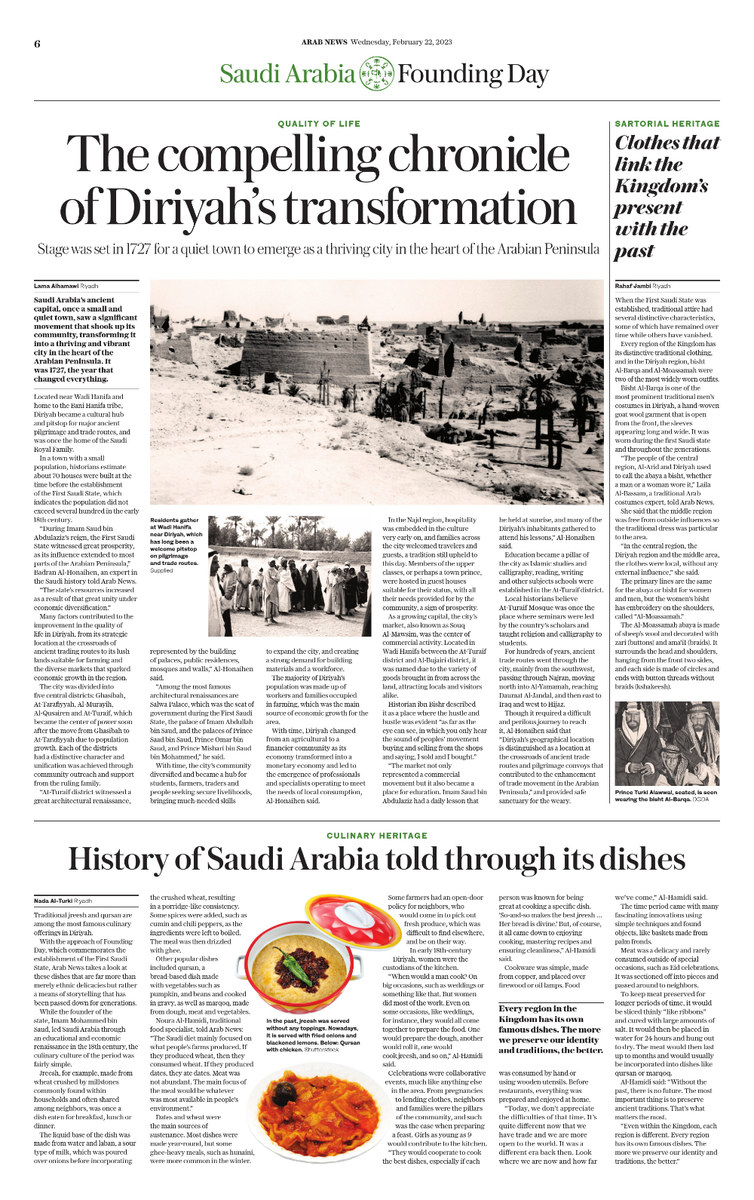
RIYADH: While the traditional dishes jreesh & qursan are one of the famous traditional dishes in Diriyah, their origins stretch back centuries.

With the approach of Founding Day, which commemorates the establishment of the first Saudi state, Arab News takes a look at these dishes that are far more than merely ethnic delicacies but rather a means of storytelling that has been passed down for generations.

While the founder of the state, Imam Mohammed bin Saud, led Saudi Arabia through an educational and economic renaissance in the 18th century, the culinary culture of the period was fairly simple. 

Jreesh, for example, made from wheat crushed by millstones commonly found within households and often shared among neighbors, was once a dish eaten for breakfast, lunch or dinner.

The liquid base of the dish was made from water and laban, a sour type of milk, which was poured over onions before incorporating the crushed wheat, resulting in a porridge-like consistency. Some spices were added, such as cumin and chili peppers, as the ingredients were left to boil, then stirred using utensils made from palm fronds or wood. The meal was then drizzled with ghee. 

Other popular dishes included qursan, a bread-based dish made with vegetables such as pumpkin, corn and beans and cooked in gravy, as well as marqoq, made from dough, meat and vegetables.

Noura Al-Hamidi, a traditional food specialist, told Arab News: “The Saudi diet mainly focused on what people’s farms produced. If they produced wheat, then they consumed wheat. If they produced dates, they ate dates. Meat was not abundant. The main focus of the meal would be whatever was most available in people’s environment.”

FASTFACT

Saudi cuisine

Culinary culture of the period when the first Saudi state existed was fairly simple. 

Produce such as tomatoes and carrots appeared when migration increased.

Dates and wheat were the main sources of sustenance. Most dishes were made year-round, but some ghee-heavy meals, such as hunaini, were more common in the winter.

Some farmers had an open-door policy for neighbors, who would come in to pick out fresh produce, which was difficult to find elsewhere, and be on their way.

In early 18th-century Diriyah, women were the custodians of the kitchen.

“When would a man cook? On big occasions, such as weddings or something like that. But women did most of the work. Even on some occasions, like weddings, for instance, they would all come together to prepare the food. One would prepare the dough, another would roll it, one would cook jreesh, and so on,” Al-Hamidi said.

Celebrations were collaborative events, much like anything else in the area. From pregnancies to lending clothes, neighbors and families were the pillars of the community, and such was the case when preparing a feast. Girls as young as 9 years old would contribute to the kitchen.

“They would cooperate to cook the best dishes, especially if each person was known for being great at cooking a specific dish. ‘So and so makes the best jreesh… her marqoq is amazing, a third’s qursan is divine.’ But, of course, it all came down to enjoying cooking, mastering recipes and ensuring cleanliness,” Al-Hamidi said.

Cookware was simple, made from copper, and placed over firewood or oil lamps. Food was consumed by hand or using wooden utensils. Before restaurants, everything was prepared and enjoyed at home.

“Today, we don’t appreciate the difficulties of that time. It’s quite different now that we have trade and we are more open to the world. It was a different era back then. Look where we are now and how far we’ve come,” Al-Hamidi said.

The time period came with many fascinating innovations using simple techniques and found objects, like baskets made from palm fronds.

Meat was a delicacy and rarely consumed outside of special occasions, such as Eid celebrations. It was sectioned off into pieces and passed around to neighbors.

To keep meat preserved for longer periods of time, it would be sliced thinly “like ribbons” and cured with large amounts of salt, according to Al-Hamidi.

It would then be placed in water for 24 hours and hung out to dry. The meat would then last up to months and would usually be incorporated into dishes like qursan or marqoq.

“Without the past, there is no future,” Al-Hamidi said. “The most important thing is to preserve ancient traditions. That’s what matters the most. We are proud of such traditions, and they make us unique.

“Even within the Kingdom, each region is different. Every region has its own famous dishes. The more we preserve our identity and traditions, the better.”

Absher Hackathon finalists highlight scale of Saudi tech talent

Updated 14 December 2025
Follow

Absher Hackathon finalists highlight scale of Saudi tech talent

  • World’s largest hackathon underscores growing national enthusiasm for tech innovation

RIYADH: Saudi Arabia’s push to position itself as a global hub for digital innovation was on display this weekend as the Absher Tuwaiq Hackathon 2025 — billed as the world’s largest hackathon — concluded with the announcement of finalist teams competing for prizes totaling SR1 million ($266,000). 

The three-day hackathon, organized by the Ministry of Interior in partnership with Tuwaiq Academy, brought together innovators from across the Kingdom to develop digital solutions aligned with the ministry’s digital transformation goals. 

The finalist teams recognized for their projects were: Shadow, Wusool, Watheeq , Tanabbah, HRS, Ikhlaa, Amal, Mustabiq, Al‑Dahna, Inspire, Saqour Al‑Watan, Thaqib, Sawt Al‑Mustaqbal, Manee, and YS Advance International. 

The finalists were announced at the end of the three-day Absher Tuwaiq Hackathon organized by the Ministry of Interior in partnership with Tuwaiq Academy. (AN photo/Supplied)

In addition to cash prizes, the competition offered SR450,000 in support from the National Technology Development Program, along with incubation opportunities at Invi Lab to help teams turn prototypes into market-ready products.   

Tariq Al‑Hamid, official spokesperson for the Absher Conference, told Arab News that the hackathon has generated strong momentum nationwide.  

This year’s event included more than 4,000 participants from all regions of the Kingdom — “a reflection of the growing national enthusiasm for digital innovation,” he said. 

HIGHLIGHT

The Absher Tuwaiq Hackathon brought together innovators from across the Kingdom to develop digital solutions aligned with the ministry’s digital transformation goals. 

According to Al‑Hamid, the 2025 event was structured around four specialized tracks: digital identity and security applications; artificial intelligence for predictive and proactive security; Internet of Things applications supporting field operations; and innovations to enhance or expand services on the Absher Platform. 

Tariq Al-Hamid (center) said that the hackathon’s impact extends beyond prize money. (Supplied)

He added that this focused approach allowed participants “to present high‑quality ideas and advanced prototypes at levels comparable to international competitions.” 

Participants also took part in more than 80 training programs delivered by global partners including Google Cloud, Meta, NVIDIA, and Huawei, an experience Al-Hamid said significantly strengthened both the competition and participants’ skills. 

Al-Hamid said that the hackathon’s impact extends beyond prize money. “More important than the cash reward is the opportunity to turn creative ideas into real products that make an impact on citizens, residents, and visitors.” 

Standout participants often attract the attention of leading national technology companies seeking new talent, he added. 

Participation was open to individuals and teams from across Saudi Arabia, from high school students to industry professionals, highlighting the inclusivity of the event and the breadth of the Kingdom’s innovation ecosystem.  

The hackathon forms part of the wider Absher Tuwaiq initiative, a core pillar of the upcoming Absher Conference 2025, which will empower more than 100,000 participants across seven technical tracks in 16 cities, in partnership with 20 local and international organizations. 

The conference, organized by the Ministry of Interior and Tuwaiq Academy, sponsored by Elm Company and held in strategic partnership with the Saudi Data and Artificial Intelligence Authority, will take place in Riyadh from Dec. 17 -19. 

The event will showcase national digital innovations and reinforce Saudi Arabia’s role in global technology.