Turkiye rejects links between NATO expansion, F-16 deal

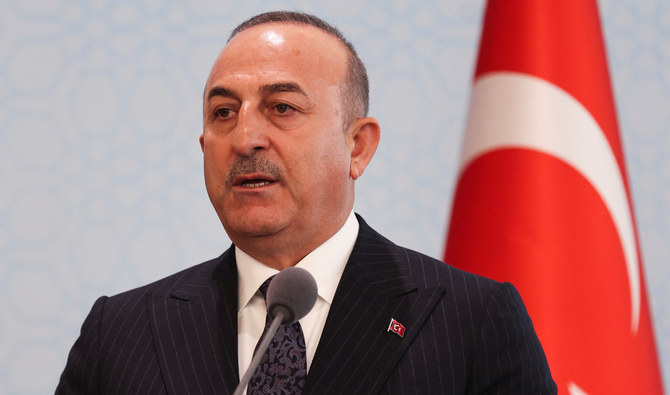
Turkish Foreign Minister Mevlut Cavusoglu. (AFP)
Short Url
Updated 20 February 2023
Follow

Turkiye rejects links between NATO expansion, F-16 deal

ANKARA: US Secretary of State Antony Blinken on Monday called for Sweden and Finland to be accepted into NATO “as quickly as possible,” although his Turkish counterpart dismissed the possibility of any link between their accession and Turkiye’s request for F-16 fighter jets.

Turkiye has delayed the Nordic countries admission to the trans-Atlantic defense alliance, citing concerns over terrorism. 

Meanwhile, members of the US Congress have tied approval of the F-16 deal to Ankara retracting its opposition to the NATO enlargement.

“We’re confident that NATO will formally welcome them in soon,” Blinken told a joint news conference with Turkish Foreign Minister Mevlut Cavusoglu in Ankara. “And when that happens, it will enhance the security of every NATO member, including the US, including Turkiye.”

Cavusoglu repeated Turkiye’s position that it would be willing to approve Finland joining NATO before Sweden. 

Turkiye has complained about what it sees as Stockholm’s tolerance of support for the Kurdistan Workers’ Party, or PKK, which has waged a 39-year insurgency against Ankara.

“Unfortunately PKK supporters are still present in Sweden,” he said. “They are recruiting people and they are financing terror acts and they are carrying out terror propaganda in Sweden ... because they don’t want Sweden to become a NATO member.”

While acknowledging that Sweden had made constitutional changes in a bid to satisfy Turkiye’s demands, he said that more needed to be done to “convince our parliament and people.”

Ankara has also been angered by Sweden allowing protests against Turkish President Recep Tayyip Erdogan and not preventing an anti-Islam activist from burning the Qur’an, the Muslim holy book, in a separate, solitary protest.

Swedish Prime Minister Ulf Kristersson said Monday he remained “convinced that (Sweden and Finland) will join together.” He added: “Ultimately, it is a Turkish decision to decide on ratification, that has not changed.”

In Ankara, Cavusoglu made clear his country objects to the sale of F-16 jets being tied to ratifying the NATO membership of Sweden and Finland which must be agreed by all 30 members of the alliance. Only the parliaments of Turkiye and Hungary have yet to give consent.

“It would not be right or fair to make two independent issues — the two countries’ NATO membership and the purchase of F-16s — conditional on each other,” Cavusoglu said.

“It would not be possible for us to purchase the F-16s under these conditions.”

Ankara has been seeking to upgrade its F-16 fleet after it was kicked off the project to develop the next-generation F-35 fighter following its acquisition of Russian air defense missiles.

Underlining the US administration’s support for the F-16 deal, Blinken said it was “very important for ongoing NATO interoperability and in the national interest of the United States.”

Blinken also commented on reports that China is considering military support for Russia in its war in Ukraine.

“We are concerned that China is considering supporting Russia’s war effort in Ukraine with lethal assistance, something that we are watching very, very closely,” he said.

Reiterating that there would be “real consequences... were China to provide lethal assistance to Russia” or help Moscow evade sanctions in a “systematic way,” he said there was a “real concern that China is considering doing just that.”

While not explaining these consequences, Blinken added that other countries, not just the US, would take similar action.

Blinken was in Turkiye for the first time since he was appointed two years ago.

The trip comes after the country and neighboring Syria were hit by a 7.8-magnitude earthquake on Feb. 6 that has left nearly 45,000 dead.

He met with US and Turkish military personnel and aid workers at Incirlik Air Base near Adana on Sunday.

They have been working to provide vital aid and assistance to the disaster zone.

Blinken promised a further $100 million in aid to help Turkiye and Syria on top of the $85 million that US President Joe Biden announced for Turkiye and Syria days after the earthquake.

The US secretary of state said that Washington had acted “within hours” of the disaster and had so far sent hundreds of personnel and relief supplies.

But he said that ordinary Americans had also responded to “heart-breaking” images from the quake zone.

“We have nearly $80 million in donations from the private sector in the United States, (from) individuals. When I visited the Turkish Embassy in Washington, I almost couldn’t get in the front door because boxes were piled high throughout the driveway to the embassy,” Blinken said.

“Turkiye faces a long road ahead to support those rendered homeless and to rebuild ... and we’re committed to providing support.”

Cavusoglu welcomed US support in the aftermath of the quake.

“I would like to thank them for not leaving us alone during these challenging times,” he said.


Syrian military tells civilians to evacuate contested area east of Aleppo amid rising tensions

Updated 15 January 2026
Follow

Syrian military tells civilians to evacuate contested area east of Aleppo amid rising tensions

  • Syria’s military has announced it will open a “humanitarian corridor” for civilians to evacuate from an area in Aleppo province
  • This follows several days of intense clashes between government forces and the Kurdish-led Syrian Democratic Forces

DAMASCUS: Syria’s military said it would open a corridor Thursday for civilians to evacuate an area of Aleppo province that has seen a military buildup following intense clashes between government and Kurdish-led forces in Aleppo city.
The army’s announcement late Wednesday — which said civilians would be able to evacuate through the “humanitarian corridor” from 9 a.m. to 5 p.m. Thursday — appeared to signal plans for an offensive in the towns of Deir Hafer and Maskana and surrounding areas, about 60 kilometers (40 miles) east of Aleppo city.
The military called on the Kurdish-led Syrian Democratic Forces and other armed groups to withdraw to the other side of the the Euphrates River, to the east of the contested zone.
Syrian government troops have already sent troop reinforcements to the area after accusing the SDF of building up its own forces there, which the SDF denied. There have been limited exchanges of fire between the two sides, and the SDF has said that Turkish drones carried out strikes there.
The government has accused the SDF of launching drone strikes in Aleppo city, including one that hit the Aleppo governorate building on Saturday shortly after two Cabinet ministers and a local official held a news conference there.
The tensions in the Deir Hafer area come after several days of intense clashes last week in Aleppo city that ended with the evacuation of Kurdish fighters and government forces taking control of three contested neighborhoods. The fighting killed at least 23 people, wounded dozens more, and displaced tens of thousands.
The fighting broke out as negotiations have stalled between Damascus and the SDF, which controls large swaths of northeast Syria, over an agreement to integrate their forces and for the central government to take control of institutions including border crossings and oil fields in the northeast.
Some of the factions that make up the new Syrian army, which was formed after the fall of former President Bashar Assad in a rebel offensive in December 2024, were previously Turkiye-backed insurgent groups that have a long history of clashing with Kurdish forces.
The SDF for years has been the main US partner in Syria in fighting against the Daesh group, but Turkiye considers the SDF a terrorist organization because of its association with the Kurdistan Workers’ Party, or PKK, which has waged a long-running insurgency in Turkiye. A peace process is now underway.
Despite the long-running US support for the SDF, the Trump administration has also developed close ties with the government of interim Syrian President Ahmad Al-Sharaa and has pushed the Kurds to implement the integration deal. Washington has so far avoided publicly taking sides in the clashes in Aleppo.
The SDF in a statement warned of “dangerous repercussions on civilians, infrastructure, and vital facilities” in case of a further escalation and said Damascus bears “full responsibility for this escalation and all ensuing humanitarian and security repercussions in the region.”
Adm. Brad Cooper, commander of US Central Command, said in a statement Tuesday that the US is “closely monitoring” the situation and called for “all parties to exercise maximum restraint, avoid actions that could further escalate tensions, and prioritize the protection of civilians and critical infrastructure.” He called on the parties to “return to the negotiating table in good faith.”
Al-Sharaa blasts the SDF
In a televised interview aired Wednesday, Al-Sharaa praised the “courage of the Kurds” and said he would guarantee their rights and wants them to be part of the Syrian army, but he lashed out at the SDF.
He accused the group of not abiding by an agreement reached last year under which their forces were supposed to withdraw from neighborhoods they controlled in Aleppo city and of forcibly preventing civilians from leaving when the army opened a corridor for them to evacuate amid the recent clashes.
Al-Sharaa claimed that the SDF refused attempts by France and the US to mediate a ceasefire and withdrawal of Kurdish forces during the clashes due to an order from the PKK.
The interview was initially intended to air Tuesday on Shams TV, a broadcaster based in Irbil — the seat of northern Iraq’s semi-autonomous Kurdish region — but was canceled for what the station initially said were technical reasons.
Later the station’s manager said that the interview had been spiked out of fear of further inflaming tensions because of the hard line Al-Sharaa took against the SDF.
Syria’s state TV station instead aired clips from the interview on Wednesday. There was no immediate response from the SDF to Al-Sharaa’s comments.