

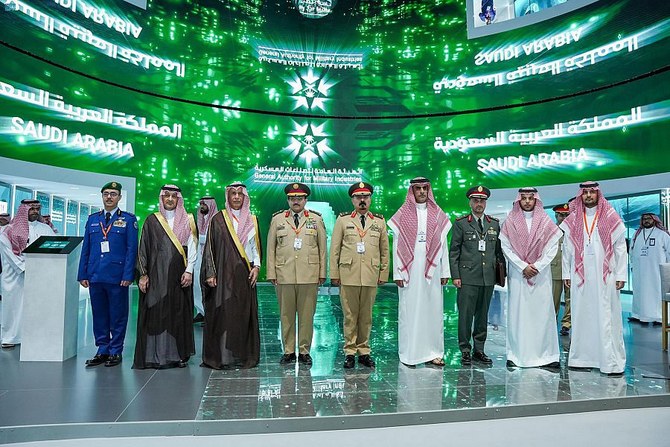
GAMI launches Saudi pavilion at IDEX 2023, eyes expansion

the KSA pavilion will see representation from the Saudi Ministry of Interior, the Saudi Ministry of Investment, as well as 14 private sector defense firms (SPA)
Short Url
Updated 20 February 2023
Follow

GAMI launches Saudi pavilion at IDEX 2023, eyes expansion

RIYADH: Saudi Arabia’s General Authority for Military Industries has launched the Kingdom’s pavilion at the 16th edition of the International Defense Exhibition in Abu Dhabi.

Inaugurated by the GAMI Gov. Ahmad Al-Ohali, the pavilion is anticipated to further expand and increase outreach after what was a dynamic 2022 for the company, according to a statement.

On the opening day of the event, the defense regulator, enabler, and licensor pinpointed and shed light on multiple investment opportunities and prospects worth billions of dollars in an attempt to incentivize and further encourage investors from around the world.

This comes as the Kingdom is aiming for localizing half of the defense expenditure by the year 2030.

“We have achieved a localization rate of 11.7 percent in 2022, up from just 2 percent in 2018,” Al-Ohali said. 

“Strategic partnerships with global investors have been a key component of this success, and IDEX 2023 is a great opportunity for us to meet industry leaders who are keen to join us along our journey of localizing more than 50 percent of our defense expenditure by the year 2030,” the governor added.

In addition to this, the KSA pavilion will see representation from the Saudi Ministry of Interior, the Saudi Ministry of Investment, as well as 14 private sector defense firms.

Moreover, in line with the Saudi Vision 2030, GAMI continues to contribute to the Kingdom’s economic diversification efforts through the numerous strategic programs such as the supply chain localization and the Military Industry Human Capital Strategy – which ranges from manufacturing to education.

“We are delighted to be present at IDEX 2023 to showcase our initiatives and our sector’s capabilities to the global defense community, and to empower meaningful and strategic engagement between our KSA pavilion partners amongst key public and private sector entities, and our valued stakeholders and investors from all over the world,” the governor said.

IDEX 2023 aims to offer a global platform through which the latest innovations in international defense with regards to advanced technology and equipment are showcased and discussed.


Saudi consumer inflation eases to 1.8% in January: GASTAT 

Updated 4 sec ago
Follow

Saudi consumer inflation eases to 1.8% in January: GASTAT 

RIYADH: Saudi Arabia’s inflation softened to 1.8 percent in January, signaling contained price pressures even as housing rents remained the main driver of consumer costs, official data showed.  

According to the General Authority for Statistics, average prices for housing, water, electricity, gas and other fuels rose 4.2 percent in January, reflecting a 5.2 percent increase in actual residential rents. 

Saudi Arabia’s inflation trajectory broadly aligns with projections by the International Monetary Fund, which said in October the Kingdom is expected to maintain an annual inflation rate of about 2 percent in 2026. 

In its latest report, GASTAT stated: “The Consumer Price Index in Saudi Arabia recorded an annual increase of 1.8 percent in January 2026, compared to the same month of the previous year.”   

It added: “This increase was mainly driven by a rise in housing, water, electricity, gas, and other fuel prices by 4.2 percent, transport prices by 1.5 percent and restaurant and accommodation services prices by 1 percent.”  

According to the report, expenses for personal care, social protection and miscellaneous goods and services increased 7.9 percent year on year in January, while insurance and financial services costs rose 3.3 percent. 

Prices for recreation, sport and culture increased 2.3 percent, driven by a 3.7 percent rise in package holiday expenses. Education service prices rose 1.6 percent, reflecting higher secondary education costs. 

Food and beverage prices increased 0.2 percent year on year. 

Conversely, prices for furnishings, household equipment and routine household maintenance fell 0.3 percent in January, while healthcare expenses declined 0.1 percent over the same period. 

On a month-on-month basis, Saudi Arabia’s CPI rose 0.2 percent in January from December. 

Housing, water, electricity, gas and other fuels increased 0.5 percent month on month, again driven by higher residential rents. Transport prices rose 0.2 percent, while restaurant and accommodation services gained 1 percent. 

Food and beverage prices fell 0.6 percent during the month, and information and communication costs slipped 0.1 percent. Education, healthcare, furnishings and tobacco prices were largely unchanged. 

Wholesale Price Index 

In a separate report, GASTAT said Saudi Arabia’s Wholesale Price Index rose 2.9 percent in January compared with the same month in 2025. 

The increase was attributed to higher prices for other transportable goods — excluding metal products, machinery and equipment — which climbed 4.9 percent, as well as agricultural and fishery products, which rose 4.2 percent. 

Metal products, machinery and equipment prices increased 1.2 percent year on year in January, while food products, beverages, tobacco and textiles rose 0.3 percent. Ores and mineral prices declined 0.1 percent. 

Compared with December, the Kingdom’s WPI increased 1.5 percent, driven by a 3.4 percent rise in other transportable goods excluding metal products, machinery and equipment. 

On a month-on-month basis, agricultural and fishery product prices increased 0.5 percent, while food products, beverages, tobacco and textiles posted a modest 0.2 percent gain. 

Average prices 

In another report, GASTAT highlighted notable changes in average prices of goods and services across Saudi Arabia in January. 

Local watermelon recorded the largest month-on-month increase at 7.5 percent, followed by local black eggplants at 6.5 percent, local okra at 6.3 percent and Indian pomegranates at 6.1 percent. 

Conversely, several items posted sharp price declines. 

Abu Sorra Egyptian oranges recorded the steepest fall at 28.2 percent, followed by Pakistani mandarins at 21.3 percent and green beans at 12.3 percent.