

Main Afghan-Pakistani border crossing closed, residents report gunfire

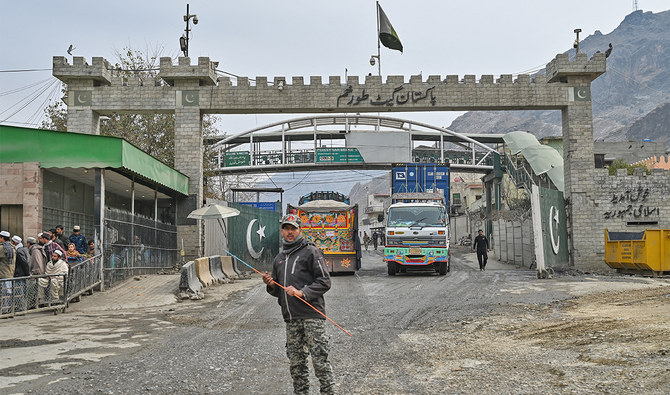
In this picture taken on February 2, 2023, a Pakistan border policeman is pictured from the zero point Torkham border crossing between Afghanistan and Pakistan, in Nangarhar province. (AFP/File)
Short Url
Updated 20 February 2023
Follow

Main Afghan-Pakistani border crossing closed, residents report gunfire

  • Disputes linked to the 2,600km border have been a bone of contention between the neighbors for decades
  • It was not immediately clear if the Afghan or the Pakistani authorities closed the Torkham border crossing

KABUL/PESHAWAR: The main border crossing between Afghanistan and Pakistan was closed on Monday, officials from the two sides said, and residents in the area reported the sound of gunfire near the normally bustling border transit point. 

It was not immediately clear if Afghan or Pakistani authorities closed the Torkham border crossing, near the Khyber Pass, but it comes after relations between Afghanistan’s ruling Taliban and Pakistan have deteriorated sharply. 

“The border is closed, we will share details later,” a spokesperson for the Taliban administration’s police force in the eastern Afghan province of Nangahar told Reuters. 

Media reported that the border was closed on Sunday evening but did not give a reason. 

Pakistani military, police and government spokespeople were not immediately available for comment but two Pakistani security officials in the region confirmed that the border had been closed and some gunfire had been exchanged. 

Disputes linked to the 2,600 km (1,615 mile) border have been a bone of contention between the neighbors for decades. 

The Torkham border point is the main point of transit for travelers and goods between Pakistan and landlocked Afghanistan. 

Mohammad Ali Shinwari, a resident of Landi Kotal on the Pakistani side, said the border had been closed late on Sunday and gunfire erupted early on Monday. 

“When we heard gunshots in the morning, we got worried and believed that troops of the two countries might have started fighting,” he said. 

Clashes on the border have occurred for years, during the two-decade rule of Afghanistan’s US-backed government and since the Taliban took over Afghanistan in 2021. 

Clashes between Afghan and Pakistani security forces have also at times closed the second most important crossing between the two countries, at Chaman to the south. 

Pakistan’s foreign minister told a security conference in Germany on Sunday that the risks of militancy stemming from Afghan soil could affect the world. 

A Taliban foreign ministry spokesperson said later Pakistan should raise issues in private and not at public forums. 

The foreign ministry said the Taliban administration would not allow its territory to be used against other countries, particularly against its neighbors. 


Curfew extended in Gilgit-Baltistan, probe ordered after deadly Khamenei protests

Updated 03 March 2026
Follow

Curfew extended in Gilgit-Baltistan, probe ordered after deadly Khamenei protests

  • At least 15 people were killed in clashes with law enforcement agencies over the weekend in Gilgit-Baltistan
  • Government also announces a de-weaponization campaign, crackdown on hate speech and cybercrime in region

ISLAMABAD: The government in Pakistan’s Gilgit-Baltistan (GB) region on Tuesday extended a curfew in Gilgit district and ordered a judicial probe into violent protests over the killing of Iranian Supreme Leader Ali Khamenei in US-Israeli strikes last week, an official said.

At least 15 people were killed in clashes with law enforcement agencies over the weekend in GB, where protesters torched and vandalized several buildings, including United Nations regional offices, an army-run school, software technology park and a local charity building.

The violence prompted regional authorities to impose curfew in Gilgit and Skardu districts on March 2-4 as officials urged people to stay indoors and cooperate with law enforcers, amid widespread anger in Pakistan, particularly among members of the Shiite minority, over Khamenei’s killing.

On Tuesday, the GB government convened to review the situation and announced the extension of curfew in Gilgit among a number of security measures as well as ordered the establishment of a judicial commission to investigate the weekend violence in the region.

“The government has made it clear that the law will strictly take its course against elements involved in vandalism at government institutions, private properties and incidents of vandalism in Gilgit and Skardu and no kind of mischief will be tolerated,” Shabbir Mir, a GB government spokesperson, said in a statement.

“In view of the security situation, curfew will remain in force in Gilgit, while the decision to extend the curfew in Skardu will be taken keeping the ground realities and the changing situation in view.”

The statement did not specify how long the curfew will remain in place in Gilgit.

Besides the formation of the judicial commission to investigate the violent clashes, the government also decided to launch a large-scale de-weaponization campaign in the entire Gilgit district, for which relevant institutions have been directed to immediately complete all necessary arrangements, according to Mir.

In addition, a crackdown has been ordered on hate speech, spread of fake news and cybercrime.

“The aim of these decisions is to ensure the rule of law, protect the lives and property of citizens and crack down on miscreants,” he said. “Approval has also been given to immediately survey the affected infrastructure and start their restoration work on priority basis.”

Demonstrators in Pakistan’s southern port city of Karachi also stormed the US Consulate on Sunday, smashing windows and attempting to burn the building. Police responded with batons, tear gas, and gunfire, leaving 10 people dead and more than 50 injured.

Pakistani authorities have since beefed up security at US diplomatic missions across the country, including around the US consulate building in Peshawar, to avoid any further violence.