

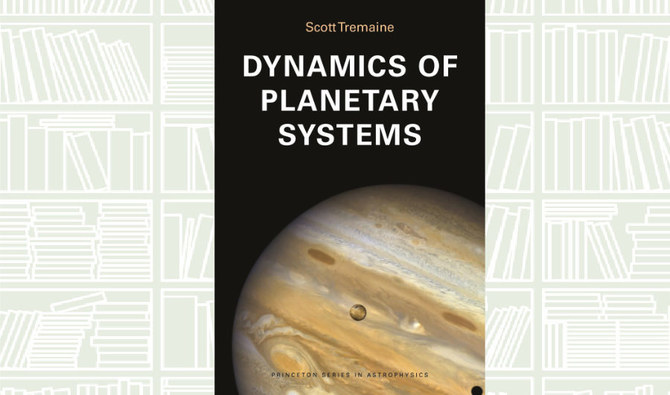
What We Are Reading Today: Dynamics of Planetary Systems

Photo/Supplied
Short Url
Updated 19 February 2023
Follow

What We Are Reading Today: Dynamics of Planetary Systems

Author: SCOTT TREMAINE

Celestial mechanics—the study of the movement of planets, satellites, and smaller bodies such as comets—is one of the oldest subjects in the physical sciences. Since the mid-twentieth century, the field has experienced a renaissance due to advances in space flight, digital computing, numerical mathematics, nonlinear dynamics, and chaos theory, and the discovery of exoplanets. This modern, authoritative introduction to planetary system dynamics reflects these recent developments and discoveries and is suitable for advanced undergraduate and graduate students as well as researchers.


Book Review: ‘Gut: the inside story of our body’s most underrated organ’

Updated 30 January 2026
Follow

Book Review: ‘Gut: the inside story of our body’s most underrated organ’

The New York Times bestseller “Gut: the inside story of our body’s most underrated organ” by Dr. Giulia Enders is an eye-opener.

Originally published in German in 2014 as “Darm mit Charme,” the English version, “Gut,” translated by David Shaw, has gone through several revisions, the most recent of which was published in January 2026.

Layering her medical knowledge with lived human experience, Enders shapes the material at hand into a tangible map of digestion, metabolism and immunity while weaving in real life stories to tie it all in.

She begins with her own personal story, before providing additional context as an expert who specializes in internal medicine and gastroenterology, with a focus on gut health, microbiology and the gut-brain connection.

While some parts might seem like an oversimplification, I like her storytelling style — she makes the dense science accessible for the masses.

Viewers of Netflix might have seen her animated antidotes more recently as one of the main experts in the 2024 documentary, “Hack your Health: The Secrets of Your Gut.”

Similarly, in this book, she expressively explores the microbiome’s connection to the brain and delves into psychobiotics — the microbes that influence mood, stress and even depression.

Enders showcases how and why the gut is powerful; it is not just background machinery within the human body, or even an organ often oddly used as a punchline in a joke.

She highlights how digestion, immunity, metabolism, and mental health are all intertwined and that the gut might arguably be the most vital and predictable organ we could use as a metric to predict overall imminent and immune health.

Some of the things she mentions at the beginning of the book hit me in the gut, as they say. She touches on some key things that are intricately linked and might unlock some of the digestive issues one might develop throughout one’s life. I feel seen.

Nodding along with nearly each page flip, I found my stomach flipping with excitement too, finally finding the parallels between her early experiences and connecting it to my own eventual gut issues.

By the last page, “Gut” will leave you aware that everything does happen for a reason.

You feel those butterflies in your stomach? It is not merely poetic — it signals much more than a seemingly fleeting feeling. It is central to how your whole body works. The “gut feeling” is not just a feeling but also a fact.

“Seen under the microscope, bacteria look like nothing but little, bright spots. But taken together, their sum is much greater than their parts,” she writes.

“Most sit in our mucus membrane, training our immune system, soothing our villi, and producing vitamins. If the good and the bad are in equilibrium, the bad ones can make us stronger and the good ones can keep us healthy.”

When the science parts get slightly too heavy, the whimsy illustrations scattered throughout the book will make you feel grounded. Illustrated by her older sister, Jill Enders, the playful drawings make the complex concepts even easier to digest.