

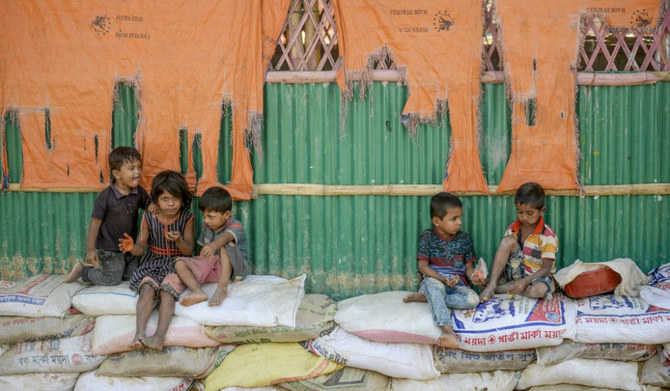

DHAKA: The UN’s decision to slash food aid to Rohingya refugees in Bangladesh would have catastrophic consequences, experts warned on Friday, as the World Food Program plans to reduce rations from next month.
Bangladesh hosts more than 1.2 million Rohingya Muslims, most of whom escaped deadly violence and persecution in neighboring Myanmar during a military crackdown in 2017.
International aid for the Rohingya has been dropping since 2020 despite urgent pleas for donations by the UN World Food Program Rohingya Refugee Response. The WFP is appealing for $125 million in funding to avoid ration cuts and has warned it would reduce the value of its food assistance to $10 per person from $12, or by 17 percent, starting March.
If no new funding commitments are made by April, the UN body said another round of deeper reductions will have to be made.
The cuts, which will coincide with the Muslim holy month of Ramadan, would deepen food insecurity and child malnutrition in Rohingya camps in Bangladesh, which are already the world’s largest refugee settlement.
The rations currently provided to the Rohingya are already insufficient and further decreasing them would pose grave health problems for the refugee population.
“Without access to nutritious food, children will be malnourished and there may be effects on their growth as well as their life expectancy. That may actually go down over a period of time,” Asif Munier, a migration expert and former official of the International Organization for Migration, told Arab News.
Two UN special rapporteurs, Michael Fakhri and Thomas Andrews, warned that the cuts would impact vulnerable people who are already food insecure.
“Acute malnutrition levels remain high, and chronic malnutrition is pervasive among the Rohingya refugee population in Bangladesh, with more than a third of children stunted and underweight,” they said in a Human Rights Council report.
“The most vulnerable, including children under 5, adolescent girls, and pregnant and breastfeeding mothers, will be particularly exposed…The Rohingya, survivors of genocidal attacks by the Myanmar military, are now further victimized by the failure of the international community to ensure their basic right to food.”
Bangladesh is not a signatory to the 1951 UN Refugee Convention and the Rohingya it is hosting cannot be legally employed to earn their livelihood. They also cannot freely leave their camps to engage in any business activity with the local community.
The refugees are dependent on aid, and if it is lacking, more of them will be desperate to leave, which may affect the security situation.
Mohammed Nur Khan, renowned Bangladeshi rights activist and migration expert, said that if food supplies are insufficient, the Rohingya will try to move to other places in Bangladesh, which would have repercussions on Bangladeshi society.
“There will be social problems. The Rohingya are not acquainted with the social system of Bangladesh, and vice versa. So, there will be a crisis in this context,” he told Arab News.
“When people are experiencing a crisis with no solution, this makes them desperate, and law and order will deteriorate.”


