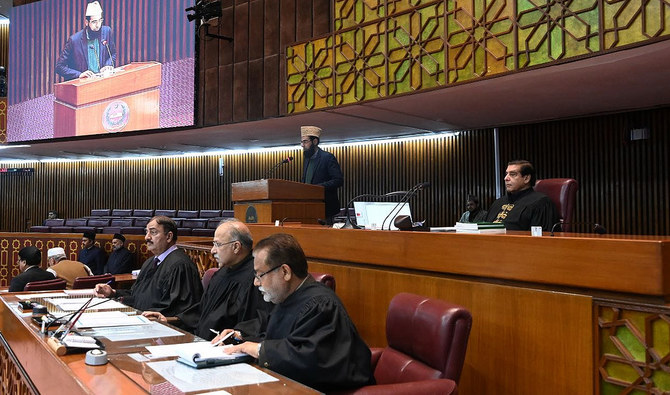

ISLAMABAD: A session of the National Assembly, the lower house of Pakistan parliament, was adjourned on Friday, without a vote on a bill to collect additional taxes for the resumption of the country's stalled $6.5 billion International Monetary Fund (IMF) loan program.
Finance Minister Ishaq Dar tabled the bill in parliament on Wednesday to collect additional taxes to revive the loan program, stalled since late last year, with the IMF imposing tough conditions on the South Asian nation already struggling with surging inflation and macroeconomic problems.
The South Asian nation of 220 million is making frantic attempts to complete all prior actions suggested by the global lender to reach a staff-level agreement for the disbursement of a $1.2 billion tranche as part of the bailout program secured in 2019.
The National Assembly was expected to hold a vote on the bill, so that it could be sent to the president for approval and subsequent progress on the IMF conditions. However, Speaker Raja Pervez Ashraf briefly presided over the session of the assembly before it was adjourned until Monday.
“NA session has been adjourned to meet again on Monday, the 20th February 2023 at 5:00 pm,” read a tweet on the official National Assembly account Friday noon.
Ashraf said that more lawmakers were interested in speaking on the bill that is crucial to unlocking the stalled IMF funds.
In the finance bill, Finance Minister Dar proposed increasing the general sales tax (GST) rate from 17 percent to 18 percent, besides increasing federal excise duty (FED) on cigarettes and sugary drinks, to generate additional revenues.
The minister said tax on luxury items was also being increased from 17 percent to 25 percent.
The bill proposes the FED on business and first-class air tickets be increased by up to 50 percent and a 10 percent withholding adjustable advance income tax on marriages in wedding halls. It also calls for the FED on cement to be increased from Rs1.5 per kilogram to Rs2 per kilogram.
The government hopes to reach a staff-level-agreement with the IMF next week after the passage of the bill.
During the brief debate on the bill, lawmakers from the government-allied parties criticised the additional burden and called on the finance minister to review it in light of the recommendations floated by parliamentarians.
“If we are allies of the government, it means we want to steer the country out of the economic crisis,” Muttahida Qaumi Movement-Pakistan (MQM-P) lawmaker Salahuddin said, adding that the finance minister had already "dropped bombs" on the masses by increasing electricity, gas and petrol prices.
Pakistan Peoples Party (PPP) lawmaker Qadir Mandokhail suggested the government to impose additional taxes on luxury cars and palatial houses, instead of shifting the burden onto the poor. He proposed the government should tax social media apps like WhatsApp and Twitter, instead of levying taxes on phone calls.
“Please take care of the poor and impose maximum taxes on luxury bungalows, cars and property to lessen burden on the poor,” Mandokhail added.
Meanwhile, the Senate, the upper house of parliament, on Friday forwarded its recommendations on the supplementary bill to the National Assembly secretariat.
Senate Opposition Leader Dr Shahzad Waseem objected to the bill and urged the government to revise it and impose taxes only on rich individuals.
“We completely reject this finance bill as this is anti-poor and anti-people,” Waseem said on the floor of the Senate.
An IMF delegation was in Pakistan from January 31 to February 9 to discuss the revival of the program but departed without signing a staff-level agreement with Islamabad. The government is now holding virtual talks with the Washington-based lender, hoping to reach an agreement by the end of this week.
Once revived, the IMF program will also help unlock funding from Pakistan’s bilateral and multilateral donors.