IAEA chief lauds ‘world-class’ safety measures at Pakistani nuclear power plants

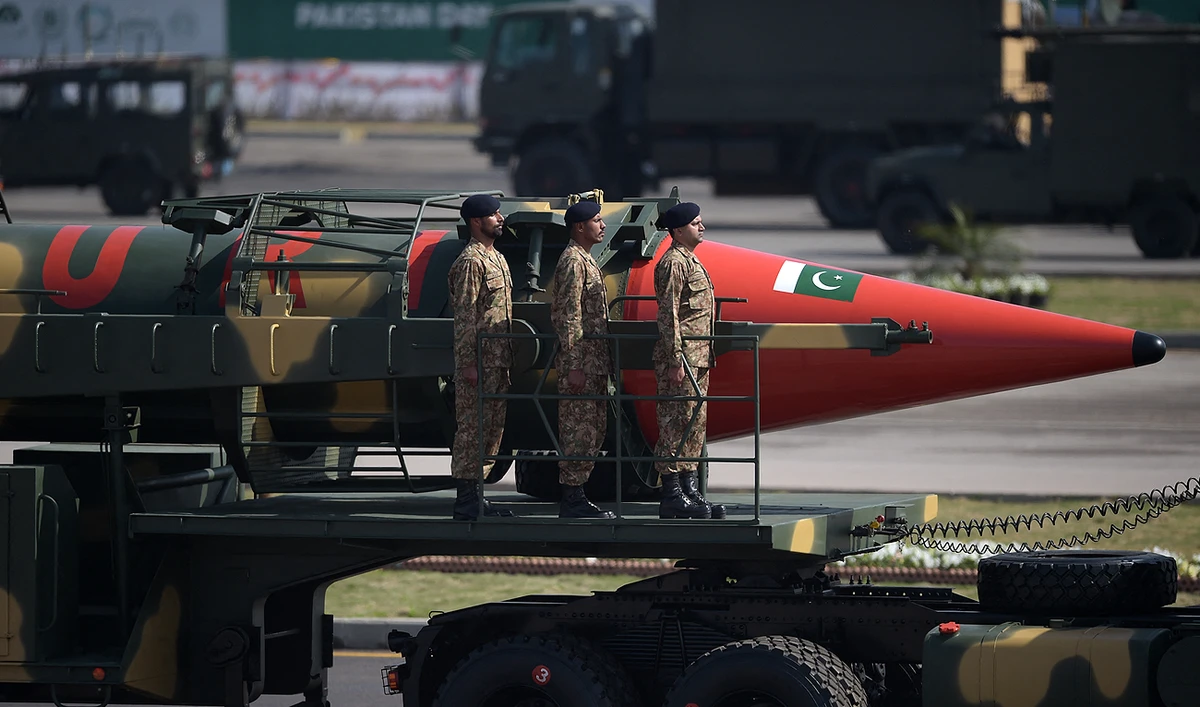
In this file photo taken on March 23, 2017, Pakistani military personnel stand beside a Ghauri nuclear-capable missile during a Pakistan Day military parade in Islamabad. (Photo courtesy: AFP/File)
Short Url
Updated 17 February 2023
Follow

IAEA chief lauds ‘world-class’ safety measures at Pakistani nuclear power plants

  • Rafael Mariano Grossi says Pakistan’s capacity to establish new plants indicates a promising future
  • For energy-deficient countries, nuclear power is ‘best solution’ to climate change, minister says

ISLAMABAD: International Atomic Energy Agency (IAEA) chief Rafael Mariano Grossi on Thursday lauded safety measures at Pakistani nuclear power plants as “world-class,” Pakistani state media reported, adding that the IAEA official acknowledged the South Asian country’s capacity to establish new reactors.

Grossi, who was on a two-day visit to Islamabad, said this at a seminar he addressed in the Pakistani capital together with the Pakistan’s Planning Minister Ahsan Iqbal. The purpose of his visit was to attend bilateral meetings and visit different institutions that make use of nuclear technology in health, agriculture, industry, and power generation.

The IAEA, an intergovernmental body, promotes safe and peaceful nuclear technology internationally. As a collaborative effort with its members and partners, it focuses on advancing the development of nuclear energy while ensuring its security and safety.

“Pakistan’s capacity in establishing new nuclear power plants indicates a promising future for nuclear energy and achieving Sustainable Development Goals,” Grossi was quoted as saying by the state-run Radio Pakistan broadcaster.

“There is strong political support for new nuclear power plants in Pakistan,” he said, acknowledging Pakistan’s technical and engineering capacity for new nuclear power plants.
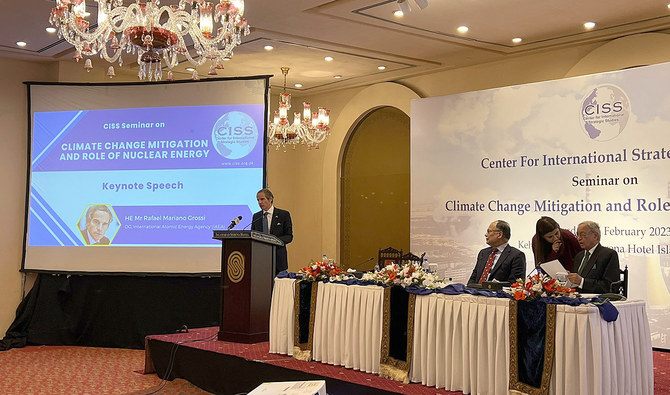


The International Atomic Energy Agency (IAEA) chief Rafael Mariano Grossi (center) speaks during a seminar on Climate Change Mitigation in Islamabad on February 16, 2023. (Photo courtesy: Twitter/rafaelmgrossi)

Pakistan is one of the founding members of the IAEA and has longstanding and mutually beneficial collaboration with the global agency since 1957.

Planning Minister Iqbal said Pakistan had a mutually beneficial relationship with the IAEA that included all areas of nuclear technology, according to the report.

He stated that despite of ranking as low as 158th among carbon-emitting countries, Pakistan is among the countries most severely affected by climate change.

“Pakistan has achieved great milestones in nuclear science and technology for the socio-economic uplift of the country in areas such as cancer diagnosis and treatment, development of disease-free and high-yield crop varieties and food preservation,” Iqbal was quoted as saying.

“Nuclear power provides clean and cheap energy and currently contributes to eight percent of Pakistan’s energy mix with six operational nuclear power plants.”

Iqbal said Pakistan had an impeccable nuclear safety and security record and plans to develop more power plants.

For energy-deficient, economically strained countries like Pakistan, nuclear power is sustainable, clean and a green source of energy, and is the best solution to the challenge of climate change, he added.
Pakistani business federation says EU envoy pledges support for training industrial workforce

Updated 4 sec ago
Follow

Pakistani business federation says EU envoy pledges support for training industrial workforce

  • Support aims to boost competitiveness as Pakistan expands skilled labor for exports and remittances
  • FPCCI says the country’s economic future hinges on preparing its workforce for modern technologies

ISLAMABAD: The European Union’s top diplomat in Pakistan has pledged support for the country’s push to train its industrial workforce, exporters and small businesses through the national technical and vocational education system, Pakistan’s top business federation said in a statement on Tuesday, calling the assistance critical for boosting competitiveness.

The commitment came during the first annual conference on Technical and Vocational Education and Training (TVET), jointly organized by the Federation of Pakistan Chambers of Commerce and Industry (FPCCI) and the TVET Sector Support Program, where the EU envoy addressed business leaders and government officials.

“Pakistani industries, exporters, trade bodies and SMEs will be facilitated and supported in their training, and exporters should draw maximum benefit from the GSP+ program,” said EU Ambassador Raymonds Kroblis, according to the FPCCI statement, referring to the EU trade scheme that grants Pakistan preferential, duty-free access for most exports in return for implementing international conventions.

He added that Pakistan’s economic future depended on preparing its workforce for modern technologies.
FPCCI President Atif Ikram Sheikh said Pakistan could “change its economic trajectory” through large-scale skills development and called for a sustained public–private partnership to modernize vocational training.

He said the federation would train 1,000 officials from chambers and trade bodies to strengthen workforce readiness.

Sheikh said Pakistan’s youth had “immense potential” and required structured opportunities to advance, both for domestic industry and for overseas employment.

Pakistan has been working to expand its pool of skilled workers to tap opportunities in Gulf economies, where higher-skilled migration could help lift remittances, a major stabilizing force for Pakistan’s economy.

Speakers at the conference said aligning Pakistan’s workforce with international standards was key to improving productivity, securing export growth and preparing workers for global labor markets.