

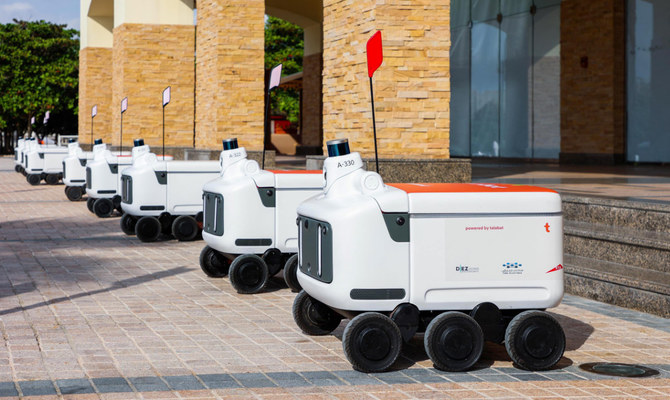
Pilot phase for Talabat food delivery robots in Dubai Silicon Oasis

The pilot launch of food delivery robots in Dubai Silicon Oasis has been announced by the UAE’s Roads and Transport Authority. (Dubai Media Office)
Short Url
Updated 16 February 2023
Follow

Pilot phase for Talabat food delivery robots in Dubai Silicon Oasis

  • ‘Talabots’ use advanced artificial intelligence to transport deliveries in 15 minutes within a range of 3 km.
  • Initiative blurs faces to prevent any facial recognition, in line with privacy laws

DUBAI: The pilot launch of food delivery robots in Dubai Silicon Oasis has been announced by the UAE’s Roads and Transport Authority, in partnership with the Integrated Economic Zones Authority, and Talabat UAE, the Emirates News Agency reported on Wednesday.

Three “talabots” will serve residents of a gated community in the heart of DSO during the pilot phase.

They will use advanced artificial intelligence to deliver food from point to point within a range of 3 km. from their launching point. They are intended to transport deliveries within 15 minutes.

Customers can track the robot’s journey and receive notifications when it arrives at their property using an app.

In accordance with UAE regulations governing the protection of the community’s privacy, the AI technology used in the talabots protects people’s identities by blurring faces to prevent any facial recognition.

The initiative aims to promote zero-emission modes of delivery using advanced technology, in line with Dubai’s goal of converting 25 percent of all transportation trips to smart and driverless by 2030.

DSO’s Director-General Dr. Juma Al Matrooshi said: “Smart mobility is one of the six pillars of DSO’s Smart City Strategy, which is at the core of piloting carbon-neutral delivery robots in a closely monitored and controlled environment within the hi-tech park.

“We look forward to the success of this trial, and its expansion as part of DSO’s role as an innovation and knowledge hub under the Dubai 2040 Urban Master Plan.”

Ahmed Bahrozyan, CEO of the Licensing Agency at the RTA, said that the authority was keen to broaden its partnerships with the private sector and aimed at spreading the culture of innovation in the transportation sector.


Saudi stock market opens its doors to foreign investors

Updated 06 January 2026
Follow

Saudi stock market opens its doors to foreign investors

RIYADH: Foreigners will be able to invest directly in Saudi Arabia’s stock market from Feb. 1, the Kingdom’s Capital Market Authority has announced.

The CMA’s board has approved a regulatory change which will mean the capital market, across all its segments, will be accessible to investors from around the world for direct participation.

According to a statement, the approved amendments aim to expand and diversify the base of those permitted to invest in the Main Market, thereby supporting investment inflows and enhancing market liquidity.

International investors' ownership in the capital market exceeded SR590 billion ($157.32 billion) by the end of the third quarter of 2025, while international investments in the main market reached approximately SR519 billion during the same period — an annual rise of 4 percent.

“The approved amendments eliminated the concept of the Qualified Foreign Investor in the Main Market, thereby allowing all categories of foreign investors to access the market without the need to meet qualification requirements,” said the CMA, adding: “It also eliminated the regulatory framework governing swap agreements, which were used as an option to enable non-resident foreign investors to obtain economic benefits only from listed securities, and the allowance of direct investment in shares listed on the Main Market.”

In July, the CMA approved measures to simplify the procedures for opening and operating investment accounts for certain categories of investors. These included natural foreign investors residing in one of the Gulf Cooperation Council countries, as well as those who had previously resided in the Kingdom or in any GCC country. 

This step represented an interim phase leading up to the decision announced today, with the aim of increasing confidence among participants in the Main Market and supporting the local economy.

Saudi Arabia, which ‌is more than halfway ‍through an economic plan ‍to reduce its dependence on oil, ‍has been trying to attract foreign investors, including by establishing exchange-traded funds with Asian partners in Japan and Hong Kong.