

US Army Central team arrives in Pakistan to share disaster management expertise

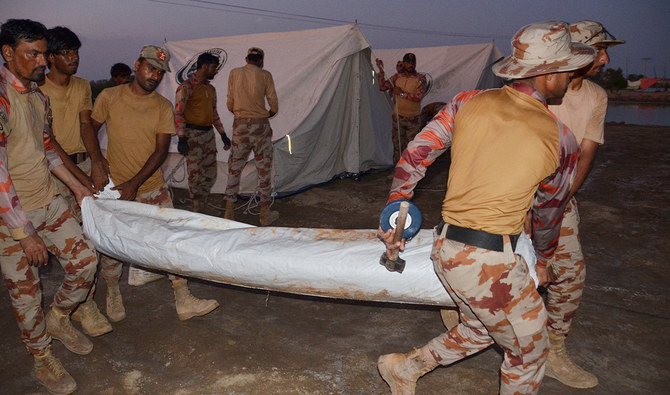
Pakistan army prepare to make tents for flood-affected people at a makeshift camp after heavy monsoon rains at Sohbatpur in Jaffarabad district of Balochistan province on September 3, 2022. (Photo courtesy: AFP/FILE)
Short Url
Updated 15 February 2023
Follow

US Army Central team arrives in Pakistan to share disaster management expertise

  • US team will hold training sessions with Pakistani disaster management authority 
  • Visit comes months after Pakistan suffered huge losses in devastating floods in 2022

ISLAMABAD: A delegation of the United States Army Central (USARCENT) has arrived in Pakistan on a four-day visit to meet with officials of the country’s disaster management authority, provide training and share expertise. 

The United States Army Central is home to America’s land domain experts in the Middle East, Central Asia, and South Asia. The operational-level force produces military plans, improves relationships and interoperability with partner nations through exercises, and facilitates the seamless transition of joint forces in and out of war theater.

The visit by the US team comes months after Pakistan was hit by devastating floods that killed more than 1,700 lives, displaced 33 million people, and led to economic losses estimated at $33 billion.

“An eleven-member United States Army Central (USARCENT) delegation, led by Deputy Command Major General Wendul Glenn Hagler, has arrived here for taking part in a four-day interactive session with National Disaster Management Authority (NDMA) officials and relevant stakeholders dealing with Disaster Management (DM),” the Associated Press of Pakistan reported, citing an official statement. 

During the initial session, Chairman NDMA Lt. Gen. Inam Haider Malik briefed the delegation about the lessons Pakistan learnt during the calamities faced by the country in 2022 and indicated areas where possible US cooperation was urgently required.

Maj. Gen Hagler offered condolence over the loss of lives in the floods of 2022 and appreciated the efforts by Pakistan to remodel its disaster management system. The USARCENT team promised all possible cooperation with NDMA. 

Training sessions will continue for the next two days in which USARCENT and Pakistan disaster management teams will deliberate on matters related to hazards and vulnerabilities, NDMA’s role in integrating international assistance and the search and rescue capacity of the Pak-USAR Rescue Team.

Pakistan mulls space-based monitoring to support port expansion, maritime safety

Updated 53 min 6 sec ago
Follow

Pakistan mulls space-based monitoring to support port expansion, maritime safety

  • Minister says satellite technology could aid port planning and environmental protection
  • Islamabad seeks to modernize ports as it eyes transshipment role, Central Asian trade

KARACHI: Pakistan is considering the use of space-based monitoring systems to support port expansion, maritime safety and environmental protection, the country’s maritime affairs minister said on Wednesday, as he visited the headquarters of the national space agency.

The visit comes as Islamabad seeks to position itself as a transshipment hub by upgrading cargo handling, streamlining import and export processes and offering its southern ports on the Arabian Sea to landlocked Central Asian states as trade gateways.

“Advanced space-based monitoring systems can play a vital role in safeguarding seas, improving maritime management and strengthening responses to environmental threats,” Maritime Affairs Minister Muhammad Junaid Anwar Chaudhry said, according to a statement released after his visit.

Chaudhry was briefed on satellite-based assessments identifying potential sites for new ports, as well as tools for maritime traffic monitoring and disaster response.

Pakistan has been working to expand and modernize its port infrastructure to improve efficiency and attract regional cargo flows, particularly as it seeks to enhance connectivity through its coastline along the Arabian Sea.

During the visit, officials from the Pakistan Space and Upper Atmosphere Research Commission (SUPARCO) outlined the use of high-resolution satellite imagery, artificial intelligence and digital modelling to monitor ports, track cargo dwell time, detect oil spills and support search-and-rescue operations at sea.

“We can benefit from continuous monitoring of coastal ecosystems to assess water quality, sediment dispersion and overall environmental health,” Chaudhry said, adding that data-driven approaches were essential for informed policymaking in the maritime sector.

He also highlighted the growing risks posed by climate change, including rising sea levels, coastal erosion and extreme weather events, and said stronger cooperation between maritime authorities and scientific institutions was needed to protect coastal communities and infrastructure.

SUPARCO officials said the agency was ready to develop artificial intelligence-based solutions for ports and maritime operations, including systems to address customs-related inefficiencies and improve emergency response times.
The minister said the ministry and SUPARCO would move toward formalizing cooperation through a structured framework to support joint initiatives.